PerMix Mayonnaise Production
PerMix News
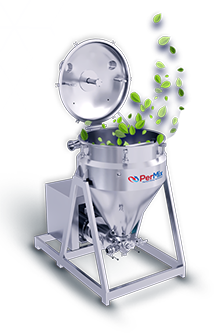

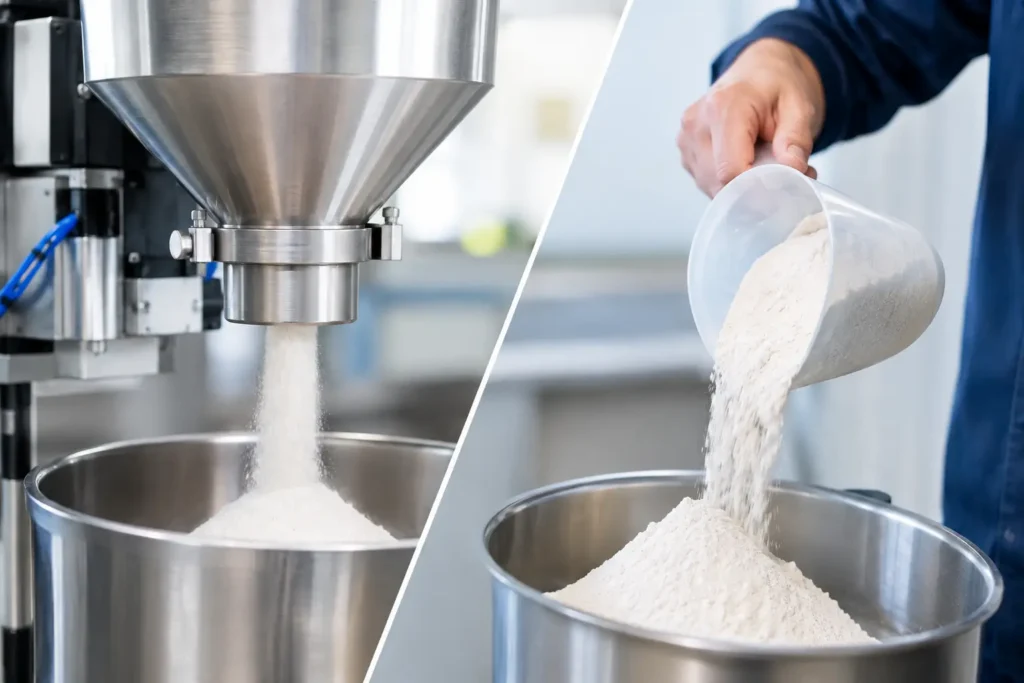
A mayonnaise batch can look correct at the start and still fail hours later because starch, stabilizer, or protein was not fully wetted during addition. That is why powder induction versus manual feeding is not simply a labor decision. It directly affects dispersion, emulsion stability, batch cycle time, sanitary control, and the ability to repeat a formula from one production run to the next.
For manufacturers scaling mayonnaise, dressings, ketchup, and vegan emulsions, the right choice depends on powder behavior, batch size, formulation complexity, and required throughput. Manual feeding remains useful in certain pilot and low-volume applications. For frequent commercial production, however, a properly engineered powder induction system can remove several common sources of inconsistency before they reach the finished product.
Manual feeding typically means an operator opens bags, measures ingredients, and adds powders directly through a vessel opening or hopper. In a simple batch, this approach appears straightforward. It requires limited auxiliary equipment, lets the operator observe each addition, and can be practical when recipes change constantly or production volumes are small.
The limitations become clear when powders contact liquid at the surface. Many hydrocolloids, modified starches, gums, milk powders, proteins, and seasoning blends begin hydrating immediately. If the material is added too quickly or into a low-energy zone, the outer surface wets first and forms a barrier around dry material. The result can be fisheyes, lumps, floating powder, incomplete hydration, and long mixing times.
A powder induction system uses vacuum or controlled suction to draw dry ingredients into the liquid stream or directly into a high-shear processing zone. Rather than relying on an operator to pour at a consistent rate, the system meters the powder into conditions designed for rapid wetting and dispersion. In a vacuum emulsifying mixer, this can occur under a closed process environment while the product receives controlled agitation and homogenization.
The practical difference is significant. Manual feeding introduces powder from above. Induction brings powder into the process under managed flow, where liquid contact, shear, and feed rate can be controlled.
Manual feeding should not be treated as an automatic process failure. It is often a sound choice for laboratory work, product development, short specialty runs, and facilities making a wide range of formulas in limited quantities. R&D teams may need to pause between additions, evaluate viscosity, or make deliberate formula adjustments. A manual process provides that flexibility.
It can also reduce initial capital cost. A plant producing occasional batches of a forgiving dressing formulation may not immediately justify an automated induction package. When powders are readily dispersible, addition quantities are low, and an experienced operator is available, manual feeding may meet the production requirement.
But manual feeding has a process ceiling. As batch size increases, the physical act of handling bags becomes slower and less consistent. Operators can vary in pour rate, timing, and technique. Airborne powder can create housekeeping burdens and exposure concerns. Open-vessel additions can also complicate sanitation and increase the chance of foreign-material entry.
For high-viscosity mayonnaise or low-fat formulas with more demanding stabilization systems, manual feeding frequently shifts from a flexible method to a production bottleneck.
The purchase price of a manual feeding setup can be low, but its operating cost is not always low. Longer batch times consume mixer capacity. Rework consumes ingredients and labor. A batch held for extra hydration time can delay downstream filling. If operators must screen or remill product to correct visible particles, the plant loses the efficiency it expected to gain from a simpler process.
The largest cost is often variability. A formula that depends on operator technique is harder to validate, scale, and transfer between shifts or production sites.
Powder induction is designed to make difficult dry ingredients behave predictably. The system pulls powders from a hopper or feed station and introduces them at a controlled rate. The liquid phase immediately wets the powder, while a high-shear emulsifying head or recirculation loop breaks down agglomerates and distributes the ingredient throughout the batch.
For mayonnaise and dressings, this controlled addition is particularly valuable with starches, gums, egg powders, plant proteins, sugar, salt, acidulants, and stabilizer premixes. These ingredients do not all require the same handling conditions. Some disperse easily but generate dust. Others hydrate rapidly and can form lumps within seconds. A process built around induction gives the manufacturer more control over both categories.
A closed vacuum process also supports cleaner production. Powder can be transferred without repeatedly opening the vessel, reducing dust release and helping protect the batch from outside contamination. For plants with allergen controls, clean-in-place requirements, and strict sanitation procedures, this advantage can be commercially meaningful.
Powder induction can improve production performance in four connected ways:
These benefits are strongest when the induction system is matched to the formulation and the mixer has sufficient shear capacity. Induction alone cannot compensate for an undersized homogenizer, incorrect processing temperatures, poor ingredient order, or inadequate recirculation.
A standard full-fat mayonnaise may tolerate a broader range of processing conditions than a low-fat or egg-free product. High oil content contributes body and can help mask minor process variation. By contrast, low-fat mayonnaise often relies more heavily on starches, gums, proteins, and water-phase structuring. Those materials demand precise wetting and dispersion to create the target mouthfeel without graininess or excessive viscosity.
Vegan mayonnaise presents another reason to evaluate the feeding method carefully. Plant proteins and specialty stabilizers can be sensitive to shear, pH, temperature, and hydration sequence. Feeding a premix too rapidly can create persistent agglomerates. Feeding it too slowly can extend the batch cycle and alter hydration behavior. An induction system with adjustable feed control gives process teams a repeatable starting point for optimization.
Dry starch incorporation is another common decision point. If starch is added manually to a liquid phase with insufficient surface movement, clumps can form before the mixer has a chance to disperse them. Drawing the starch into a high-energy zone improves wetting and helps manufacturers reach a smooth texture with less corrective processing.
The question is not only whether to add a powder induction unit. It is whether the complete process system supports the desired result. A well-designed mayonnaise production line considers vessel geometry, agitator design, rotor-stator homogenization, vacuum capability, recirculation, heating and cooling, discharge method, and cleaning requirements.
For a small development operation, a universal vacuum mixer processor may provide the flexibility to test manual and induced addition methods across multiple formulas. For commercial production of repeatable mayonnaise or dressing batches, an integrated vacuum emulsifying mixer with a powder induction package can provide a more controlled operating platform.
Sizing matters. A system must be selected for the real batch volume, expected viscosity range, powder addition rate, and production schedule, not only for nominal vessel capacity. A powder induction unit that feeds faster than the process can wet and disperse material will still create problems. Conversely, an overly conservative feed rate may limit output without improving quality.
PerMix evaluates these variables as part of equipment sizing because the best process result comes from matching the feeding method to the full mixing and emulsification duty.
Procurement and process teams should begin with the actual production challenge. Is the objective to eliminate lumps in starch-based formulas? Reduce operator exposure to airborne powder? Shorten a batch cycle? Increase repeatability across shifts? Support a new low-fat or vegan product line?
The answers determine whether a basic hopper, vacuum induction unit, or fully integrated high-shear vacuum system is appropriate. Ask suppliers to demonstrate how the equipment manages difficult powders, not only how it handles water and oil. Review the proposed process sequence, expected feed rates, cleaning approach, and controls for repeatable operation.
Manual feeding can remain the better option when batches are genuinely small, formulas change daily, powders are easy to disperse, and product development requires frequent intervention. It may also be useful as a backup path for unusual ingredients that arrive in small trial quantities or require special handling.
The key is to recognize its limits before output targets rise. Once a plant is scheduling repeated production runs, employing multiple operators, or producing formulations with sensitive stabilizer systems, consistency becomes a system requirement rather than an operator skill.
The strongest manufacturing decision is not to automate every step by default. It is to control the steps that most influence product quality and production capacity. When powders determine texture, stability, and batch speed, induction is often where a mayonnaise process becomes easier to scale with confidence.

Get in touch with us today and learn how to we can help your business.