PerMix Mayonnaise Production
PerMix News

A vegan mayonnaise that separates after filling, feels thin on the tongue, or carries a noticeable bean note will not hold shelf space for long. Plant based mayonnaise market trends are therefore changing the production conversation: growth is no longer driven by a vegan claim alone. Manufacturers must deliver the familiar gloss, body, spreadability, and stability consumers expect from conventional mayonnaise, while controlling cost and scaling efficiently.
For processors, this creates a clear opportunity and a tougher technical assignment. The winning products will be built around formulation discipline, dependable powder handling, and emulsification systems designed for repeatable results.
The category has moved beyond its early position as a specialty alternative. Plant-based mayonnaise is now appearing across retail private label, foodservice, quick-service restaurant applications, and broader sauce portfolios. Flexitarian consumers are a major force behind this shift. Many buyers are not exclusively vegan, but they are willing to choose an egg-free condiment if it performs like the product they already know.
That expectation raises the bar. A label claim may earn an initial purchase, but texture and flavor determine repeat purchase. Manufacturers are responding with products that aim for a neutral flavor profile, a bright white or familiar creamy color, and performance that works in sandwiches, dips, salads, and heated foodservice applications.
This is also a portfolio trend, not just a single-SKU trend. A condiment producer may need conventional mayonnaise, egg-free mayonnaise, low-fat mayonnaise, and flavored dressings from the same facility. Equipment selection must support that flexibility without creating unnecessary changeover time, cleaning complexity, or batch variability.
Consumers compare plant-based mayonnaise against conventional mayonnaise, not against other vegan products. The emulsion must feel rich despite a formulation that may use different proteins, hydrocolloids, starches, and oil levels. Small variations in droplet size, hydration, shear exposure, or ingredient order can change viscosity dramatically.
The formulation challenge becomes more demanding when a manufacturer targets a reduced-oil product. Lower fat levels can reduce the natural body that oil contributes, placing more responsibility on starches, fibers, gums, and protein systems. These ingredients must be dispersed fully and hydrated correctly to prevent graininess, fish eyes, weak body, or instability during storage.
Clean-label positioning continues to shape product development, although its definition varies by retailer, region, and consumer segment. Some brands are reducing familiar stabilizers. Others are prioritizing recognizable ingredients, non-GMO positioning, allergen reduction, or specific oil choices such as avocado, sunflower, or canola oil.
Each choice has process consequences. A shorter ingredient statement does not eliminate the need for stability. In many cases, it narrows the processor’s margin for error. When fewer stabilizing tools are available, precise emulsification, controlled addition rates, and effective vacuum processing become more important.
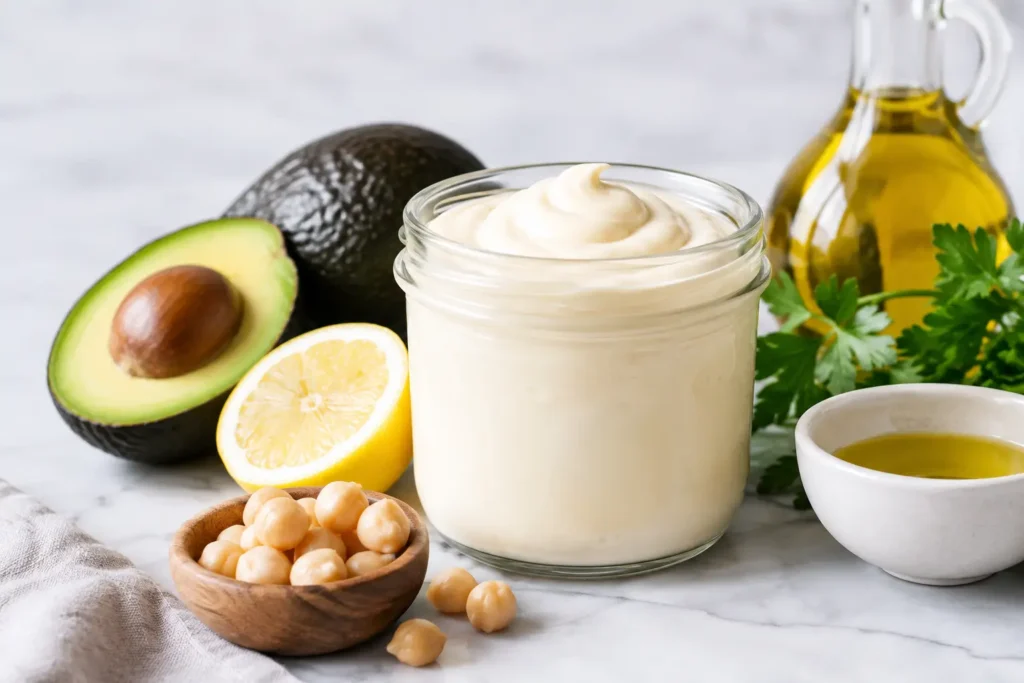
Egg yolk has historically served several functions in mayonnaise: emulsification, structure, color, and sensory richness. Removing it means replacing a system, not simply replacing one ingredient. Current formulations may use pea protein, fava protein, soy protein, potato protein, chickpea ingredients, modified or clean-label starches, aquafaba derivatives, fibers, and hydrocolloids.
No single replacement works equally well in every product. Soy may offer strong functionality but may not fit an allergen or labeling strategy. Pea protein can support emulsification but may require careful flavor management. Starches can build body economically, yet improper dispersion can create lumps or a pasty texture. The best choice depends on the target market, desired label, oil level, processing temperature, shelf-life requirement, and finished-product sensory standard.
Dry ingredient handling is a recurring production constraint. Powders added too quickly can float, clump, or trap air. Once agglomerates form, extended mixing may not fully correct the problem. A properly designed powder induction system draws powders into the liquid phase under controlled conditions, helping the processor build viscosity and structure consistently while reducing manual handling and dust exposure.
Oil is typically one of the largest cost drivers in mayonnaise. Changes in edible oil prices, supply availability, and customer preference can quickly alter a formula’s economics. Manufacturers need equipment that can accommodate formulation adjustments without sacrificing emulsion quality.
A change from one oil to another can affect viscosity, flavor, oxidation behavior, and processing conditions. A system that produces a stable emulsion at one oil level may require revised shear, circulation, or addition parameters at another. Process validation should be treated as part of commercial risk management, especially before a large retail launch.
Plant-based mayonnaise often contains ingredients that readily entrain air, especially proteins, starches, and hydrocolloids. Air can compromise appearance, reduce density control, interfere with filling, and contribute to oxidation concerns. Vacuum processing helps remove entrapped air while supporting a smoother, denser finished emulsion.
The central objective is not simply high shear. Excessive shear or incorrect processing time can damage a sensitive formulation, while insufficient shear can leave an unstable coarse emulsion. The production system must combine controlled mixing, effective homogenization, circulation, and vacuum capability in a sequence matched to the formulation.
For commercial operations, repeatability matters as much as peak performance. A pilot batch may look excellent with close operator attention, then fail when the process is transferred to a larger vessel or a different shift. Scale-up requires attention to tip speed, batch volume, powder addition rate, recirculation path, temperature control, and vacuum level. These variables should be engineered into the process rather than managed through operator improvisation.
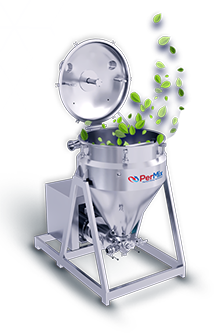
PerMix vacuum emulsifying mixers are designed around this practical requirement: producing stable emulsified products while giving manufacturers control over the difficult stages of powder incorporation, deaeration, and homogenization.
The most relevant plant-based mayonnaise market trends point to a more disciplined manufacturing model. Product development teams are being asked to create differentiated products faster, but operations teams still need predictable throughput, sanitary design, and realistic cleaning procedures.
First, manufacturers should develop formulas with scale-up in mind. An ingredient system that works in a benchtop blender may behave differently in a production vessel. Early trials should identify the required mixing sequence, powder feed method, hydration time, temperature window, and target viscosity.
Second, plants should plan for a broader range of product viscosities. Vegan mayonnaise, low-fat mayonnaise, dressings, and flavored sauces may share equipment, but they do not behave identically. An equipment configuration should be selected for the most demanding product and the expected production volume, not only for the easiest current formula.
Third, quality control needs to connect physical measurements to real product performance. Viscosity, pH, density, emulsion stability, particle distribution, and visual appearance all matter. However, the final test is whether the product maintains its texture through filling, distribution, shelf life, and consumer use. Retained samples and accelerated stability protocols help identify issues before they become market returns.
Finally, sanitation and allergen strategy require early attention. Plants making both egg-containing and egg-free mayonnaise must establish credible segregation and cleaning validation procedures. For brands that position vegan mayonnaise as egg-free, process controls are part of the product promise, not merely an operational detail.
Expect continued demand for products that make fewer compromises. The strongest plant-based mayonnaise launches will not rely only on a vegan label, a premium oil, or a clean-label message. They will combine sensory quality, ingredient transparency, price discipline, and dependable shelf stability.
Foodservice may provide an especially meaningful growth channel because operators value products that simplify menu development across dietary preferences. A single egg-free mayonnaise can support plant-forward menu items while also serving consumers without specific dietary restrictions. But foodservice buyers will evaluate yield, consistency, pumpability, and hold performance just as closely as flavor.
For manufacturers, the practical question is not whether plant-based mayonnaise will remain relevant. It is whether the production process can consistently deliver a product that earns repeat orders. Start with the desired finished texture, validate the formula under production conditions, and build the process around controlled emulsification rather than trial-and-error mixing.

Get in touch with us today and learn how to we can help your business.