PerMix Mayonnaise Production
PerMix News

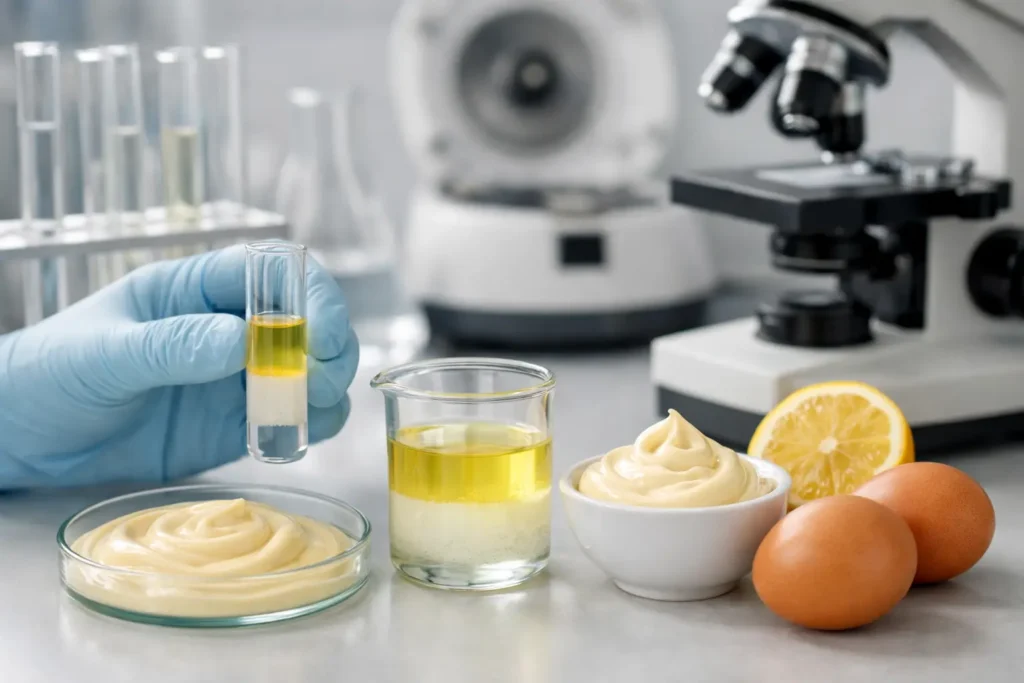
A mayonnaise batch can look smooth at discharge, fill cleanly into jars, and still fail weeks later through oil separation, water release, or texture loss. Effective emulsion stability testing methods identify that risk before product reaches distribution. For commercial mayonnaise, dressings, sauces, and vegan emulsions, the right test program connects formulation performance to the real conditions of mixing, filling, shipping, and storage.
A stable emulsion is not simply one that does not separate overnight. It must maintain droplet structure, viscosity, appearance, flavor release, and spoonable texture throughout its intended shelf life. That requires testing the product under both normal and deliberately stressful conditions.
Mayonnaise is typically an oil-in-water emulsion. Small oil droplets are dispersed through an aqueous phase and protected by emulsifiers, proteins, starches, gums, and process conditions. If those droplets begin to move together, coalesce, or migrate upward, the product can cream, break, or develop an unacceptable texture.
Stability depends on more than the ingredient deck. Oil phase percentage, acid level, salt, emulsifier selection, hydration of starch or hydrocolloids, temperature, shear energy, vacuum level, and order of addition all influence the final structure. A formula that performs well in a one-gallon laboratory batch may behave differently in a 500-gallon production vessel if powder wetting, recirculation, or shear exposure changes.
For that reason, stability testing should not be treated as a final quality-control check. It is a process-development tool that helps manufacturers set operating parameters, compare suppliers, qualify reformulations, and scale with less risk.
No single test predicts every failure mode. A practical program combines fast screening methods with real-time storage studies. The correct mix depends on product category, expected shelf life, packaging format, and the consequences of a field failure.
Visual evaluation is the starting point. Samples are stored upright and inspected on a defined schedule for a separated oil layer, serum release, creaming, color variation, air pockets, or surface defects. Record observations with standardized photos and measured layer heights rather than relying only on pass-or-fail impressions.
This method is simple, low cost, and directly relevant to what customers will see. Its limitation is speed. A product may need weeks or months to show meaningful separation at ambient temperature. Visual checks work best as part of a longer shelf-life study, not as the only development test.
Centrifugation accelerates gravitational separation by applying substantially greater force than normal storage. A weighed sample is spun under controlled time, speed, and temperature conditions, then checked for separated oil or aqueous phase.
For R&D teams, centrifuge testing is useful for quickly comparing emulsifier systems, processing conditions, and formula changes. It can expose weak products within minutes or hours. However, the test is intentionally severe. A sample that shows slight separation in a centrifuge is not automatically unsuitable for market, and a sample that passes may still fail from temperature cycling or microbial degradation. Establish product-specific acceptance limits based on correlation with actual shelf-life results.
Temperature is one of the most common triggers for emulsion failure. Distribution conditions can include hot trailers, cold warehouses, winter delivery routes, and repeated movement between environments. Temperature cycling tests subject samples to alternating warm and cold conditions, while elevated-temperature storage accelerates aging.
For mayonnaise and dressings, test temperatures must remain relevant to the formula and packaging. Excessive heat can create failure mechanisms that would never occur in normal commerce, while freezing can permanently damage some emulsions. A useful protocol may include ambient storage, elevated storage, refrigerated exposure where applicable, and controlled cycles that reflect expected logistics.
Evaluate each sample after every cycle for separation, viscosity change, color shift, and texture. If a low-fat mayonnaise fails after cycling but a full-fat version does not, the cause may be the weaker internal structure of the reduced-oil system rather than a simple emulsifier shortage.
Viscosity testing shows whether a product maintains its body, flow behavior, and filling performance. A rotational viscometer can provide a repeatable quality-control value when spindle, speed, temperature, sample preparation, and hold time are tightly controlled.
Rheology provides a deeper view. Mayonnaise is generally shear-thinning: it flows under pumping or spreading forces but holds its shape at rest. Measuring viscosity across different shear rates can reveal structural changes that a single-point reading misses. A product may retain an acceptable viscosity at one test speed while losing yield behavior, becoming thin on a sandwich or unstable in the jar.
For manufacturing, viscosity results should be linked to process conditions. Excessive homogenization can reduce droplet size and improve stability up to a point, but too much energy can damage a hydrocolloid network, entrain heat, or create a texture that no longer matches the target product.
Droplet size is a critical indicator of emulsion quality. Smaller, more uniform droplets generally resist creaming better because they rise more slowly and have less opportunity to coalesce. Particle size analysis can quantify average droplet diameter and distribution, allowing teams to compare batches objectively.
Microscopy adds visual evidence. It can show large droplets, droplet clusters, uneven dispersion, air entrainment, or signs of coalescence before gross separation is visible. This is especially valuable when troubleshooting a product that has inconsistent texture despite apparently normal viscosity.
A narrow droplet distribution is not always the only target. The desired structure depends on the specific product. Some sauces require a lighter pour, while premium spoonable mayonnaise needs a dense, stable body. The objective is repeatable droplet control that supports the required sensory profile and shelf life.
The strongest test programs begin with a defined product risk profile. Identify target shelf life, intended storage temperature, package type, oil content, pH, and expected supply-chain conditions. Then select tests that answer a specific question rather than running a collection of disconnected laboratory exercises.
When qualifying a new emulsifier, for example, compare the control and trial formula at identical pH, temperature, oil addition rate, and shear conditions. Use centrifugation and particle size analysis for rapid screening, then place the strongest candidates into real-time and accelerated storage. If the formula contains dry starches or high levels of plant protein, include a powder-dispersion assessment before assuming an emulsifier problem.
Production-scale trials require more attention. Measure ingredient addition times, batch temperature, vacuum application, mixer speed, recirculation flow, and final viscosity. A stable pilot sample can become unstable at scale if dry powders form fisheyes, oil is introduced too quickly, or the batch receives insufficient high-shear treatment.
A failed stability test does not always mean the formula needs more stabilizer. Separation after centrifugation may result from oversized oil droplets. A viscosity drop during heat storage may indicate incomplete starch hydration. Entrapped air can distort density, appearance, and oxidation performance. Poor vacuum control can leave air in the product while also limiting the desired deaeration benefit.
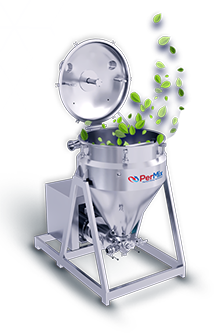
This is where equipment design becomes part of product quality. A vacuum emulsifying system should support controlled powder induction, effective wetting, repeatable high-shear dispersion, temperature management, and consistent batch-to-batch operating conditions. PerMix systems are designed around these production realities, particularly for mayonnaise, low-fat formulations, vegan emulsions, and difficult powder incorporation.
When investigating instability, compare retained samples from different production stages. Check the water phase before oil addition, the premix after powder hydration, the emulsion immediately after homogenization, and the finished product after deaeration. This approach narrows the source of variation faster than changing several ingredients at once.
Testing generates value only when results lead to clear decisions. Before starting a trial, define acceptable separation, viscosity range, droplet size range, appearance standards, and storage checkpoints. Criteria should reflect commercial requirements, not arbitrary laboratory perfection.
A mayonnaise intended for ambient distribution may require no visible oil separation through its full labeled shelf life, with controlled viscosity drift and no unacceptable color change after elevated-temperature exposure. A foodservice dressing in a flexible pouch may require additional assessment of pumpability and package interaction. Different products need different thresholds.
The most useful stability program is one that makes process choices easier: confirm the operating window, document the scale-up conditions, and challenge the product before the market does. When testing is tied closely to formulation and equipment performance, stable mayonnaise becomes a repeatable manufacturing outcome rather than a fortunate batch result.

Get in touch with us today and learn how to we can help your business.