PerMix Mayonnaise Production
PerMix News

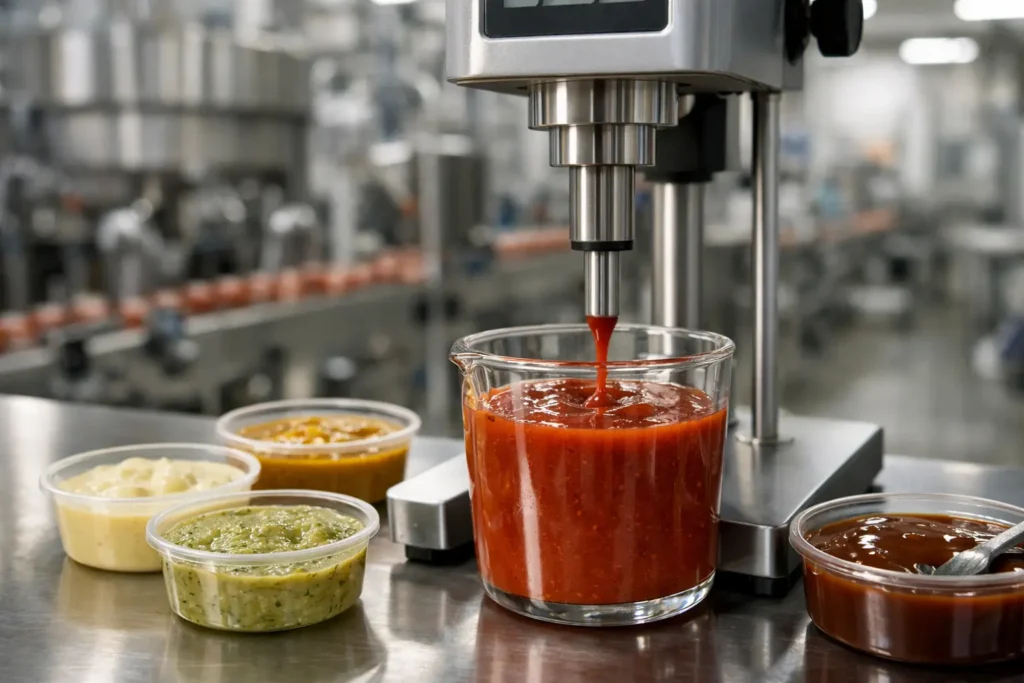
A sauce that looks right in the lab can still fail on the line. It may pump too slowly, fill inconsistently, cling poorly to the product, or thin out after thermal processing. That is why a practical sauce viscosity control guide matters in commercial production. Viscosity is not just a texture target – it affects throughput, emulsion stability, depositor accuracy, label claims, and customer acceptance.
For food manufacturers, viscosity control starts with a simple reality: the number on a viscometer is only part of the story. Most sauces are non-Newtonian systems, which means their flow behavior changes under shear, temperature, and time. A ketchup, mayonnaise, dressing, or plant-based sauce can read well in a benchtop test and still behave very differently in a high-shear mixer, transfer line, holding tank, or filler.
In production, poor viscosity control usually shows up as an operating problem before it shows up as a quality complaint. Pumps draw higher load. Fill weights drift. Powder addition slows down because agglomerates are not wetting out. Product transfer leaves more residue in the line. If the sauce is emulsified, viscosity shifts can also signal a more serious stability issue, especially when oil droplet size, hydration, or air incorporation are not under control.
This is where many teams lose time. They treat viscosity as a single formulation adjustment when it is really the result of formulation, process conditions, and equipment design working together. If one of those variables moves, the texture profile can move with it.
The first question is not, “How do we make it thicker?” The first question is, “What flow behavior does the finished product need at each stage?” A sauce may need to pour easily during transfer, hold shape after filling, suspend spices during shelf life, and still deliver the right mouthfeel when consumed.
That means your viscosity target should be defined by application, not by an isolated lab value. The useful target usually includes the measurement method, spindle or geometry, rpm, temperature, and hold time after production. Without that detail, one batch can appear in spec while behaving differently in the process.
For mayonnaise and thick dressings, the target often extends beyond simple apparent viscosity. Yield stress, emulsion stability, and texture recovery after shear can matter just as much. A sauce that rebuilds too slowly after pumping may look weak in the package even if the lab number is acceptable.
High-oil emulsions, starch-thickened sauces, protein-stabilized vegan systems, and low-fat dressings do not build viscosity in the same way. A standard mayonnaise may depend heavily on emulsion structure and droplet size distribution. A fat-free dressing may rely more on hydrocolloids, starch systems, or protein interactions. Ketchup introduces its own balance of serum phase thickness, pulp behavior, and shear thinning.
The practical point is straightforward: if you try to control all sauces with the same mixing logic, you will get inconsistent results. The thickening mechanism has to match the product architecture.
Water phase balance is usually the first place to look. Small shifts in solids, sugar, salt, acid, or oil ratio can move viscosity more than expected, especially in products with tight process windows. In emulsified sauces, the oil phase volume and droplet size interact. You can have the same oil level in two batches and still get different body if emulsification energy and droplet distribution are not consistent.
Hydrocolloids and starches add another layer. They can build viscosity efficiently, but only if they hydrate and disperse correctly. Undispersed powder creates fisheyes and false body during initial mixing, then drops out later. Overprocessed starch systems can also lose viscosity under shear or heat. What looks like a formulation issue is often a powder incorporation issue.
Acid addition timing matters too. Some starches and proteins respond differently when acid is introduced before full hydration. In vegan and reduced-fat systems, this timing effect can be even stronger because the network is less forgiving than in conventional full-fat emulsions.
A strong formulation can still underperform if process control is weak. Shear level, shear duration, vacuum, temperature, and ingredient addition sequence all affect the final rheology.
Shear is the most misunderstood variable. More shear does not automatically mean more viscosity. In an emulsified system, sufficient shear is necessary to reduce droplet size and build a stable structure. But too much shear, or shear applied at the wrong stage, can damage sensitive thickening systems, overwork proteins, or create excessive temperature rise. It depends on the product.
Temperature has a similar trade-off. Higher temperature can improve powder wetting and shorten hydration time, but it can also reduce apparent viscosity during mixing and lead operators to overcorrect. Once the product cools, the final viscosity may overshoot. If you are making process decisions based on warm-batch readings, you may be solving the wrong problem.
Many viscosity problems begin with the order of addition. Powders added too quickly into a poorly designed vortex can float, lump, or hydrate unevenly. Oil introduced before the water phase is fully prepared can weaken emulsion formation. Acid or salt added too early can interfere with hydration of gums, starches, or proteins.
On a production line, sequence control needs to be repeatable, not operator-dependent. Standard work instructions help, but equipment capability matters just as much. If the mixer cannot pull powders in quickly and disperse them uniformly, the process window gets narrower and batch variability increases.
This is where the plant floor separates theory from production reality. Viscosity is not controlled by formulation alone. It is built through wetting, dispersion, emulsification, deaeration, and heat management. Equipment that handles those steps efficiently gives manufacturers a much more stable process.
Vacuum processing is especially valuable for emulsified and high-viscosity sauces. It reduces entrapped air, improves ingredient intake, and supports a cleaner, denser final texture. Air in the batch can distort viscosity readings, affect appearance, and reduce filling consistency. In products like mayonnaise and dressings, trapped air also complicates emulsion development.
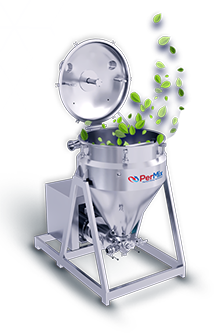
Powder induction is another major factor. Dry starches, gums, proteins, and stabilizer blends need fast and complete incorporation. Manual top-entry addition into a poorly agitated tank often leads to long mix times and inconsistent hydration. A system built for powder induction and high-efficiency dispersion reduces clumping and shortens the path to target viscosity.
For manufacturers scaling from pilot to industrial output, this is often the breaking point. The formula did not fail. The mixing environment changed. Tip speed, recirculation pattern, vessel geometry, and batch size all shifted, so the product structure shifted too. A properly engineered vacuum emulsifying mixer can close that gap by delivering controlled shear, reliable powder handling, and repeatable batch conditions at scale.
If viscosity moves out of spec, start by isolating whether the issue is formulation, process, or measurement. Too many teams change gum level first and create a second problem.
Check whether the measurement itself is consistent. Use the same temperature, sample conditioning, and timing after production. Then review batch records for actual addition order, mix time, vacuum level, and temperature profile. If those are stable, move to raw material variation. Hydrocolloids, starches, egg products, oils, and proteins can all shift from lot to lot.
If the sauce is too thin, the likely causes include incomplete hydration, insufficient emulsification, low solids, incorrect phase ratio, or over-shearing of the thickening system. If it is too thick, the issue may be overhydration, temperature-related overcorrection, excessive solids, or too much post-process cooling before measurement. The fix depends on the mechanism, not just the symptom.
The best sauce viscosity control guide is the one used before production problems start. During scale-up, manufacturers should confirm more than a target cps value. They should verify powder incorporation rate, hydration time, emulsion formation, temperature rise, transfer behavior, and texture recovery after pumping.
This is especially important for low-fat, fat-free, and vegan sauces, where the margin for error is smaller. These systems often rely on precise processing to replace the body and stability that fat once provided. Equipment selection becomes a process decision, not just a capital purchase.
For manufacturers producing mayonnaise, dressings, ketchup, and related sauces, that is where specialized processing support adds value. PerMix focuses on this exact challenge: building repeatable viscosity and emulsion quality through equipment designed for vacuum mixing, powder induction, and scalable performance.
When viscosity control is handled correctly, the payoff is not limited to texture. You get better line efficiency, more consistent fills, fewer batch adjustments, and a product that behaves the same way in production as it did in development. That is the standard worth aiming for – not just a thicker sauce, but a process you can trust.

Get in touch with us today and learn how to we can help your business.