PerMix Mayonnaise Production
PerMix News
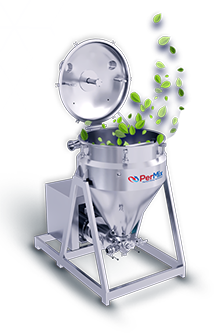

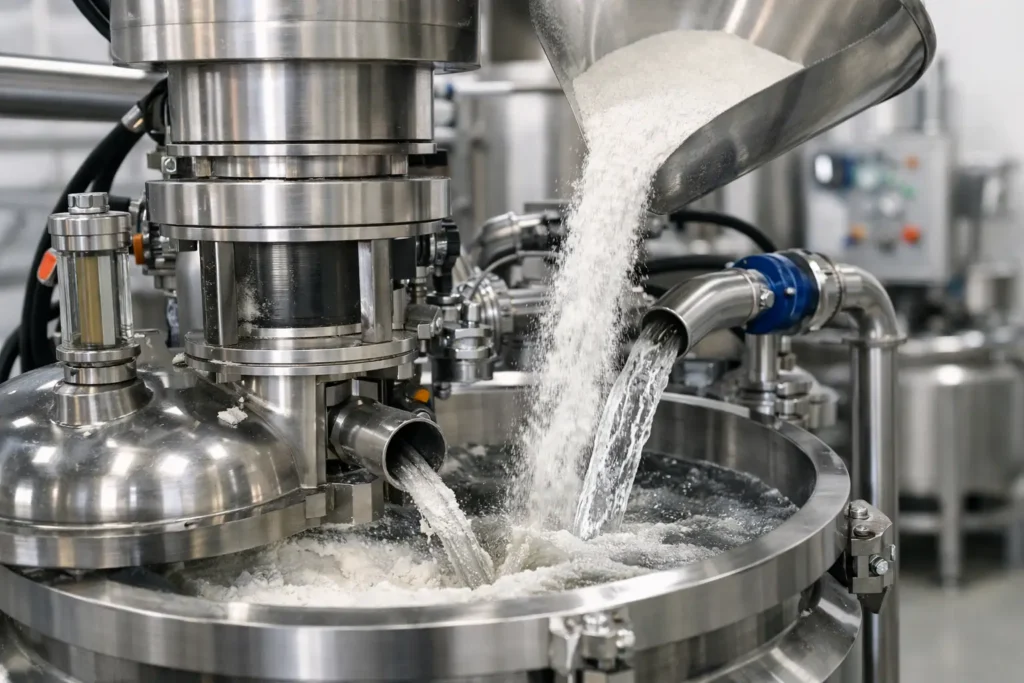
When starch hits the vessel wall, gums fisheye on contact, or protein powders float instead of wetting out, the issue is rarely the recipe alone. In most sauce and emulsion plants, the real bottleneck is liquid powder blending equipment that cannot pull solids into the process fast enough, wet them evenly, and disperse them before defects start showing up downstream. That is where batch consistency, texture, and line efficiency are won or lost.
For manufacturers producing mayonnaise, dressings, ketchup, and related viscous foods, powder incorporation is not a minor step. It shapes viscosity development, emulsion stability, mouthfeel, and cycle time. If the blending system is undersized, poorly configured, or simply built for general mixing rather than demanding food applications, production teams end up compensating with longer batch times, extra operator intervention, and higher reject risk.
In practical terms, liquid powder blending equipment must do three things well. It must create strong enough liquid movement to draw powders into the batch, it must wet those powders immediately, and it must break down agglomerates before they become persistent defects. If one of those steps fails, the plant pays for it later through screens, rework, or unstable finished product.
This matters even more in mayonnaise and dressing production because many formulations combine oil, water, egg or egg alternatives, starches, gums, sugar, salt, acids, and functional powders in tightly controlled sequences. Some ingredients hydrate quickly. Others clump on contact. Some build viscosity early, making later powder addition much harder. The equipment has to manage that progression, not fight it.
A basic top-entry mixer can circulate product, but circulation alone is not the same as effective powder induction. A system designed for true powder-liquid blending uses controlled flow, shear, and often vacuum conditions to improve wetting and reduce air entrainment. That difference shows up in the finished product.
Most plants recognize the symptoms before they identify the cause. Operators see lumps that do not disappear, powder dust around the vessel, inconsistent viscosity from batch to batch, or emulsions that break under shear or during storage. Procurement may see excess ingredient consumption. Quality teams may see texture variation that should not exist in a controlled formula.
These problems often begin at the point of addition. Powders such as starches, stabilizers, gums, milk proteins, plant proteins, and seasoning blends can behave very differently depending on particle size, moisture sensitivity, and hydration speed. A mixer that works well for one recipe may struggle badly with another.
Low-fat and fat-free systems are especially demanding. They rely more heavily on hydrocolloids, starch networks, and protein functionality to create body and stability. Vegan formulations add another layer of complexity because alternative proteins and emulsifier systems may be less forgiving during dispersion. In these applications, poor powder incorporation is not just a cosmetic issue. It directly affects structure and shelf performance.
Vacuum is one of the most useful process advantages in high-value food mixing, especially when the goal is smooth, stable, visually clean product. Under vacuum, powders can be inducted with less air incorporation, which helps reduce foam and limits oxidation. For mayonnaise and dressings, that matters for both process efficiency and finished appearance.
Vacuum also improves wetting behavior in many formulations. When trapped air is reduced, powders are less likely to float or form persistent dry pockets. The result is faster dispersion and more reliable hydration. That does not mean every formula requires deep vacuum at every stage. It means the equipment should give the process engineer control over when and how vacuum supports the batch.
For emulsified foods, vacuum blending also supports downstream homogenization and deaeration objectives. A smoother, better dispersed premix is easier to emulsify consistently than a batch carrying hidden agglomerates and entrained air.
The right machine is not chosen by vessel volume alone. Capacity matters, but so do product rheology, batch sequence, powder load, and the required finished texture. A thin brine with minor dry additions needs a very different blending approach than a high-viscosity mayonnaise base with starch and gum incorporation under tight cycle times.
This is where application-specific design becomes commercially important. Rotor-stator systems can deliver the shear needed for rapid dispersion, but shear level has to match the product. Too little and powders remain undispersed. Too much and sensitive structures can be damaged, especially in later processing stages. Anchor agitation, wall scraping, recirculation loops, powder induction ports, and vacuum capability all need to work as one system rather than as separate features.
For many condiment manufacturers, the best answer is a vacuum emulsifying mixer or universal mixer processor built around the actual formulation family. That is particularly true when one plant runs full-fat mayonnaise, low-fat variants, vegan SKUs, and dressings on shared equipment. Flexibility matters, but not if it comes at the cost of weak powder handling.
Good liquid powder blending equipment does not only improve one quality metric. It changes the economics of the room. Faster wet-out shortens batch times. Better dispersion reduces rework. Lower dusting improves housekeeping and ingredient control. More repeatable hydration supports tighter viscosity targets and fewer operator corrections.
There is also a labor effect. When equipment pulls powders in efficiently, operators spend less time manually chasing clumps, adjusting addition rates by feel, or extending mix cycles just to be safe. That helps standardize production across shifts. For multi-SKU plants, it can also reduce changeover headaches because the process becomes more predictable.
From a quality standpoint, the payoff is straightforward. Better powder incorporation supports smoother texture, more stable emulsions, and more consistent appearance. In mayonnaise and sauces, those are not secondary gains. They are the product.
The best buying decisions usually start with process questions, not brochure comparisons. Ask how the system handles fast-hydrating powders, whether it can induct solids under vacuum, and how it performs as viscosity climbs during the batch. Ask what happens when running low-fat or vegan formulations with heavier stabilizer demands. Ask how easily the mixer can scale from pilot work to production without changing the product profile.
Sanitary design deserves equal attention. Food manufacturers need equipment that supports reliable cleaning, minimizes dead zones, and aligns with plant hygiene standards. A powerful mixer that is difficult to clean can create just as many production losses as a weak one.
It is also worth asking about control strategy. Powder blending is not only mechanical. Ingredient sequencing, flow rate, vacuum level, rotor-stator speed, and temperature all influence the result. Equipment should give teams enough process control to repeat success, not rely on operator intuition every time a difficult formula comes up.
A common mistake is assuming any high-speed mixer can handle powder-liquid blending in difficult emulsified foods. General-purpose mixers may work for simple liquids or low-solids batches, but problems surface as soon as formulations become more functional. Clumping, inconsistent hydration, and poor dispersion usually do not come from a lack of motor power alone. They come from the wrong process architecture.
That is why specialist suppliers tend to outperform generalists in these applications. Equipment designed around mayonnaise, dressings, and sauce systems is built with the real production constraints in mind – not just mixing, but emulsification, powder induction, viscosity development, sanitation, and scale-up. PerMix focuses on that exact operating reality, which is why its vacuum emulsifying and universal mixing systems are positioned around formulation performance rather than generic mixing capacity.
Food manufacturers do not invest in better blending equipment just to own newer machinery. They invest because poor powder incorporation is expensive. It slows throughput, increases ingredient waste, creates quality risk, and limits the plant’s ability to launch or scale more demanding products.
The strongest case for upgrading liquid powder blending equipment is usually a combination of quality and throughput. If your team is fighting recurring lumps, inconsistent viscosity, long hydration times, or unstable emulsions, the process is already signaling that the blending step needs attention. Better equipment will not fix a flawed formula, but it will allow a good formula to perform as intended.
That is the standard worth using when evaluating any system. Not whether it can spin, circulate, or claim high speed, but whether it can consistently turn difficult powders into stable, market-ready product at the pace your plant requires.
The right blending system should make problem ingredients easier to run, not force your team to work around the machine.

Get in touch with us today and learn how to we can help your business.