PerMix Mayonnaise Production
PerMix News

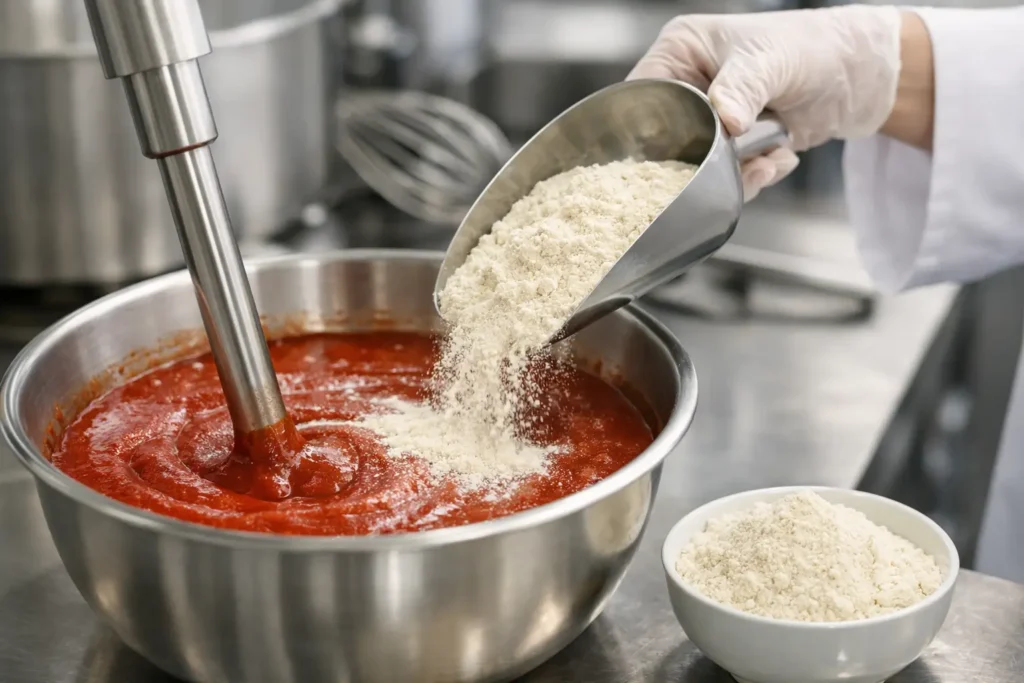
A sauce batch can look acceptable at the mixer and still fail hours later in the holding tank, filler, or finished package. Sauce powder incorporation problems often begin with one visible defect – a fish-eye, dry lump, or floating powder raft – but their real cost is broader: extended batch time, unstable viscosity, inconsistent flavor distribution, clogged transfer equipment, and rejected product.
For mayonnaise, dressings, ketchup, and other viscous sauces, powders are not minor additions. Starches, gums, protein systems, spices, salt, sugar, acids, and functional ingredients each interact with water, oil, temperature, and shear differently. Reliable production requires more than adding ingredients in the correct order. It requires controlling how each powder enters, wets, disperses, hydrates, and is incorporated into the final emulsion.
Most dry ingredients are designed to hydrate or thicken quickly. That is useful in a finished sauce, but it creates risk during charging. When powder meets liquid too slowly, the outside surface hydrates first and forms a barrier around dry material. The result is a lump with a wet exterior and an unhydrated core. Higher agitator speed after the lump has formed may reduce its size, but it does not always fully hydrate the trapped powder.
The issue becomes more severe as product viscosity rises. A thin aqueous phase can accept powder relatively easily. A partially developed sauce or a high-solids premix resists circulation, leaving ingredients exposed to uneven wetting conditions. Operators may compensate by mixing longer or raising speed. This can increase air entrainment, heat generation, or emulsion stress without correcting the underlying incorporation method.
At commercial scale, the consequences compound. A small powder addition error may be tolerable in a pilot vessel, while the same process in a larger tank produces persistent agglomerates, batch-to-batch texture variation, and a longer sanitation cycle. Scale-up is not simply a matter of increasing ingredient quantities and mixer RPM.
Adding powder directly onto a liquid surface is one of the most common sources of failure. The powder may float, form a crust on the vessel wall, or enter the batch in heavy clumps. This is especially problematic with hydrocolloids and pregelatinized starches, which can hydrate rapidly at the surface before the bulk liquid has a chance to disperse them.
The correct addition point depends on the formulation and equipment configuration. Many systems benefit from adding powder into a high-velocity recirculation zone or a dedicated induction point where liquid immediately pulls and wets the material. The objective is consistent contact between every particle and the liquid phase, not simply fast charging.
A vessel can have adequate overall agitation but poor local conditions where powder enters. This distinction matters. The bulk batch may appear to circulate well while the powder feed area has low velocity, dead zones, or an unstable vortex that pulls in air rather than material.
Effective incorporation requires enough local energy to break apart agglomerates as they form. However, excessive rotor-stator shear is not automatically the answer. In egg-based mayonnaise, for example, process conditions must disperse dry ingredients while preserving the target droplet size and emulsion structure. The right balance depends on formula viscosity, oil phase addition rate, temperature, and ingredient sensitivity.
Powder addition order can determine whether a sauce becomes smooth and stable or difficult to recover. Salt, sugar, acids, starches, gums, proteins, and emulsifiers do not behave the same way in water. Some ingredients compete for available moisture. Others change pH, ionic strength, or viscosity before subsequent materials can hydrate properly.
A gum added after viscosity has already developed may form clusters because the liquid can no longer circulate freely around the powder. Conversely, adding a thickener too early can create a high-viscosity base that makes later ingredient dispersion more difficult. Formulation development and equipment design must work together to establish an order that supports wetting and hydration.
Open-vessel powder feeding often introduces air along with dry material. Entrained air can create foam, lower apparent density, interfere with accurate filling, and compromise the appearance of a finished sauce. In emulsified products, air may also affect oxidation stability and make it harder to evaluate the actual process condition during mixing.
Vacuum processing addresses this issue by removing air from the vessel and supporting cleaner powder intake. It is particularly valuable for premium mayonnaise, dressings, and sauces where glossy appearance, dense texture, and stable filling performance are commercial requirements.
Not every incorporation problem starts in the process vessel. Powders can bridge in hoppers, compact in transfer lines, absorb moisture during storage, or separate by particle size during handling. A feeder may deliver material in pulses instead of a steady flow, producing localized overconcentration in the batch.
The process team should evaluate the full path from ingredient storage to the mixing zone. Consistent feeding is necessary, but it must be paired with immediate wetting and dispersion. A precise loss-in-weight feeder cannot solve a poorly designed addition point.
The strongest approach combines controlled powder induction, recirculation, vacuum capability, and application-appropriate shear. Instead of relying on an operator to manually work powders into a vortex, the system should create repeatable conditions that pull ingredients into the liquid stream and distribute them through the batch.
Start by establishing the correct liquid phase. Water temperature, initial volume, and dissolved ingredient sequence should be defined before any thickening or functional powder is introduced. If a starch requires heat for full functionality, that thermal step must be coordinated with mixing intensity and residence time. If a gum needs rapid dispersion before hydration, it should enter at a point where the liquid has enough velocity to separate particles immediately.
Next, control the addition rate. Faster is not always better. A powder induction system must match feed rate to the available wetting capacity of the liquid stream. If material is introduced faster than it can be dispersed, accumulation begins at the feed point and lumps follow. For difficult powders, a slower and steadier addition frequently delivers a shorter total batch time because it eliminates rework.
Then apply shear at the right stage. High shear is highly effective for breaking agglomerates, creating fine emulsions, and reducing particle size in many sauce applications. Yet shear should be engineered around the product objective. A delicate emulsion, a particulate-containing dressing, and a high-starch sauce do not require identical processing conditions.
Finally, verify performance with measurable criteria. Visual inspection is useful, but it is not enough for industrial control. Track viscosity at defined temperature, particle or lump presence, batch time, vacuum level, final density, filling behavior, and product stability over time. These measurements reveal whether the process is truly repeatable.
A purpose-built vacuum emulsifying mixer gives manufacturers more control than a conventional agitator vessel. The combination of an anchor agitator, high-shear emulsifying head, vacuum system, and powder induction capability supports the full sequence of sauce production: wetting, hydration, emulsification, deaeration, and final homogenization.
For high-volume or formulation-diverse operations, recirculation is particularly valuable. It moves product repeatedly through a controlled high-energy zone rather than depending on one pass of bulk agitation. This can shorten processing time and improve uniformity, especially in formulations with dry starches, gum systems, proteins, or high solids.
Sanitary design also matters. A powder system that improves incorporation but creates difficult cleaning points is not a production solution. Hygienic construction, clean-in-place compatibility, accessible seals, and properly designed piping help maintain product safety while reducing downtime between mayonnaise, vegan dressing, and specialty sauce runs.
PerMix designs vacuum mixing and emulsification systems around these practical production demands, including the difficult combination of powder handling, viscosity development, and emulsion stability. Equipment sizing should be based on the actual formula, batch volume, viscosity range, production schedule, and required level of automation – not vessel volume alone.
Equipment can solve many process limitations, but not every powder issue is mechanical. If a formulation uses incompatible hydrocolloids, excessive powder concentration, unsuitable particle size, or a hydration profile that conflicts with the intended process temperature, the product may require adjustment.
This is where process trials are valuable. A change as small as preblending a gum with sugar, changing a starch grade, modifying water temperature, or shifting acid addition can dramatically improve incorporation. The best result usually comes from treating formulation and equipment as one process system rather than separate decisions.
A smooth sauce is not created by mixing longer. It is created by giving every powder particle the correct path into the batch, the correct conditions for hydration, and the correct amount of energy at the right time. When those conditions are designed into the process, difficult powders become controlled inputs instead of recurring production risks.

Get in touch with us today and learn how to we can help your business.