PerMix Mayonnaise Production
PerMix News

A mayonnaise batch that looks perfect in the pilot room can fail fast on the production floor. Air pickup, poor powder wet-out, fat droplet inconsistency, and long cycle times usually point to one issue – the mixing system is not built for true emulsification. That is where a vacuum emulsifying mixer homogenizer earns its place.
For food manufacturers producing mayonnaise, dressings, ketchup, sauces, and other viscous emulsified products, this equipment is not just a vessel with an agitator. It is a process tool designed to control dispersion, particle size, deaeration, and batch repeatability in one integrated system. When the formulation includes starches, gums, proteins, egg-based ingredients, or oil phases that must be incorporated under tight process control, the equipment choice directly affects product quality and plant efficiency.
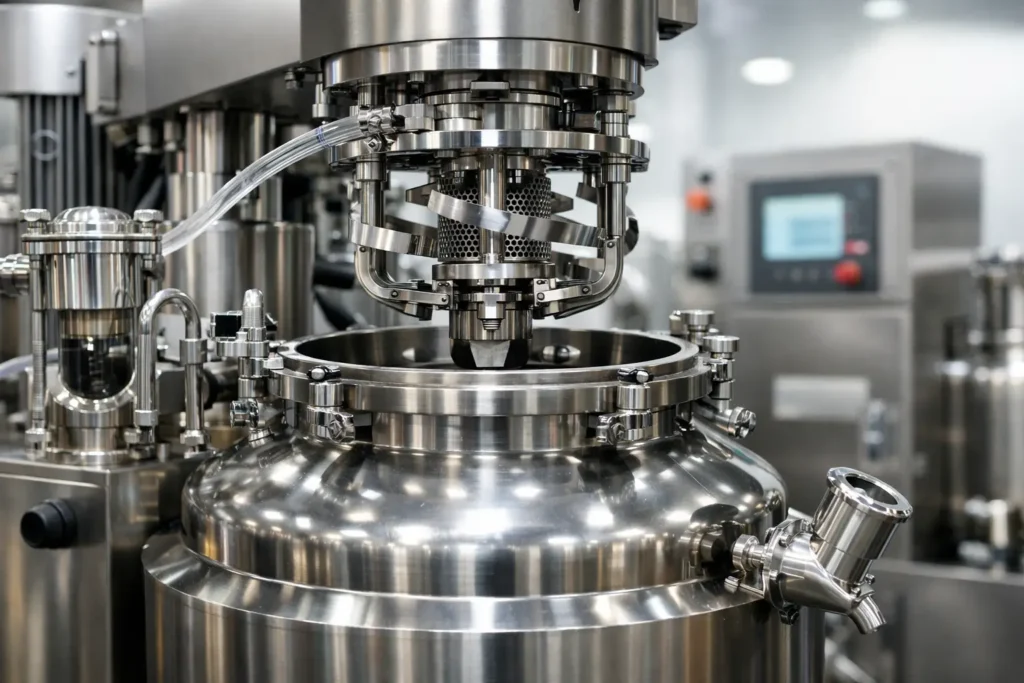
At a practical level, a vacuum emulsifying mixer homogenizer combines several functions inside one processing system. It mixes liquid and semi-solid ingredients, applies high shear to create or refine emulsions, removes entrapped air under vacuum, and helps pull powders into the batch more cleanly than open-top mixing systems.
That combination matters because emulsified foods are sensitive to process variation. A batch can meet target viscosity and still show weak stability in storage. It can taste right but carry too much air, which affects fill weight, oxidation, appearance, and shelf life. It can look smooth at discharge but break when exposed to downstream pumping or temperature fluctuation. Good emulsification equipment is designed to reduce those risks before they become production losses.
In mayonnaise and dressing production, the homogenizing action helps reduce oil droplet size and improve distribution throughout the aqueous phase. The vacuum section minimizes foam and air inclusion. The mixer section keeps bulk movement uniform so ingredients are not left sitting in dead zones. If powder induction is included, dry ingredients can be dispersed faster and with fewer fisheyes or lumps.
Vacuum is often treated as an added feature, but in many applications it changes the whole process window. Under atmospheric mixing, high-speed agitation can pull air into the product at the same time it is trying to disperse ingredients. That creates a quality contradiction – more shear may improve one part of the batch while hurting another.
With vacuum, manufacturers can emulsify and disperse with less air entrainment. For mayonnaise, salad dressing, and similar products, that usually means better visual finish, more stable texture, and improved density control. It also helps during ingredient addition. Powders introduced into a vacuum-assisted system are less likely to float, dust, or form stubborn agglomerates, especially when paired with an effective induction arrangement.
There is also a throughput advantage. Batches that deaerate during processing often require less downstream correction. That can reduce hold times, cut rework, and improve line confidence. For plants managing multiple SKUs across standard, low-fat, fat-free, and vegan formulas, that consistency is commercially important.
In condiment manufacturing, process demands vary more than many buyers expect. Full-fat mayonnaise needs strong emulsion formation and controlled oil incorporation. Low-fat or fat-free systems often need more careful hydration of starches, gums, and proteins to build body without defects. Vegan formulas can present their own challenges around emulsifier behavior, mouthfeel, and shear sensitivity.
A vacuum emulsifying mixer homogenizer is valuable because it gives processors tighter control over all three problem areas – oil phase integration, dry ingredient dispersion, and air management. That matters when the same plant is expected to run different formulations on one line.
For example, a system designed only for bulk blending may handle a simple sauce but struggle with a thick, cold-process mayonnaise. A unit with proper homogenizing capability and vacuum performance can support finer droplet distribution, stronger texture development, and more repeatable discharge viscosity. It can also shorten the path from R&D success to commercial scale because the process conditions are more controlled and more transferable.
Not every vacuum mixer delivers the same result, even when the brochure language looks similar. Buyers should look closely at the actual process design.
The shear system is central. Rotor-stator geometry, tip speed, recirculation pattern, and batch exposure to shear all affect final emulsion quality. In food applications, more shear is not always better. The target is controlled droplet reduction and dispersion without overprocessing the formula.
Bulk movement inside the vessel matters just as much as local shear. Anchor agitators, scrapers, and internal flow design influence heat transfer, wall cleaning, and ingredient turnover. In high-viscosity products, weak bulk mixing can leave localized concentration differences that show up later as texture variation.
A true vacuum process needs stable vacuum control, not just a nominal vacuum connection. The system should support deaeration during mixing and ingredient addition while maintaining sanitary operation. If vacuum performance is inconsistent, product density and finish can drift from batch to batch.
This is a major consideration for plants running starches, hydrocolloids, proteins, milk powders, or seasoning blends. Efficient powder induction reduces manual handling time and improves wet-out. It also lowers the chance of lumps that require extra shear or rework to remove.
Food manufacturers should evaluate surface finish, seal design, dead-leg reduction, cleanability, and material compatibility. A strong process result loses value quickly if sanitation turnaround is slow or validation is difficult.
Most investment decisions in processing equipment start with a recurring plant problem. In emulsified foods, the same issues tend to appear again and again.
One is inconsistent texture across batches. That usually comes from uneven ingredient incorporation, unstable droplet size distribution, or uncontrolled air inclusion. Another is poor powder dispersion, especially with starches and gums that hydrate fast on contact and form clumps. A third is emulsion weakness, where the product looks acceptable initially but separates, thins out, or loses body over time.
A vacuum emulsifying mixer homogenizer addresses these issues by combining controlled shear with vacuum deaeration and stronger ingredient incorporation. It can also reduce cycle time in plants that currently rely on multiple steps or separate vessels to achieve the same result.
That said, equipment does not replace formulation discipline. Some products need precise ingredient sequencing, temperature control, or hold time to perform correctly. The best results come when the mixer design and the recipe process are aligned.
The right unit depends on what you are making, how often you change products, and where your current bottleneck sits. A plant running one mayonnaise SKU at high volume may prioritize throughput and repeatability. A co-manufacturer or innovation-focused producer may need flexibility across a wider range of viscosities and formulations.
Batch size matters, but it should not be the only sizing factor. Ingredient profile, target viscosity, powder load, oil percentage, and required shear intensity all influence equipment selection. So do utilities, sanitation expectations, and downstream integration with transfer pumps, holding tanks, and fillers.
Scale-up deserves special attention. A system that works well at small volume can behave differently at production size if the shear profile, circulation pattern, or powder addition method changes too much. This is why application-specific guidance matters. In mayonnaise and sauce processing, equipment should be matched to the actual product family, not sold as a generic mixer.
PerMix takes this application-first approach because food manufacturers do not buy a vessel. They buy repeatable product quality, usable throughput, and a process they can trust shift after shift.
The return on a vacuum emulsifying mixer homogenizer is rarely based on one metric alone. It comes from a mix of operational gains: fewer failed batches, shorter processing time, cleaner powder incorporation, improved texture consistency, lower air content, and smoother scale-up between development and production.
For procurement teams, that means evaluating total manufacturing impact rather than purchase price alone. A lower-cost mixer that creates longer cycle times or more rework may cost more over the life of the system. For operations teams, the value shows up in production confidence. When the process is stable, scheduling gets easier, labor pressure drops, and quality complaints become less frequent.
For manufacturers competing in crowded condiment categories, product consistency is not a soft benefit. It is a commercial requirement. Customers notice texture. Retailers notice fill variation. Quality teams notice instability. The process system behind the product needs to hold its standard every day.
If your plant is fighting air pickup, weak emulsions, slow powder incorporation, or scale-up friction, the right equipment can change the economics of the whole line. The best place to start is not with a catalog spec, but with your actual formulation demands and the production outcomes you need to achieve.

Get in touch with us today and learn how to we can help your business.