PerMix Mayonnaise Production
PerMix News

Air is often the hidden variable behind a sauce that looks acceptable in the mixer but fails on the filling line or separates during shelf-life testing. For manufacturers asking when should food mixing use vacuum, the practical answer is this: use it when entrained air, difficult powder hydration, oxidation risk, or emulsion consistency can affect the finished product.
Vacuum is not necessary for every food batch. A simple low-viscosity brine or a short-run dry blend may not justify the added process control. But for mayonnaise, dressings, ketchup, cream sauces, vegan emulsions, and other viscous products, vacuum mixing can directly improve product quality and plant efficiency. The strongest results come when the vacuum system, agitation, homogenization, temperature profile, and ingredient-addition sequence are designed as one process.
Food mixing should use vacuum when the process must remove air from the product, disperse powders without persistent foam or fish eyes, protect sensitive ingredients, or create a smooth and repeatable emulsion. In commercial condiment production, these conditions appear frequently.
The most obvious indicator is visible aeration. Whipped-in air can cause a mayonnaise or dressing to appear lighter than its target density, develop surface bubbles, fill inconsistently by volume, or show an unstable texture after storage. Air pockets also reduce the reliability of in-process measurements. A batch may look full in the vessel while containing less actual product mass than expected.
Vacuum pulls entrained gases from the batch and helps collapse foam during mixing. This produces a denser, cleaner-looking product and supports more consistent downstream filling. It can also reduce the risk of false high-volume readings and improve control over batch yield.
Vacuum becomes especially valuable as product viscosity rises. Thick sauces hold air more aggressively than thin liquids, and the air is harder to release once the batch has been fully developed. Removing it during processing is more effective than waiting for a finished product to settle, which costs time and may still leave trapped bubbles in the package.
High-shear mixing, recirculation, and powder addition can introduce significant air into a batch. This is common when operators add gums, starches, proteins, spices, sugar, salt, or stabilizer systems into an open vessel. The more difficult the powder is to wet out, the more likely the process is to create foam.
In mayonnaise production, air can interfere with the desired dense, glossy appearance and make the emulsion less visually uniform. In dressings and sauces, it can create pinholes, irregular fill weights, and a product that appears less premium on the shelf. A controlled vacuum phase gives that air a route out of the vessel instead of allowing it to remain dispersed in the product.
Many functional ingredients resist hydration. Modified starches, hydrocolloids, milk proteins, plant proteins, fiber ingredients, and seasoning blends can form dry agglomerates when they contact water too quickly. Once a dry core is sealed inside a lump, additional mixing time may not solve the problem.
Vacuum does not replace an effective powder induction system, but it supports better powder incorporation by reducing foam and helping liquid penetrate porous powder structures. When paired with proper agitation and high-shear emulsification, a vacuum mixer can shorten hydration time and improve dispersion quality.
This matters in low-fat, fat-free, and vegan mayonnaise formulations. These products often depend on starches, gums, proteins, and other texture-building ingredients to replace the body normally provided by oil. Their formulation window is narrower, and poor powder dispersion quickly becomes visible as graininess, weak viscosity, or inconsistent texture.
Products containing oils, natural flavors, color systems, herbs, or sensitive functional ingredients can be affected by oxygen exposure. Vacuum processing reduces the amount of air present in the vessel, helping limit oxidation during critical mixing stages.
The benefit depends on the formula, processing time, and packaging method. Vacuum alone will not guarantee extended shelf life, and it cannot correct poor raw-material quality or weak packaging barriers. It is, however, a practical control point for manufacturers working to protect flavor, color, and oil quality in oxygen-sensitive products.
A stable emulsion requires more than vacuum. The formula must have the right balance of oil phase, aqueous phase, emulsifier, stabilizer, temperature, and shear energy. Still, air can make a well-designed emulsion harder to produce consistently.
Foam and air bubbles interfere with the clean, uniform structure manufacturers expect from mayonnaise and similar products. They can also make the batch appear more viscous during processing than it actually is. Vacuum deaeration supports a more accurate view of product texture while helping produce a smooth, dense finished emulsion.
The best time to apply vacuum depends on the recipe and the mixer configuration. In many processes, vacuum is applied after the initial liquid phase is established and during or after powder incorporation. This helps manage foam before it becomes excessive and supports more complete deaeration as viscosity builds.
For mayonnaise and emulsified dressings, manufacturers may use vacuum throughout key stages of the batch: during aqueous-phase preparation, while incorporating functional powders, during oil addition and homogenization, and during final deaeration. The exact sequence should reflect the emulsion system. Applying maximum vacuum at the wrong point can create operational issues, particularly if the batch is hot, contains volatile flavors, or is prone to rapid expansion.
Temperature requires close attention. Vacuum lowers the boiling point of water, so a warm product can flash or boil under deep vacuum. That may create uncontrolled foaming, change moisture balance, or strip desirable volatile flavors. A properly engineered system gives operators the ability to control vacuum level, jacket temperature, agitation speed, and processing time rather than treating vacuum as a single on-off setting.
For cold-process mayonnaise, vacuum can be particularly effective because it removes air without requiring thermal evaporation. For heated sauces, ketchup, and cooked dressings, the process must account for vapor generation and the desired final solids level. In these applications, vacuum may support deaeration, but the vessel and condenser system must be sized for the actual vapor load.
Vacuum equipment is highly effective, but it should not be used to compensate for basic process errors. If an emulsion breaks because oil is added too quickly, the emulsifier level is inadequate, or the homogenizer lacks sufficient shear, vacuum will not repair the formulation. If powders are entering the vessel as uncontrolled clumps, the answer may be improved powder induction, feed rate control, or a better ingredient-addition sequence.
Some products also do not need vacuum. A low-viscosity liquid with no foaming tendency, no oxygen sensitivity, and no challenging powder system may process efficiently in a conventional mixer. Adding vacuum in that situation can increase capital cost, cleaning complexity, and operator responsibilities without delivering a meaningful return.
The decision should be based on measurable production issues. Consider vacuum mixing when the plant is seeing repeated problems with foam, inconsistent density, slow deaeration, poor powder hydration, air pockets in packaged product, unstable texture, or batch-to-batch variation. Those are process signals, not cosmetic inconveniences.
A vacuum mixer should be selected around the product and production target, not simply the vessel volume. The system needs sufficient agitation to move the batch, enough high-shear capability to form the emulsion, and a vacuum arrangement that can remove air without pulling product into the vacuum line.
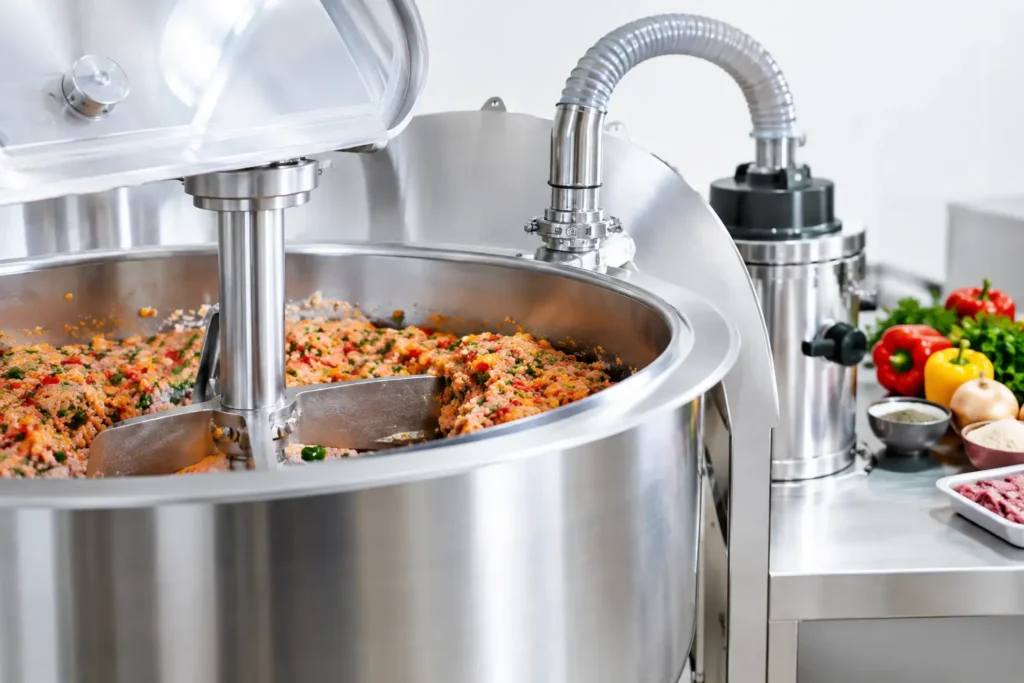
For mayonnaise and heavy dressings, a bottom-entry or inline emulsifying head can provide the local shear needed for oil droplet reduction and powder dispersion. Anchor or scraper agitation keeps viscous material moving across the vessel wall for efficient heat transfer and uniform mixing. A properly sized vacuum system then removes air from the full batch rather than only from the surface.
Sanitary design is equally important. Product-contact surfaces, seals, discharge valves, clean-in-place capability, and access for inspection all affect uptime and food safety. A mixer that makes an excellent batch but requires excessive manual cleaning will create an avoidable production bottleneck.
PerMix vacuum emulsifying systems are designed around these real operating requirements: controlled powder incorporation, high-shear emulsification, efficient deaeration, and repeatable processing for mayonnaise, sauces, and dressing applications.
The right question is not whether vacuum mixing is inherently better. It is whether removing air and improving process control will protect the product attributes your customers pay for. When consistency, texture, appearance, and efficient scale-up matter, vacuum becomes a production advantage rather than an optional feature.

Get in touch with us today and learn how to we can help your business.