PerMix Mayonnaise Production
PerMix News

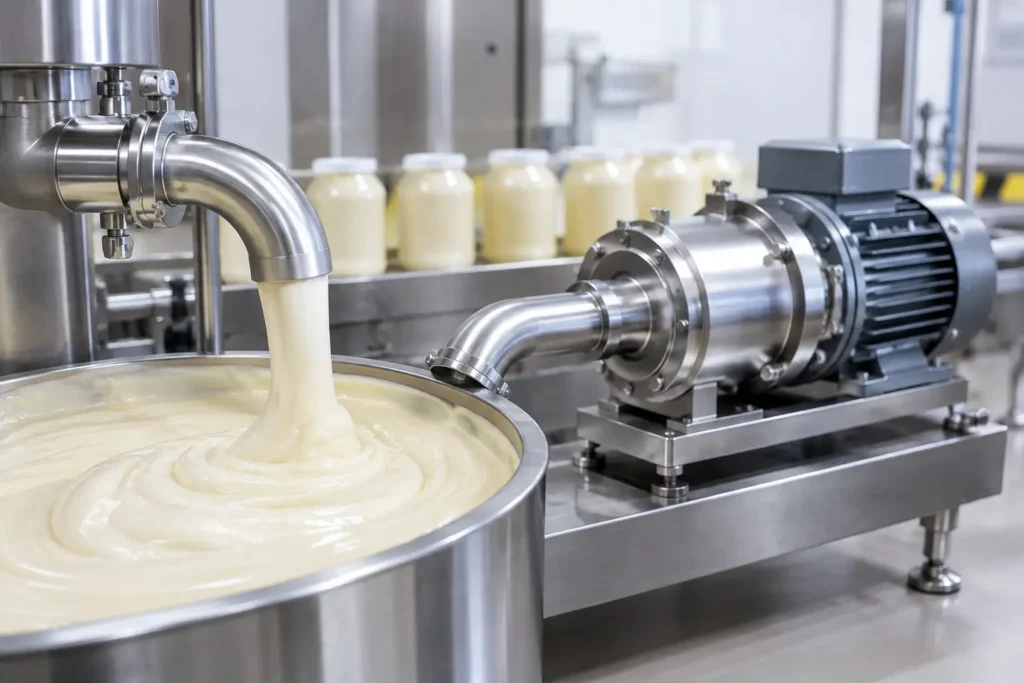
Mayonnaise does not behave like a simple liquid. Its high viscosity, oil-water emulsion structure, shear sensitivity, and temperature response make transfer equipment a direct contributor to finished-product quality. The top pumps for mayonnaise transfer are not defined by flow rate alone. They must move product predictably while protecting texture, limiting air pickup, meeting sanitary requirements, and handling the full range of formulations on the production schedule.
For a food plant producing standard, low-fat, fat-free, or vegan mayonnaise, the right pump depends on more than the line’s gallons-per-minute target. Product viscosity can vary substantially between recipes and at different process temperatures. Fillers, starches, egg alternatives, gums, and protein systems can further change how the mayonnaise responds under pressure and shear. Pump selection should therefore begin with the product and process, then match the equipment to the duty.
A transfer pump may receive mayonnaise from a vacuum emulsifying mixer, feed a buffer tank, supply a filling machine, recirculate product through a process loop, or move product to a packaging area. Each duty imposes different demands. A short, low-pressure transfer is not equivalent to a long line with elevation changes, restrictive valves, mass flow control, or multiple filling heads.
The pump must maintain a stable flow without excessive pulsation or pressure spikes. It must also tolerate the product’s apparent viscosity at the lowest expected processing temperature, not merely a favorable laboratory measurement. A mayonnaise that flows well at 80°F may be far more difficult to move at 55°F after holding or cooling.
Sanitation is equally critical. Product-contact surfaces should be suitable for hygienic food service, and the pump must be compatible with the facility’s clean-in-place procedure where required. Dead zones, difficult disassembly, seal failures, and inadequate cleanability create avoidable downtime and food safety risk.
There is no universal number-one pump for every mayonnaise line. The strongest choice is the pump that fits the formulation, line pressure, sanitary design standard, and production objective. In commercial mayonnaise processing, four pump categories deserve serious consideration.
Twin screw pumps are a premium option for manufacturers that need broad operating flexibility. They can handle highly viscous mayonnaise, accommodate variable product conditions, and generate the pressure needed for longer transfer runs or downstream equipment. Their controlled, low-pulsation conveying action is particularly useful when consistent flow to filling equipment is a priority.
A key advantage is operating range. A properly sized twin screw pump can often manage both thin cleaning solutions and viscous finished product, supporting efficient CIP operation without a separate dedicated cleaning pump in some system designs. This can simplify piping and reduce equipment footprint.
The trade-off is capital cost and system complexity. Twin screw pumps should be selected with accurate data on viscosity, pressure drop, speed range, and suction conditions. Oversizing can create unnecessary shear, energy use, and purchase cost. For high-value mayonnaise lines with multiple products or frequent cleaning cycles, however, the flexibility can justify the investment.
Rotary lobe pumps remain a common choice for mayonnaise transfer because they are sanitary, positive displacement pumps with dependable performance across many viscous food applications. Their gentle product handling and relatively simple construction make them well suited to transfer from a processing vessel to a holding tank or filler.
For standard mayonnaise formulas moving over moderate distances, a rotary lobe pump can offer an effective balance of cost, cleanability, and throughput. It is especially practical where the process requires repeatable batch transfers rather than highly variable duty conditions.
Clearances, lobe geometry, rotational speed, and pressure requirements matter. At elevated differential pressure or with very high-viscosity product, internal slip and heat generation can affect performance. Running a lobe pump too fast to compensate for poor sizing can also introduce more shear than the product requires. The right approach is to size for the actual formulation and required pressure, then operate within a controlled speed range.
Progressive cavity pumps are highly effective where mayonnaise must travel through long pipelines, rise to elevated tanks, or overcome substantial backpressure at controlled flow rates. Their positive displacement action delivers a steady, low-pulsation stream, which can be valuable for feeding packaging equipment or transferring dense, cold product.
These pumps are often considered when a plant handles very thick mayonnaise, starch-containing dressings, or formulations with challenging rheology. They can provide precise flow control when paired with suitable speed control and instrumentation.
Their limitations are tied to stator and rotor wear, cleaning requirements, and dry-running sensitivity. A progressive cavity pump should not be treated as a fit-and-forget component. Seal selection, elastomer compatibility, CIP validation, and operator safeguards all need attention. For the right service, it is a high-performance solution. For a line requiring frequent formulation changes and rapid sanitation, its maintenance and cleaning profile should be evaluated carefully.
Air-operated double-diaphragm pumps, often called AODD pumps, can be useful for smaller batches, pilot systems, intermittent transfer, and certain specialty applications. They can handle viscous materials and are mechanically simple, with the ability to run at variable rates.
For bulk mayonnaise transfer to a high-speed filling line, they are usually not the first choice. Their pulsating flow can complicate accurate filling, and compressed-air use can raise operating costs. Air quality, diaphragm material, sanitary configuration, and discharge smoothing must also be addressed.
Still, an AODD pump can be practical for R&D rooms, small production lots, rework transfer, or low-volume products where flexibility is more valuable than tightly controlled continuous flow.
Mayonnaise viscosity is the starting point, but it is not enough to state a single centipoise value on a specification sheet. Provide viscosity across the anticipated temperature range, along with any yield-stress or thixotropic behavior. Many mayonnaise products become easier to move after shearing, while others recover structure quickly at rest. That behavior affects suction performance, pressure drop, and pump control.
Line design is the next deciding factor. Pipe diameter, total length, bends, valves, filters, elevation, and filling-machine pressure requirements all contribute to total dynamic conditions. A pump that performs well at the mixer outlet may fail to meet capacity at the end of an undersized or restrictive pipeline.
Suction conditions deserve equal attention. Thick mayonnaise does not readily flow into a pump. Keep suction piping short, adequately sized, and free of unnecessary restrictions. Positioning the pump close to the discharge of the vacuum mixer or buffer vessel can improve product feed and reduce cavitation-related issues. When a vessel is under vacuum, the transfer arrangement must be engineered to maintain stable flow without drawing excessive air into the product.
Formulation changes can also shift the preferred pump. Low-fat and fat-free mayonnaise may contain modified starches, hydrocolloids, proteins, and other ingredients that increase viscosity or alter shear response. Vegan mayonnaise can introduce plant proteins and stabilizer systems with different processing behavior from egg-based formulas. A pump sized only for conventional full-fat mayonnaise may become a production constraint when the product portfolio expands.
Transfer is not usually the primary emulsification step, but poor pumping can still damage the product. High speed, abrupt pressure changes, excessive recirculation, and uncontrolled heat buildup can alter viscosity, affect texture, or contribute to emulsion instability. The risk rises when the mayonnaise has already been processed to a fine droplet size and is being moved repeatedly through restrictive equipment.
The goal is controlled displacement, not maximum pump speed. Use variable-frequency control where practical, monitor discharge pressure, and avoid creating bottlenecks downstream of the pump. A properly designed transfer system should deliver mayonnaise at the rate the filler or receiving process needs, without forcing the pump to operate at its limit.
PerMix designs mayonnaise processing systems around the interaction between vacuum emulsification, powder incorporation, vessel discharge, and downstream transfer. That process-level view matters because a high-performing pump cannot compensate for poor product feed, unsuitable piping, or an emulsification process that has not achieved stable texture.
A useful pump inquiry includes batch size, target transfer time, product temperature, viscosity range, pipe layout, elevation, required flow rate, discharge pressure, solids or particulates, cleaning method, and available utilities. It should also identify every formula planned for the line, not just the current best-selling SKU.
Ask for performance at your actual duty point rather than a maximum capacity figure. Confirm wetted materials, seal arrangement, surface finish, CIP suitability, motor and control requirements, and the expected maintenance plan. For filling applications, verify that pulsation and flow variation will not affect package weights or filler accuracy.
The best transfer system is one that moves every approved mayonnaise formula without disrupting quality, slowing the filler, or creating a sanitation burden. Start with the hardest product in the portfolio and the most demanding line condition. If the pump performs there with controlled, sanitary operation, the rest of the production schedule becomes much easier to manage.

Get in touch with us today and learn how to we can help your business.