PerMix Mayonnaise Production
PerMix News
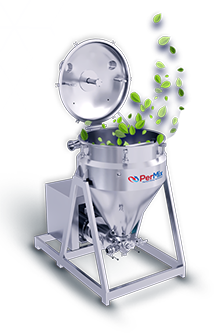

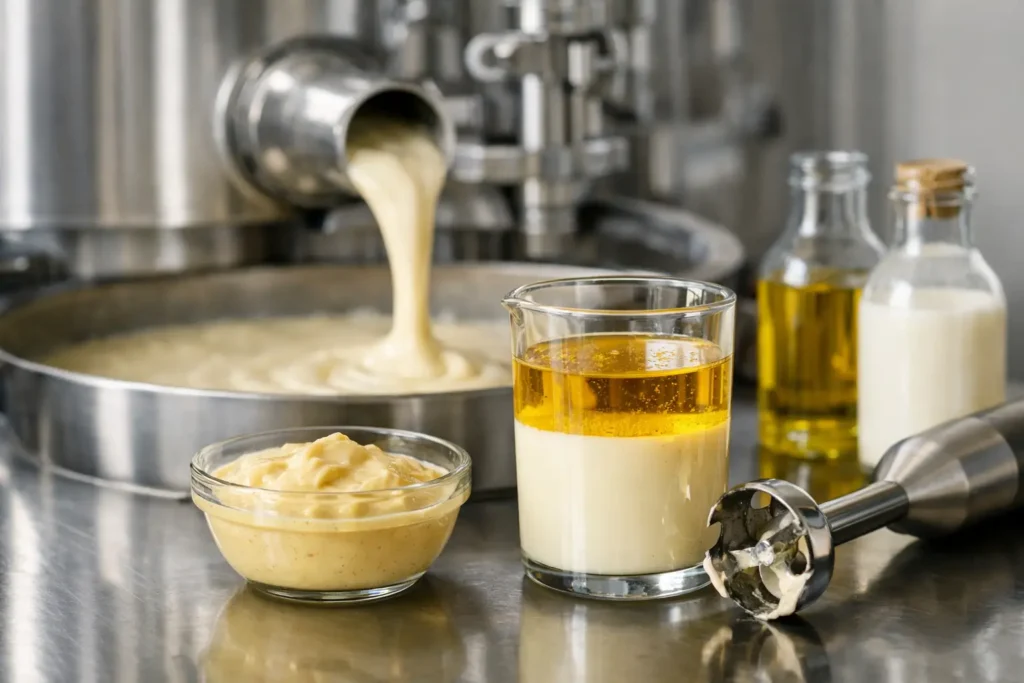
A mayonnaise batch that looks fine in the vessel can still fail on the line, in the filler, or two weeks into shelf life. That is the reality of processing difficult food emulsions at commercial scale. The challenge is rarely just one variable. It is usually the interaction between formula, powder incorporation, shear, vacuum, viscosity rise, and the order in which ingredients enter the process.
For food manufacturers, this is where equipment design stops being a purchasing detail and becomes a product quality decision. A stable emulsion is not created by high speed alone. It depends on how quickly droplets are formed, how uniformly powders are wetted, how much air is pulled out, and whether the system can keep up as the batch thickens. When any of those factors fall short, the result is familiar – fisheyes, broken texture, poor gloss, oil separation, inconsistent yield, and longer batch times.
Some emulsions are forgiving. Standard full-fat formulations with well-behaved raw materials often have a wider process window. Difficult emulsions do not. Low-fat mayonnaise, fat-free dressings, vegan emulsions, starch-thickened sauces, and formulations with challenging hydrocolloids all narrow that window considerably.
The reason is simple. As fat content drops or ingredient systems become more complex, the process has to work harder to create body, suspend solids, and maintain long-term stability. In many cases, powders hydrate slowly while viscosity builds quickly. That combination makes dispersion more difficult with every minute of processing.
Vegan formulations add another layer. Replacing egg yolk changes emulsification behavior, mouthfeel, and tolerance to shear. The emulsion may need tighter control over droplet size, mixing intensity, and ingredient sequencing. A process that works for a conventional mayonnaise may not hold up when proteins, starches, gums, and fibers take on a larger functional role.
This is why production teams often see the same symptoms repeat across different products. The formula may change, but the root cause is often mechanical – poor powder induction, uneven recirculation, trapped air, or inadequate homogenizing under rising viscosity.
Air is one of the biggest hidden problems. When too much air enters the batch, apparent volume can look acceptable while actual product quality declines. Air disrupts smooth texture, affects density, reduces visual appeal, and can destabilize the system over time. In high-viscosity products, once air is trapped, removing it is much harder.
Powder addition is another frequent bottleneck. Dry starches, stabilizers, proteins, and gums need fast wetting and uniform incorporation. If powders float, agglomerate, or hydrate on the surface before full dispersion, they create lumps that are difficult to break down later. Operators then compensate with longer mixing times, but that often increases heat and does not fully solve the problem.
Oil addition rate matters just as much. Add oil too quickly and the system may not generate enough interfacial coverage to stabilize droplets. Add it too slowly and batch time stretches unnecessarily, reducing throughput. The correct rate depends on the formulation, the available shear, and the viscosity profile through the batch.
Then there is scale-up. A batch that performs well in pilot production may fail in a larger vessel because flow patterns change. Dead zones increase, turnover slows, and powder incorporation becomes less predictable. Without the right mixer geometry and emulsifying system, scaling up can expose weaknesses that were not obvious in development.
When manufacturers evaluate systems for processing difficult food emulsions, they often start with horsepower or maximum speed. Those numbers matter, but they do not tell the full story. The more important question is how the machine moves product through the critical zones of mixing, dispersion, and emulsification.
A well-designed vacuum emulsifying mixer improves performance because it addresses several failure points at once. Vacuum helps reduce entrapped air and improves product appearance and stability. A high-shear emulsifying head reduces droplet size more efficiently than agitation alone. A properly engineered vessel and agitator create consistent turnover, preventing localized overprocessing in one zone and underprocessing in another.
Powder induction is equally important. For difficult dry ingredients, manual top entry is slow and inconsistent. It increases dust, extends batch time, and raises the risk of lump formation. A powder induction system draws solids directly into the liquid phase under controlled conditions, which improves wetting and reduces operator dependency.
This is where process-focused equipment has a clear advantage over generic mixing platforms. In mayonnaise, dressings, ketchup, and related products, the mixer is not just blending ingredients. It is building structure. That requires a system designed around actual formulation behavior, not a broad promise of mixing capability.
Better results usually come from better control, not just more intensity. Shear has to match the product stage. Early in the batch, aggressive dispersion may be useful to wet powders and establish the emulsion. Later, as viscosity rises, the goal shifts toward maintaining uniformity without creating unnecessary heat or damaging sensitive components.
Ingredient order should be treated as a process parameter, not a routine habit. Water phase preparation, powder hydration, acid addition, oil incorporation, and final viscosity adjustment each affect stability. Small changes in sequence can alter hydration efficiency and emulsion strength. That is especially true in low-fat and vegan systems, where the margin for error is narrower.
Temperature control also deserves attention. Some ingredients hydrate better within a specific range, but excessive heat can change viscosity, affect flavor, or reduce stability. The right process keeps thermal exposure under control while still allowing efficient incorporation and emulsification.
Vacuum is often underestimated until a plant compares batches side by side. Products processed under vacuum typically show improved gloss, smoother texture, and more consistent density. In filling operations, that consistency can also support more predictable performance downstream.
For manufacturers balancing multiple SKUs, flexibility matters. A system may need to handle full-fat mayonnaise in one shift and a starch-heavy low-fat dressing in the next. That puts pressure on mixer design, cleanability, batch repeatability, and process adaptability. Equipment that performs well on one easy product but struggles with the rest will create long-term costs that do not appear in the initial quotation.
The best equipment choice depends on your product range, target batch size, and level of formulation complexity. Still, a few capabilities consistently matter in this category.
First, the machine should combine strong vessel agitation with true high-shear emulsification. One without the other often leads to inconsistency, especially as viscosity rises. Second, vacuum capability should be integrated into the process, not treated as an optional extra for appearance only. Third, powder handling should be engineered for rapid wetting and minimal agglomeration.
Sanitary construction and cleanability are also critical. Difficult emulsions often include sticky, adhesive, or highly viscous phases. If the system is hard to clean, downtime increases and changeovers become more disruptive. For plants with frequent product variation, that can become a serious operational constraint.
Control strategy matters as well. Operators need repeatable settings for mixing speed, shear rate, vacuum level, and ingredient addition timing. Without that level of control, consistency becomes too dependent on individual experience. That may work in small-scale production, but it does not support reliable industrial output.
For many manufacturers, this is where specialized systems such as vacuum emulsifying mixers and universal vacuum mixer processors deliver measurable value. They are built for the real conditions that make emulsified foods difficult to process – rising viscosity, sensitive ingredient systems, powder loading, and the need for stable, repeatable structure.
When an emulsion process is unstable, the cost is not limited to rejected batches. It shows up in longer cycle times, higher labor input, inconsistent filling weights, customer complaints, reformulation work, and reduced confidence during scale-up. Plants often carry these losses quietly for months because the product is still being made, just not efficiently.
A stronger process changes that equation. It shortens incorporation time, improves batch-to-batch consistency, reduces rework, and gives R&D teams a more reliable platform for product development. It also makes procurement decisions easier to defend because the return is tied to throughput, waste reduction, and product quality.
At that point, the discussion is no longer about buying a mixer. It is about securing a process that can support current production and future formulation demands. That is the difference between equipment that simply runs and equipment that performs.
If your products include low-fat, fat-free, vegan, or otherwise challenging emulsions, the right processing approach pays for itself in fewer surprises and better output. PerMix builds around that reality – because in commercial food production, stable emulsions are not a lab result. They are a production standard.

Get in touch with us today and learn how to we can help your business.