PerMix Mayonnaise Production
PerMix News
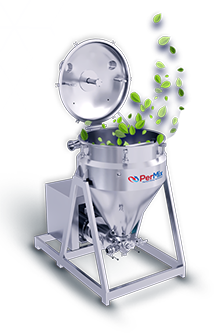

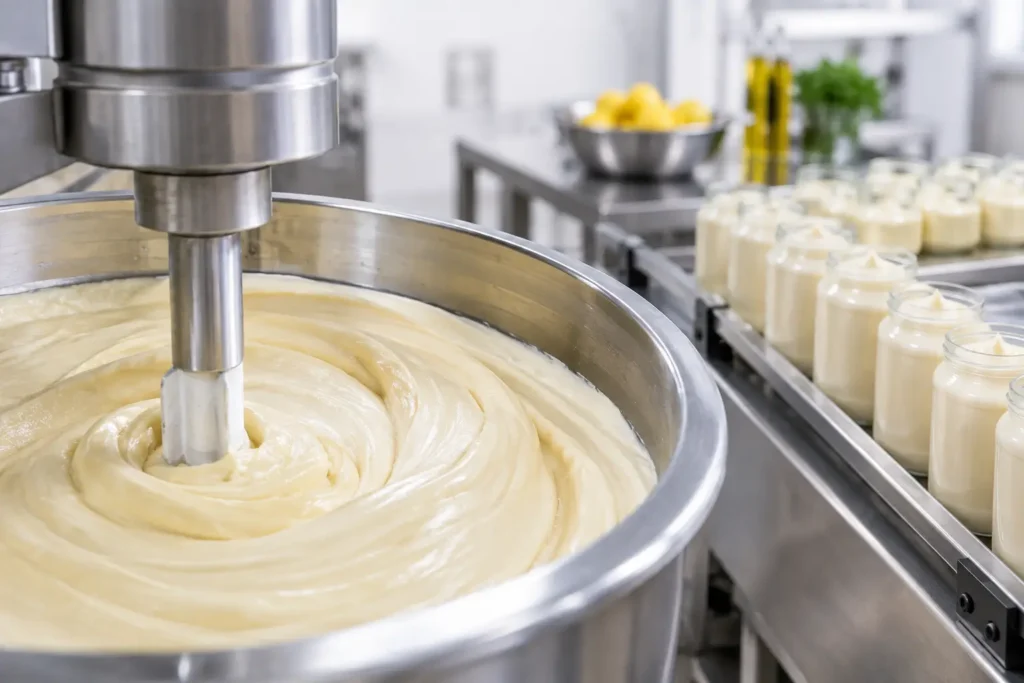
A stable aioli line is not created by simply adding oil to eggs and garlic at a larger volume. At commercial scale, how to manufacture stable aioli comes down to controlling droplet size, ingredient hydration, shear, temperature, vacuum, and the order in which materials enter the batch. When one variable moves outside its operating window, the result can be a thin, grainy, aerated, or broken product that creates costly rework and inconsistent filling performance.
For manufacturers producing premium aioli, flavored mayonnaise, or egg-free garlic sauces, the process must protect both product identity and production reliability. The goal is a fine, uniform oil-in-water emulsion with the target viscosity, clean flavor release, and stability through shelf life, transportation, and consumer use.
Traditional aioli is associated with garlic and oil, often emulsified with egg yolk. Commercial aioli formulations may also include water, vinegar or lemon juice, salt, sugar, mustard, spices, stabilizers, and preservative systems where permitted and required. Vegan aioli replaces egg yolk with plant-based emulsifiers, proteins, starches, hydrocolloids, or a combination of these ingredients.
The first engineering decision is the target oil level. A full-fat aioli generally has a wide stability margin because the dispersed oil phase supports a thick, spoonable texture when properly emulsified. Low-fat formulas are less forgiving. They require a carefully designed aqueous phase to replace body normally supplied by oil, and they are more vulnerable to watery texture, poor cling, and viscosity loss during storage.
Acidification is equally important. The acid system contributes flavor, microbial control, and protein functionality. However, adding acid too early or too quickly can affect egg proteins and certain hydrocolloids. The correct sequence depends on the formulation and the ingredients selected. A bench formula that works with hand mixing should never be assumed to transfer directly to a 500-gallon production vessel.
Garlic also deserves process attention. Fresh garlic provides a strong, authentic profile, but particle size, enzymatic activity, and microbiological control must be managed. Garlic puree, dehydrated garlic, or standardized flavor systems may provide greater consistency. The right choice depends on the product positioning, available sanitation controls, and desired flavor intensity.
A dependable production cycle starts by preparing the water phase under controlled agitation. Water, salt, sugar, acids, and water-soluble ingredients are combined until fully dissolved. Dry stabilizers, modified starches, proteins, and gums must be dispersed without fisheyes or agglomerates. This is a frequent failure point in low-fat and vegan products, where incomplete powder hydration can appear later as graininess or unstable viscosity.
High-efficiency powder induction can materially improve this stage. Pulling powders directly into the liquid under vacuum or controlled negative pressure reduces airborne dust, shortens loading time, and promotes rapid wetting. It also gives operators a more repeatable method than manually dumping bags into an open vessel.
Once the aqueous phase is uniform, the emulsifier system is introduced and allowed to hydrate or activate as required. For egg-based aioli, yolk or pasteurized egg ingredients should be incorporated before the main oil addition. For vegan aioli, plant proteins, starches, and emulsifying agents may need a defined hydration period and, in some cases, a controlled heating and cooling cycle.
Oil is then metered into the batch gradually while the rotor-stator homogenizer creates high local shear. The objective is not maximum shear at every moment. It is controlled shear that reduces oil droplets to a consistent size without overheating the product or damaging the desired texture. Adding oil too quickly can overload the emulsifying system and cause coalescence. Adding it too slowly can extend batch time unnecessarily and reduce plant throughput.
A practical process uses a defined oil feed rate, homogenizer speed, and recirculation pattern for each product family. Those parameters should be documented as operating setpoints, not left to operator judgment alone. This becomes especially important when scaling from pilot quantities to production volumes, where vessel geometry and recirculation rates change the actual energy delivered to the product.
Air is an often-overlooked source of aioli quality problems. Entrained air can make the product appear lighter in color, distort density readings, interfere with accurate filling, and increase oxidation risk. It can also exaggerate apparent viscosity during mixing, only for the product to thin after deaeration.
Vacuum emulsification removes entrapped air while supporting faster powder incorporation and a smoother finished appearance. It is particularly valuable for viscous aioli formulas that trap air during high-shear mixing. A closed vacuum system also improves hygiene, reduces exposure during processing, and creates a more controlled manufacturing environment.
The vacuum level should be matched to the product and process stage. Pulling excessive vacuum at the wrong point can cause aggressive foaming, especially when proteins or certain surfactants are present. The most effective approach is a programmed process that coordinates vacuum, agitation, homogenization, oil feed, and discharge conditions.
PerMix vacuum emulsifying mixers are designed around this requirement: combine efficient dispersion, high-shear emulsification, powder handling, and vacuum deaeration in one controlled process platform. For manufacturers running multiple mayonnaise and sauce formats, that integration helps reduce batch variation and simplify scale-up.
Temperature affects viscosity, emulsifier performance, hydration, and food safety. It is not a background condition. In egg-based aioli, excessive heat can damage proteins or push the product toward a cooked flavor. In starch-structured or vegan formulas, insufficient heat may leave the starch underdeveloped, while overheating can produce an overly thick, pasty, or unstable texture.
Many commercial aioli processes use jacketed vessels to heat or cool the batch at specific stages. The correct temperature profile depends on the formula. A cold-process full-fat aioli may need only temperature management to prevent heat buildup from homogenization. A low-fat or vegan formula may require a more deliberate thermal cycle to hydrate gums, activate starches, or achieve the needed microbial process control.
Measure product temperature in the batch, not only jacket temperature. Also monitor temperature during recirculation and immediately before filling. A product that meets its viscosity target at 75 degrees Fahrenheit may flow very differently at 95 degrees Fahrenheit, affecting both filling accuracy and the final consumer experience.
A visually smooth aioli at discharge is only the first quality checkpoint. Finished batches should be evaluated for viscosity, pH, density, particle distribution, oil separation, color, flavor, and microbiological compliance. The exact test program depends on the formula, packaging, distribution environment, and regulatory requirements.
Accelerated stability testing can expose weak emulsions before commercial release. Hold samples at refrigerated, ambient, and elevated temperatures where appropriate, then monitor for oiling off, syneresis, thinning, color change, or flavor deterioration. Freeze-thaw testing may also be useful if products could experience cold-chain abuse, although not every aioli is intended to withstand freezing.
Packaging matters as well. High-viscosity aioli behaves differently in jars, squeeze bottles, pouches, and portion packs. The filling system must handle the product without introducing air or breaking the emulsion, while the package must provide adequate barrier protection for the intended shelf life.
Most production failures trace back to a short list of controllable conditions: poor powder dispersion, incorrect phase sequence, uncontrolled oil addition, inadequate shear, excess air, temperature drift, or a formula that was never designed for the target process. The corrective action should address the actual cause, not simply add more stabilizer after the fact.
If aioli breaks during manufacture, review the oil feed rate and emulsifier loading first. If it is smooth initially but separates in storage, investigate droplet size, pH, temperature history, and the functionality of proteins or hydrocolloids. If viscosity varies batch to batch, confirm hydration time, ingredient lot consistency, temperature, and mixer operating parameters.
Stable aioli manufacturing is a disciplined combination of formulation science and equipment control. Build a process window, document it, validate it at production scale, and select mixing technology that can repeat it batch after batch. That is how a premium garlic sauce becomes a reliable commercial product rather than a recurring production risk.

Get in touch with us today and learn how to we can help your business.