PerMix Mayonnaise Production
PerMix News
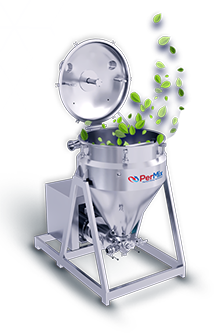

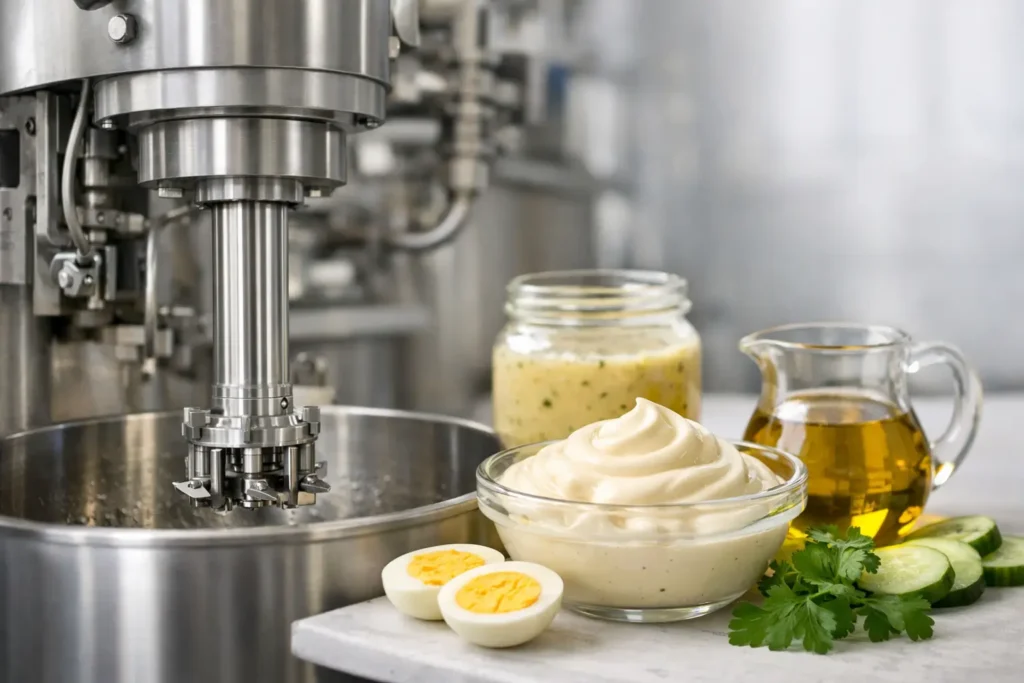
A mayonnaise batch can look finished at the mixer and still fail in the tank, on the filling line, or weeks later on a retail shelf. Oil separation, uneven body, visible starch particles, and trapped air are usually process failures before they are formulation failures. This high shear mixer review examines what food manufacturers should expect from mixing equipment when producing mayonnaise, dressings, sauces, ketchup, and other demanding emulsified products.
The right mixer is not simply the unit with the highest motor rating or the fastest rotor speed. It is the system that creates the required shear where it matters, incorporates powders without fish eyes, manages air, supports sanitary changeovers, and repeats the same product quality as batch volumes grow. For condiment producers, those factors determine throughput, waste, shelf stability, and customer acceptance.
High shear mixing works by forcing product through a close-tolerance rotor-stator workhead. The rotor accelerates the material, while the stator openings create intense hydraulic and mechanical forces. In an oil-in-water emulsion such as mayonnaise, this action reduces oil droplet size and distributes those droplets throughout the aqueous phase. With the correct emulsifier system and process sequence, a finer, more uniform droplet distribution improves body and emulsion stability.
That is the principle. In production, performance depends on the complete process.
A standard full-fat mayonnaise may emulsify readily when oil is added at a controlled rate and the aqueous phase is properly prepared. Low-fat, fat-free, and vegan products are less forgiving. They often rely on starches, gums, proteins, fiber systems, or plant-based emulsifiers to replace some of the structure normally supplied by oil and egg. These ingredients can hydrate quickly at the surface and form lumps that conventional agitation cannot break down efficiently.
A useful mixer review therefore begins with the formulation and batch sequence. Ask whether the equipment can disperse your dry ingredients into liquid, hydrate them consistently, process the oil phase at the right rate, and achieve the target viscosity without excessive processing time. A mixer that performs well on a thin vinaigrette may be poorly matched to a high-viscosity vegan mayonnaise.
The most important measure is not a published RPM number. It is the actual emulsion produced at your target batch size, temperature, viscosity, and oil level. A well-designed high shear system should deliver repeatable droplet reduction without creating localized overheating or damaging sensitive ingredients through unnecessary recirculation.
Rotor-stator geometry, tip speed, stator configuration, and product flow all affect the result. Fine stator openings can improve dispersion, but they may also reduce flow with thick products. More aggressive shear is not automatically better. If a formulation reaches its required texture at moderate shear, adding more energy can increase cycle time, aeration, or temperature without improving stability.
For this reason, manufacturers should evaluate sample batches against practical quality measures: viscosity, texture, oil separation, appearance, yield, and stability after storage. A successful test is one that reproduces the finished product specification, not one that merely demonstrates that the mixer can create an emulsion.
Powder handling is often the point where a seemingly capable process becomes inefficient. Starches, stabilizers, gums, milk powders, protein blends, salt, sugar, and seasoning systems must enter the batch cleanly and disperse before they form agglomerates. Adding powders through an open vessel can create dust, operator exposure, slow addition, and inconsistent hydration.
A powder induction system uses vacuum or controlled liquid flow to pull dry ingredients into the process stream. Combined with a high shear workhead, it can wet and disperse powders quickly while reducing the chance of floating rafts and stubborn lumps. This is especially valuable for low-fat mayonnaise and thick dressings, where small dispersion defects can become obvious in the finished product.
The trade-off is that powder induction equipment must be sized for the powder type and feed rate. Free-flowing sugar behaves differently from fine modified starch or a hygroscopic gum blend. A supplier should ask for formulation details rather than promise the same induction performance for every powder.
Air is a hidden production cost. It can make mayonnaise appear lighter than intended, interfere with viscosity readings, reduce filling accuracy, contribute to oxidation, and create an unstable visual finish. Vacuum processing removes entrained air while the product is being mixed and emulsified. It can also support faster powder incorporation when the system is designed for vacuum induction.
For premium mayonnaise, creamy dressings, and viscous sauces, a vacuum emulsifying mixer is often a stronger choice than an open, top-entry high shear mixer. The enclosed process gives operators greater control over powder addition, deaeration, and sanitary production. It also helps maintain a cleaner work area.
Vacuum is not mandatory for every application. A low-viscosity sauce with limited air sensitivity may be produced successfully in a simpler system. But when product appearance, density control, and emulsion quality are central to the specification, vacuum should be evaluated as a production requirement rather than an optional feature.
A high shear workhead cannot compensate for poor vessel circulation. Thick products need an anchor or sweep agitator to move material from the vessel wall toward the high shear zone. Scrapers help control wall buildup and heat transfer, while proper baffle and vessel geometry prevent stagnant areas.
This matters most during scale-up. A pilot batch can look excellent because the workhead reaches a large percentage of the material. At industrial scale, dead zones become more likely if the vessel, agitator, and emulsifier are not engineered as one system. The correct design balances bulk movement with localized high shear.
When reviewing proposals, procurement teams should look beyond the equipment price and request clear answers to the production questions that affect total operating cost. The following points are worth documenting before a purchase decision:
These questions reveal whether the proposal is based on process knowledge or on a generic equipment catalog. A credible supplier will discuss limitations as well as capabilities. For example, a formula with high levels of pregelatinized starch may require a different powder addition sequence than a traditional egg-based mayonnaise. A plant running multiple allergens may prioritize clean-in-place design and faster changeovers over the highest possible batch speed.
An inline high shear mixer is useful for recirculation, finishing, and continuous processing. It can provide excellent control when product is pumped through the workhead at a stable flow rate. However, inline equipment alone may not solve powder wetting or vessel circulation issues in thick batches.
A batch rotor-stator mixer mounted in the vessel gives direct shear at the point of processing and can be effective for many sauces and emulsions. Its performance depends heavily on agitator support and vessel design, particularly as viscosity rises.
A vacuum emulsifying mixer combines an enclosed vessel, sweep agitation, high shear emulsification, vacuum deaeration, and often powder induction capability. This configuration is well suited to manufacturers producing mayonnaise and dressings with demanding texture, stability, and sanitation requirements. The initial investment is higher than a basic open tank, but it can reduce batch variability, manual handling, and rework.
PerMix designs vacuum emulsifying and universal vacuum mixer processors around these real production demands, with equipment selection based on product behavior rather than a one-size-fits-all mixing claim.
One of the most expensive mistakes in condiment manufacturing is assuming that a larger vessel with a larger motor will reproduce a smaller batch. Scale changes heat transfer, circulation paths, powder addition time, vacuum response, and the energy delivered per unit of product. A process that takes 15 minutes in development may need a different addition order or workhead configuration at commercial volume.
Before committing to a system, define the expected annual volume, normal batch size, maximum viscosity, product range, cleaning schedule, and future line expansion. Include the difficult formulas in the evaluation, not only the easiest flagship product. If the system can consistently handle the thick vegan dressing or low-fat mayonnaise with high powder loading, it is far more likely to handle the standard line efficiently.
The best mixer decision is made at the intersection of formulation, process, and production economics. Choose equipment that gives your operators control over the batch, not equipment that asks them to compensate for its limitations.

Get in touch with us today and learn how to we can help your business.