PerMix Mayonnaise Production
PerMix News
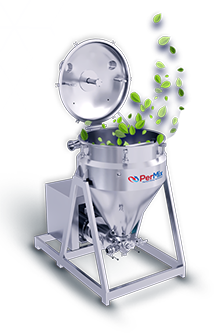

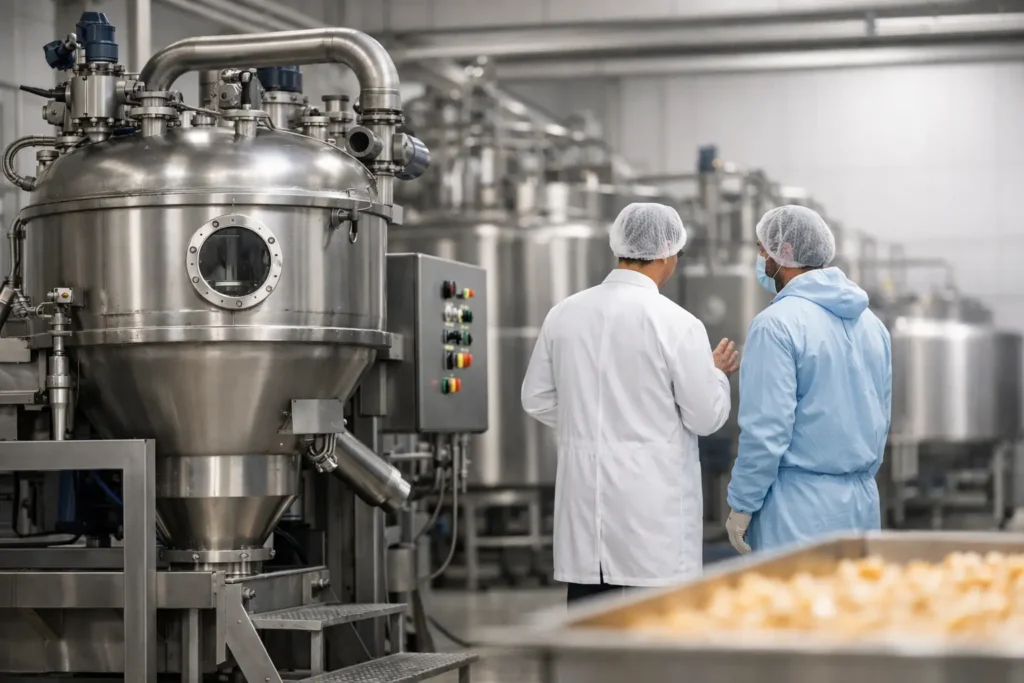
A mixer that looks right on paper can still become the bottleneck on your floor. In mayonnaise, dressings, and other emulsified products, a proper vacuum mixer sizing guide is not just about vessel volume. It is about matching batch size, viscosity, powder loading, cycle time, and future production plans so the system performs under real manufacturing conditions.
For food manufacturers, sizing errors usually show up fast. The batch takes too long, the emulsion quality drifts from run to run, powders do not wet out cleanly, or the vessel never operates in its ideal working range. The result is lower throughput, more operator intervention, and a process that becomes harder to scale as demand grows.
A useful sizing approach answers three practical questions. First, how much product must the system make in a shift, day, or week? Second, what process demands does the formulation place on the mixer? Third, how much operating margin is needed for product variation, line expansion, and sanitation downtime?
Too many equipment decisions start and end with nominal tank capacity. That is not enough for high-value emulsified foods. A 500-liter vessel does not automatically deliver a 500-liter finished batch, and a mixer sized only for current demand may struggle when you add a low-fat SKU, a starch-heavy formula, or a vegan emulsion with different hydration behavior.
The first step in any vacuum mixer sizing guide is to separate total vessel volume from working volume. Vacuum emulsifying mixers need headspace for agitation, circulation, powder incorporation, and vacuum performance. If the vessel is filled too high, mixing efficiency drops and the process becomes less predictable.
In practice, manufacturers should define the target finished batch size and then confirm the mixer’s recommended minimum and maximum working capacity. This matters especially for plants running multiple SKUs. If one product runs at 80 percent of vessel capacity and another only at 35 percent, the same machine may perform very differently across the range.
Minimum batch size deserves as much attention as maximum size. Many processors size for their largest campaign batch, then find that development runs, seasonal products, or customer-specific orders are too small to process efficiently. If your business needs flexibility, the operating window of the machine matters as much as the top-end capacity.
The right mixer size depends on how many saleable batches you need, not how many theoretical liters fit in the tank. That means looking at the full cycle. Charging liquids, pulling vacuum, inducting powders, heating or cooling if required, homogenizing, deaerating, and discharge all affect output.
For example, a plant targeting 6,000 liters per shift may assume a single 2,000-liter mixer running three batches is enough. That can work if the total cycle time is controlled. If the actual cycle stretches because starches hydrate slowly, oil addition requires tighter control, or washdown cuts available hours, the same machine may fall short.
This is where undersizing becomes expensive. A smaller unit can appear cost-effective upfront, but if it drives long batch cycles, overtime, scheduling pressure, or missed orders, the savings disappear quickly. Oversizing has its own trade-off. A vessel that is too large for the routine batch can reduce mixing intensity at low fill levels and tie up capital in unused capacity.
Not all mayonnaise and sauce systems load a mixer the same way. High-oil mayonnaise, reduced-fat emulsions, fat-free dressings, and vegan products create very different flow behavior. A vacuum mixer sizing guide needs to account for apparent viscosity across the entire process, not just the final texture.
A batch may begin as a low-viscosity liquid phase and then tighten significantly as powders hydrate, gums activate, starches build body, or oil is emulsified into the water phase. The mixer must handle that viscosity rise without losing circulation or creating dead zones.
This is especially important for processors working with difficult powders. Dry starches, stabilizers, proteins, and hydrocolloids can create fish eyes, lumping, or incomplete dispersion if the induction and mixing system is not sized for the load. When the formulation is powder-intensive, mixer selection should be based on dispersion performance as much as vessel capacity.
Two plants making the same daily volume may need different mixer sizes because their products behave differently in process. A standard mayonnaise formula with stable raw material handling may run efficiently in a straightforward batch profile. A product portfolio that includes low-fat, fat-free, and vegan lines usually demands more process flexibility.
Low-fat and fat-free systems often depend more heavily on starches, gums, and texture-building ingredients. These formulas may need stronger powder induction, more shear, or longer hydration time. Vegan emulsions can introduce different protein and stabilizer interactions that affect viscosity development and emulsion stability. In these cases, the safe sizing decision is often based on the most demanding product, not the easiest one.
That does not always mean buying the largest unit available. It means sizing around the process window required to maintain batch consistency, product stability, and commercial output across the full product mix.
Vacuum is not a box to check. It directly affects air removal, emulsion quality, density control, and finished appearance. In mayonnaise and similar products, poor vacuum performance can contribute to foam, unstable texture, and inconsistent filling behavior downstream.
As vessel size increases, the vacuum system and process design must still support efficient deaeration and controlled ingredient incorporation. If the mixer is large but the vacuum pull is slow relative to the batch profile, production may lose time at every cycle. If powder addition under vacuum is part of the process, the system must be sized so operators are not forced into workarounds that compromise quality.
A mixer should be sized as part of the line, not as a stand-alone asset. Ingredient supply, oil metering, premix preparation, transfer pumps, holding tanks, and filling speeds all influence what size makes sense.
A common mistake is choosing a larger mixer to increase output while leaving transfer or packaging capacity unchanged. The mixer finishes sooner, but the product waits. That can create temperature drift, queueing, and sanitation complications. The same issue appears upstream when raw material staging or powder handling cannot feed the mixer fast enough to support the planned cycle time.
Good sizing aligns the mixer with the actual production rhythm of the plant.
The most reliable sizing process starts with production targets and works backward through formulation and operating realities. Define the required finished volume per shift, then confirm how many batches are realistic once full cycle time is included. From there, evaluate the viscosity profile, powder load, shear requirements, and vacuum demands of the most difficult product in your range.
Next, test the operating window. Can the machine run your largest commercial batch efficiently? Can it also run smaller batches without poor circulation or inconsistent dispersion? If expansion is likely, decide whether you need growth margin in batch size, faster cycle time, or both. Those are different investments.
Finally, review sanitation and changeover frequency. Plants with frequent SKU changes may benefit more from a mixer size that supports efficient campaign planning than from one that simply maximizes single-batch volume.
You should generally size up when demand is already pressing current cycle limits, when future volume is credible in the near term, or when the formulation requires more process stability than a smaller unit can provide. You should be more cautious about sizing up when product variety is high, minimum batch size matters, or the rest of the line cannot absorb the larger output.
This is where experienced application support matters. The right answer is rarely just bigger or smaller. It is the machine that delivers the required batch quality at the required commercial pace with the least operational friction. For processors scaling mayonnaise and emulsified sauce production, that is the difference between buying equipment and buying production confidence.
PerMix approaches sizing from that practical point of view – batch performance, formulation demands, and line reality. That is the standard worth applying before any quote is approved.
The best mixer size is the one that keeps your process stable when production pressure rises, not just the one that fits the spreadsheet.

Get in touch with us today and learn how to we can help your business.