PerMix Mayonnaise Production
PerMix News

A starch slurry that looks smooth in a pilot container can become a costly production problem once it reaches a full-size batch. Dry pockets, fisheyes, uneven viscosity, and scorched starch are not ingredient failures. They are usually process and equipment failures. Manufacturers asking what equipment handles starch slurries need to look beyond a single mixer and evaluate how starch is inducted, hydrated, heated, circulated, and transferred.
For mayonnaise, dressings, sauces, and other emulsified foods, the right system protects more than texture. It supports repeatable viscosity, clean flavor release, stable emulsions, efficient batch times, and sanitary production. The best equipment choice depends on whether the starch arrives as a prepared slurry or a dry powder, whether the process requires cooking, and how much shear the finished product can tolerate.
Starch is often treated as a simple thickener, but its behavior changes quickly with water temperature, shear, pH, solids level, and time. Native and modified starches hydrate differently. Pregelatinized starches can build viscosity rapidly in cold processing, while cook-up starches must be dispersed first and heated through a controlled gelatinization range.
That distinction matters because a system that can mix a finished slurry may not be able to create one from dry powder without lumping. Likewise, a tank with enough agitation for a thin starch suspension may not have enough circulation or heat-transfer capacity once the batch thickens.
A properly engineered starch process typically includes powder induction or controlled charging, high-efficiency mixing, temperature control where required, and a transfer method matched to final viscosity. When the slurry becomes part of a mayonnaise or dressing formula, emulsification capability and vacuum processing may also be required in the same production platform.
The answer is usually a combination of equipment, not one machine. The core package should match the starch type, batch size, processing temperature, and final product rheology.
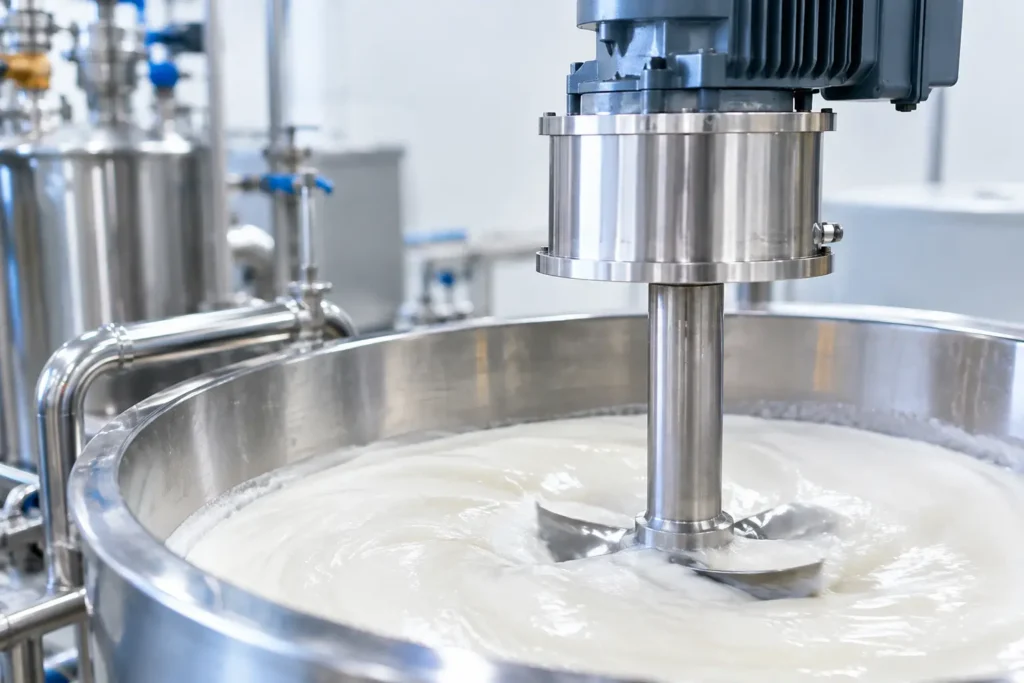
A jacketed vessel with a correctly sized agitator is the foundation for most starch slurry operations. It holds the water phase, maintains suspension, provides controlled heating or cooling, and gives operators the working volume needed for staged ingredient addition.
For low- to medium-viscosity slurries, a top-entry agitator with an appropriate impeller can maintain circulation and prevent settling. As viscosity rises, the vessel may require a scraper agitator, anchor-style agitation, or a dual-motion design that continually sweeps the vessel wall. Wall sweeping is especially valuable in cook-up starch applications because it reduces hot spots, product buildup, and localized scorching.
A jacket alone does not guarantee good cooking performance. Heat-transfer area, jacket design, agitation pattern, and batch depth all affect how evenly the starch reaches its target temperature. An undersized agitator can leave a hot zone near the vessel wall and a cooler mass in the center, producing inconsistent viscosity from one batch to the next.
When dry starch is added directly to water, powder induction is often the most decisive piece of equipment. A powder induction system draws powder into a liquid stream under controlled conditions, wets particles quickly, and returns the dispersion to the vessel with substantially less airborne dust and fewer agglomerates than open-top dumping.
This approach is particularly effective for formulations that use dry starch alongside gums, stabilizers, salt, sugar, or protein powders. These ingredients can form stubborn lumps when they contact water at the surface and hydrate before they are fully dispersed. Controlled induction minimizes that risk while improving operator safety and batch repeatability.
The key trade-off is shear and feed rate. Too little energy leaves dry particles poorly wetted. Too much powder introduced too quickly can overload the liquid stream and create lumps anyway. The best systems allow the powder feed, recirculation rate, and mixing intensity to be adjusted for the specific starch grade.
A high-shear mixer is valuable when the objective is rapid dispersion, fine particle breakdown, or incorporation of starch into a complex emulsified formula. Rotor-stator mixing creates intense localized shear that can disperse starch effectively before hydration creates a high-viscosity barrier.
For mayonnaise, dressings, and creamy sauces, a vacuum emulsifying mixer can combine starch slurry preparation with oil-phase addition, emulsification, deaeration, and temperature control. Vacuum helps remove entrained air, which improves product appearance, filling accuracy, and emulsion stability. It also supports efficient powder charging when used with the correct induction arrangement.
High shear is not automatically better. Some starch systems develop their intended viscosity with moderate mixing and controlled heating, and excessive recirculation can introduce unnecessary mechanical stress or alter the desired body of the finished sauce. Equipment selection should follow validated formulation trials, not a generic assumption that more shear solves every dispersion issue.
An inline mixer installed on a recirculation loop can provide consistent dispersion across the full batch. The vessel agitator keeps the product moving in the tank while the inline mixer processes a controlled portion of the product repeatedly. This configuration is useful when manufacturers need a uniform starch dispersion before cooking or before the slurry enters a larger sauce or dressing batch.
Recirculation also improves temperature uniformity, especially in products that thicken quickly. However, the loop must be designed for cleanability and product viscosity. Dead legs, restrictive valves, and incorrectly sized piping can reduce flow and make sanitation more difficult.
Once starch hydrates or cooks, transfer becomes a different challenge. Centrifugal pumps can work for thin slurries, but they may lose efficiency as viscosity increases and may not provide consistent flow for dense, shear-sensitive products.
Positive-displacement pumps are generally the better choice for finished starch bases and viscous dressings. Rotary lobe, twin-screw, progressive cavity, and certain sanitary diaphragm pump designs can move thicker product with controlled flow. The correct choice depends on viscosity range, particulate content, required pressure, clean-in-place requirements, and how gently the product must be handled.
Pump sizing should account for the cold product, not only the hot product. A starch slurry may pump easily after cooking but become significantly thicker during cooling, holding, or transfer to the filler.
A prepared starch slurry can often be handled with an agitated vessel, suitable transfer pump, and controlled heating system. Dry starch demands a more deliberate dispersion strategy because the first seconds of powder-to-water contact determine whether the batch will remain smooth.
For dry addition, manufacturers should evaluate powder induction, liquid temperature at the point of addition, recirculation rate, and the order of ingredient charging. Adding starch into already viscous liquid can be difficult because the powder may sit on the surface or hydrate into lumps before it disperses. In many formulas, dispersing the starch in a lower-viscosity water phase before adding oils, acids, or other viscosity-building ingredients produces better results.
Acid timing also matters in sauces and dressings. Some starches can lose viscosity under acid and heat if processing conditions are not controlled. Equipment cannot correct an incompatible formula, but accurate temperature control, fast dispersion, and repeatable process sequencing give formulators a much stronger operating window.
A supplier cannot size a starch handling system accurately from batch volume alone. The same 500-gallon vessel may perform very differently with a thin modified-starch slurry than with a high-solids vegan dressing base.
Before specifying equipment, define the starch type, target solids percentage, minimum and maximum viscosity, batch volume, temperature profile, heating and cooling utilities, powder addition rate, and required batch time. Also identify whether the product will be homogenized, emulsified, held under vacuum, or transferred directly to a filler.
Sanitary design should be included from the start. Food-grade contact surfaces, drainability, clean-in-place coverage, hygienic seals, and accessible inspection points affect uptime as much as mixing performance. A system that produces a smooth slurry but takes too long to clean is not an efficient production solution.
For manufacturers producing multiple products, the strongest investment is often a flexible process platform rather than a dedicated starch-only skid. A properly configured vacuum mixer processor can prepare the water phase, induct dry starch and stabilizers, heat and cool the batch, emulsify oil-based ingredients, and deliver a finished dressing or sauce ready for transfer.
That integration reduces product handling between steps and gives operators better control of the process variables that determine quality. It is especially useful for product lines that move between standard mayonnaise, low-fat dressings, fat-free products, and vegan formulations, where starch and hydrocolloid systems may play a larger role in texture development.
PerMix evaluates these applications as process challenges, matching vessel geometry, agitation, vacuum capability, powder induction, and transfer equipment to the actual formula and production target. The objective is not simply to move a starch slurry. It is to produce a consistent finished product at commercial speed.
The most effective starch system is the one that controls the critical moment when powder meets liquid, then maintains that control through heating, emulsification, and transfer. Start with the behavior of your formulation, and the right equipment configuration becomes far clearer.

Get in touch with us today and learn how to we can help your business.