PerMix Mayonnaise Production
PerMix News
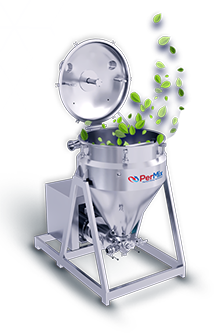

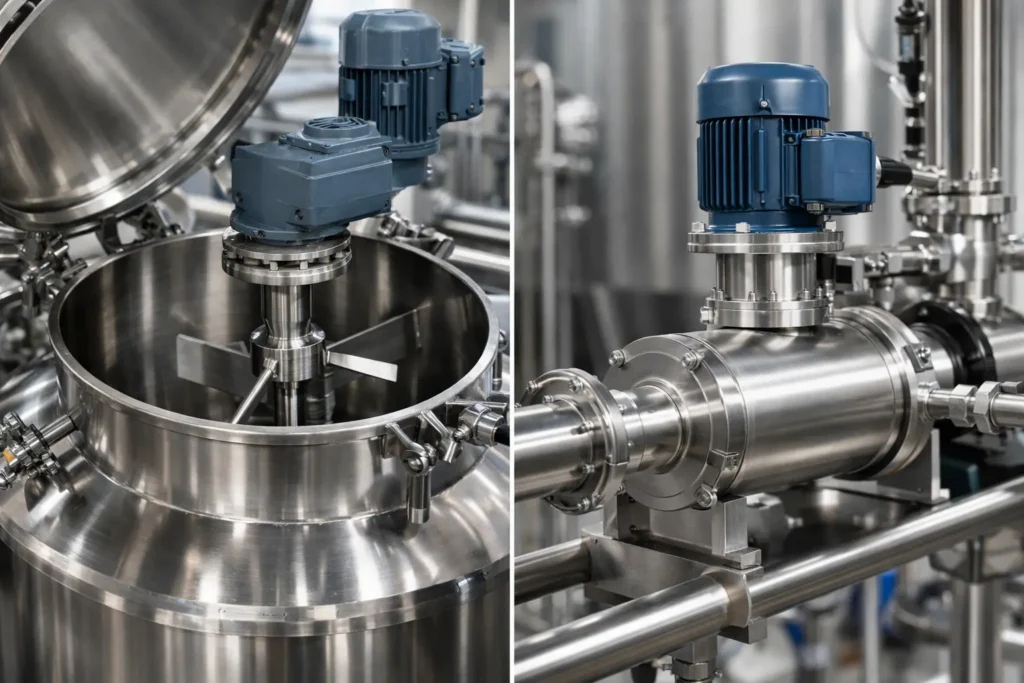
A sauce line rarely fails because of one dramatic problem. More often, performance is lost in small ways – powder that will not wet out, oil that will not fully emulsify, viscosity that drifts from shift to shift, or a product that looks fine at discharge and breaks later in the tank. That is why the question of batch mixer versus inline mixer matters so much in mayonnaise, dressings, ketchup, and related emulsified products. The right choice affects texture, stability, capacity, labor, cleaning time, and how confidently you can scale.
At a high level, a batch mixer processes a defined volume inside a vessel, while an inline mixer processes product as it flows through a pipeline or recirculation loop. That sounds simple, but in production the difference is not just vessel versus pipe. It is about how energy is applied, how ingredients are incorporated, and how much control the operator has over each stage of the process.
A batch system gives the processor a contained environment. You can sequence water, oil, vinegar, egg, stabilizers, starches, gums, and seasonings in a controlled order and adjust shear, vacuum, temperature, and timing before discharge. For emulsified food products, that control is often the difference between a stable product and one that only appears acceptable for a short time.
An inline system is built for continuous movement. Product passes through a high-shear zone and exits downstream, often at higher throughput and with less vessel hold time. In the right application, that can improve efficiency and support continuous production. But continuous flow does not automatically mean better emulsion quality. It depends on formulation, viscosity, powder behavior, and the tolerance of the product to process variation.
For mayonnaise and complex dressings, batch processing usually offers the strongest process window. These products often require several distinct steps: hydration of dry ingredients, dispersing powders without fisheyes, controlled oil addition, high-shear droplet size reduction, deaeration, and final viscosity adjustment. A batch mixer allows each step to happen under observation and control.
That matters even more when the formula is difficult. Low-fat and fat-free mayonnaise systems rely more heavily on starches, gums, proteins, and stabilizer networks. Vegan mayonnaise can introduce additional sensitivity around protein functionality and emulsion build. In both cases, powder induction and wetting are not minor details. Poor incorporation upstream can create texture defects that no amount of downstream shear will fully correct.
A vacuum-capable batch emulsifying mixer adds another practical advantage. Air management improves product appearance, reduces foam, supports more accurate density control, and helps deliver a cleaner, more stable emulsion. In commercial sauce production, vacuum is not a luxury feature. It is often a direct contributor to repeatability and shelf-life performance.
Batch systems also support R&D and multi-SKU production very well. If a plant runs several formulations with frequent changeovers, the ability to manage one controlled batch at a time can be more valuable than theoretical continuous throughput. The production team can validate the process, adjust parameters, and move to the next product with less risk.
Inline mixers can be a strong fit when the product is less sensitive, the recipe is well established, and the plant is designed around continuous flow. They are commonly attractive for high-volume operations that want to reduce processing time, shorten transfer paths, and maintain a more constant production rate.
For some sauces, liquid-liquid blending, and lower-viscosity systems, inline mixing can deliver excellent uniformity with efficient use of floor space. If the upstream ingredient handling is already well controlled and powders are pre-hydrated or easy to disperse, an inline unit may simplify the production train.
They can also work effectively as part of a hybrid design. In many plants, inline high shear is used for recirculation, polishing, or final homogenization rather than as the only mixing mechanism. That distinction matters. An inline mixer is not limited to fully continuous processing. It can complement a batch vessel and improve throughput without giving up process control.
The batch mixer versus inline mixer decision should be made around process behavior, not equipment labels. One of the biggest trade-offs is residence time. A batch mixer gives every portion of the product enough time in the vessel to complete hydration and dispersion. An inline mixer relies on flow conditions and pass count. If powders need more time to fully wet out, or if the emulsion develops in stages, batch processing tends to be more forgiving.
Another trade-off is ingredient addition. In mayonnaise production, oil addition rate and sequence can strongly affect droplet size and stability. In a batch vessel, operators can meter additions while watching viscosity build and adjusting shear accordingly. In an inline process, that same control is possible, but it typically requires tighter integration of pumps, dosing, and automation. The system can be excellent, but the margin for process drift is narrower.
Cleaning and sanitation are also worth an honest look. Inline systems may appear simpler because they reduce open vessel handling, but actual cleanability depends on the total loop, valves, dead legs, and ingredient feed points. A well-engineered batch vacuum emulsifying mixer with sanitary design can be highly efficient to clean, especially when the process is consolidated in one vessel instead of spread across multiple connected components.
Then there is scale-up. Many manufacturers assume inline means easier growth, but scale-up challenges do not disappear when a process goes continuous. If the product depends on a narrow shear history or precise powder incorporation behavior, increasing flow rate can change the result quickly. Batch systems often provide a more transparent path from pilot to production because the processing stages remain visible and controllable.
In sauce manufacturing, product quality is rarely defined by mixing alone. It is defined by the relationship between shear, vacuum, ingredient addition, and time. That is why many producers of mayonnaise, salad dressings, sandwich spreads, and similar emulsions favor batch vacuum emulsifying systems over fully inline-only designs.
The reason is straightforward. These products are not just blended. They are built. Water phase preparation, dry ingredient dispersion, emulsification, and final texturizing happen in a sequence. If one stage is weak, the finished product may show oiling off, unstable viscosity, poor mouthfeel, or inconsistent gloss. Batch processing makes it easier to manage that sequence with fewer surprises.
This is especially true when the plant runs premium or difficult formulas. Egg-free systems, low-oil formulations, and starch-thickened products can behave very differently from standard full-fat mayonnaise. Process flexibility becomes a commercial advantage. The equipment must be able to adapt, not just run at speed.
For many manufacturers, the smartest answer is not strictly batch or strictly inline. It is a system that uses a batch vessel for formulation control and powder induction, then uses inline shear or recirculation to shorten cycle time and improve final uniformity. That approach balances quality with throughput.
A hybrid design often makes sense when a plant wants to increase output without sacrificing emulsion stability. It can also help operations that struggle with dry ingredient incorporation. If powders are introduced under vacuum and dispersed in a controlled vessel first, the downstream inline stage can focus on refining the product rather than rescuing it.
This is where application-specific engineering matters. A processor making simple liquid sauces has a different requirement from a producer running high-viscosity mayonnaise with modified starches and multiple SKUs. Equipment should be selected around the formulation, target capacity, and production method – not generic assumptions about what is faster.
If your priority is maximum control, repeatable emulsion quality, and flexibility across formulations, a batch emulsifying mixer is often the stronger investment. If your priority is continuous throughput on a stable, well-defined product with tightly managed ingredient feeds, inline mixing may be the right fit. If your plant needs both quality assurance and higher output, a hybrid system deserves serious attention.
The practical test is simple. Look at where your current process loses value. If the issues are powder lumping, air entrainment, inconsistent viscosity, or unstable emulsions, more controlled batch processing usually addresses the root cause. If the issues are line speed, transfer efficiency, or continuous production flow on a simpler formulation, inline mixing may deliver the bigger gain.
PerMix works with manufacturers facing exactly these process questions in mayonnaise and emulsified food production. The right mixer is not the one with the broadest claim. It is the one that gives your formulation the process conditions it needs, every batch and every shift. That is how better equipment turns into better product.

Get in touch with us today and learn how to we can help your business.