PerMix Mayonnaise Production
PerMix News

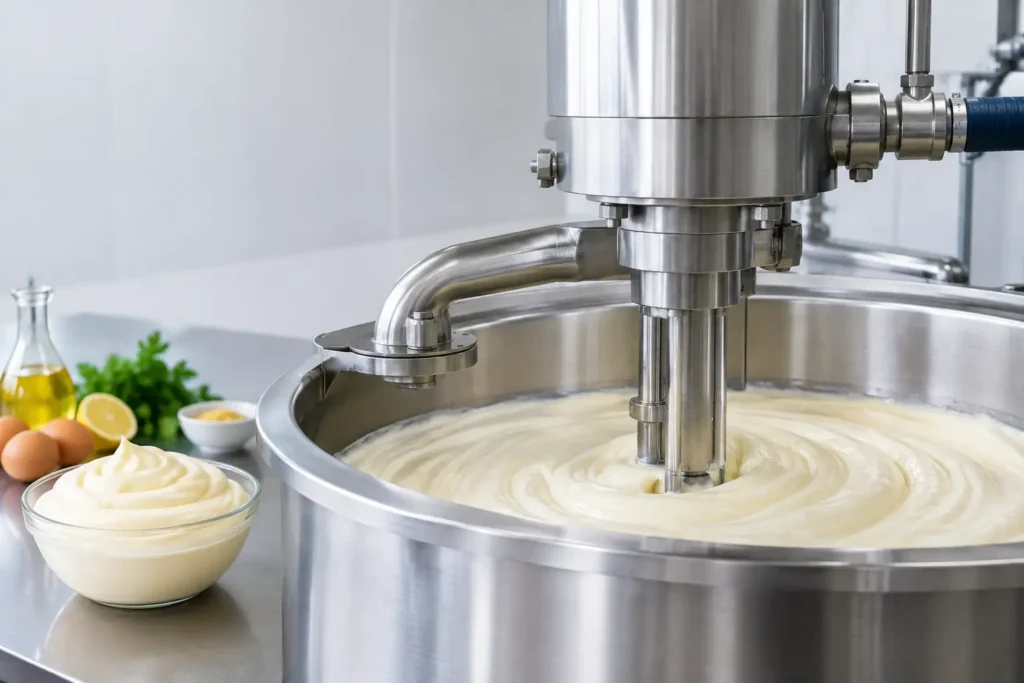
A mayonnaise batch can look acceptable at the mixer and still fail after filling. A thin body, oiling-off in storage, trapped air, or uneven texture often begins with one missed process condition. Manufacturers vacuum emulsify mayonnaise to control those conditions at the point where oil, water, egg or plant proteins, acids, and stabilizers must become one stable, market-ready product.
For commercial production, vacuum is not simply a finishing feature. Combined with high-shear emulsification, controlled ingredient addition, and proper vessel design, it helps produce a smoother product with stronger visual quality, repeatable viscosity, and better processing efficiency. The result is a process built for consistent batches, not just a successful laboratory trial.
Mayonnaise is an oil-in-water emulsion. The continuous water phase must hold a high volume of finely divided oil droplets, while emulsifiers and stabilizers protect those droplets from merging. Conventional agitation can blend the ingredients, but blending alone does not reliably create the droplet size distribution needed for a stable commercial mayonnaise.
A vacuum emulsifying system addresses two persistent production problems: entrained air and incomplete dispersion. Air enters easily when powders are added, when the product recirculates, or when a high-speed mixer pulls material from the surface. That air can create a lighter appearance, foam, inaccurate fill weights, and oxidation risk. Under vacuum, air is removed from the product as mixing continues, producing a denser, cleaner-looking mayonnaise.
Vacuum also improves the practical handling of difficult powders. Modified starches, gums, proteins, salt, sugar, mustard, and other dry components must wet out quickly and disperse without fisheyes. A properly designed vacuum system can draw powders into the liquid phase efficiently, reducing the time operators spend correcting agglomerates after they form.
The benefit is not that vacuum replaces shear. It does not. Stable mayonnaise depends on the interaction of vacuum, a high-shear homogenizing head, adequate circulation, accurate oil dosing, and a formulation designed for the intended fat level. When those elements work together, the process becomes more predictable from batch to batch.
The order of addition matters because every ingredient affects the viscosity and emulsifying capacity of the water phase. While exact procedures depend on the formula, the production logic remains consistent.
The process commonly begins by charging water and soluble ingredients into the vessel. Salt, sugar, acids, preservatives, and water-soluble stabilizers are introduced according to the formulation. If the product uses starches, gums, dairy proteins, egg products, or plant proteins, the system must provide enough agitation and powder induction performance to wet and disperse them before the oil phase reaches its final volume.
This stage determines whether the process starts with a uniform base or a batch full of hidden dry pockets. Temperature may also need control. Some ingredients hydrate more effectively within a defined temperature range, while excessive heat can alter protein function, affect viscosity, or challenge heat-sensitive components.
Once the aqueous phase is uniform, the high-shear emulsifier should create a controlled circulation pattern through the rotor-stator zone. This is where large oil streams are broken into fine droplets. Oil is then metered into the vessel at a rate the available emulsifier can handle.
Adding oil too quickly is one of the most common causes of instability. The emulsion can invert or break when the system receives more dispersed phase than the emulsifier and stabilizer package can support at that moment. A stable process uses a controlled, repeatable oil addition profile rather than relying on operator judgment alone.
For full-fat mayonnaise, the oil phase can represent the great majority of the formula, making this control especially critical. Low-fat and fat-free products have a different challenge: they often depend more heavily on starch, hydrocolloids, and protein systems to build body and maintain a creamy perception. A mixer sized only for traditional mayonnaise may not deliver the required powder dispersion or viscosity handling for those formulations.
Vacuum can be applied during powder charging, throughout emulsification, or as a final deaeration step, depending on the process and vessel configuration. The goal is to remove entrained air without causing excessive product rise, uncontrolled foaming, or loss of volatile ingredients.
A vacuum-rated, closed vessel gives the operator a more controlled environment than an open tank. It also supports sanitary processing and reduces exposure during production. The final product should leave the vessel with a uniform gloss, target density, and the smooth texture expected by consumers.
Mayonnaise production equipment should be selected around the formula and operating target, not just the batch volume. A vessel that appears large enough may still underperform if the homogenizer is not matched to viscosity, the powder system cannot wet difficult ingredients, or the vacuum capacity is inadequate for the batch conditions.
A high-shear rotor-stator homogenizer is central to droplet reduction and emulsion stability. Its design, tip speed, clearance, and placement determine how effectively product passes through the shear zone. For viscous mayonnaise, a wall-sweeping anchor agitator is equally valuable. It continuously moves material from the vessel wall toward the active mixing zone, improves heat transfer when needed, and prevents stagnant areas.
Powder induction deserves the same level of attention. Adding dry ingredients through an open manway may work for a simple formula, but it often adds dust, air, labor, and inconsistency. A vacuum-based powder intake or dedicated induction arrangement improves wetting speed and helps operators introduce powders under controlled conditions.
The vessel must also support the plant’s sanitation standards. Product-contact materials, surface finish, clean-in-place capability, drainability, gasket selection, and access for inspection all affect uptime. A high-output mayonnaise line loses its value if cleaning is slow or residue remains in dead zones between runs.
PerMix designs vacuum emulsifying systems around these operating realities, including PVC Vacuum Emulsifying Mixers and Universal Vacuum Mixer Processors for mayonnaise, dressings, ketchup, and related viscous food products.
Manufacturers should establish operating windows rather than treating a successful batch as a fixed recipe. Small variations in raw materials, ambient conditions, and operator timing can shift final texture. Tracking a few core variables makes troubleshooting faster and scale-up more reliable.
Oil addition rate should be documented against emulsifier speed and batch viscosity. Vacuum level should be held within a practical range that removes air without creating excessive foaming. Mixing time should be long enough to achieve uniformity, but not so long that unnecessary heat buildup or shear damages the intended texture.
Temperature, pH, and viscosity should be checked at defined points in the batch. pH affects flavor, preservation strategy, and the functionality of certain proteins and hydrocolloids. Viscosity should be measured using a consistent method, at a consistent temperature, because mayonnaise can appear to change dramatically when measurement conditions change.
For plants running multiple SKUs, recipe management matters as much as mechanical capability. A full-fat egg mayonnaise, a low-fat dressing, and a vegan mayo alternative may share equipment, but they should not share identical processing assumptions. Each product needs validated addition order, shear exposure, vacuum timing, and discharge conditions.
Emulsion breakage is often blamed on the mixer after the fact. In practice, the source may be an oil addition rate that exceeded the process limit, an under-hydrated stabilizer, a raw-material change, insufficient emulsifier, or a temperature shift. The corrective action must match the root cause.
Poor powder dispersion is another costly issue because it can force rework, longer batch times, or product disposal. The solution is rarely just more mixing time. Once lumps form, they can be difficult to eliminate. Better powder induction, appropriate liquid flow, and the correct order of addition prevent the problem before it enters the batch.
Air-related defects should also be treated as a process issue, not merely an appearance issue. Foam can interfere with level sensing and filling, while air pockets affect density and package presentation. Vacuum processing is particularly valuable when a product requires a premium, glossy finish or tight fill-weight control.
Scale-up requires caution. A pilot mixer can generate high local shear in a small volume, while an industrial vessel must move and process a much larger mass of product. The objective is not to copy mixing speed from the pilot batch. It is to reproduce the relevant shear, flow, addition rate, residence time, and vacuum performance at production scale.
The right mayonnaise system turns formulation complexity into a controlled manufacturing routine. Start with the product range you need to run, validate the most difficult formula first, and size the mixer around the process conditions that protect emulsion quality when production demand increases.

Get in touch with us today and learn how to we can help your business.