PerMix Mayonnaise Production
PerMix News

A sauce can look acceptable in the pilot room and still fail on the production floor. Oil separation after filling, grainy starch, air pockets, inconsistent viscosity, and long batch cycles usually point to one issue: the process was scaled without matching the equipment to the formulation.
Emulsified sauce equipment selection is not a matter of choosing the largest tank or the highest motor rating. It requires a clear match between product rheology, ingredient addition sequence, shear requirements, vacuum performance, sanitary design, and planned production volume. For manufacturers of mayonnaise, dressings, ketchup, and specialty sauces, the right system protects both product quality and plant economics.
A standard full-fat mayonnaise and a fat-free dressing may share a filling line, but they do not place the same demands on the mixer. Full-fat mayonnaise typically requires precise oil droplet reduction and controlled addition of a large oil phase. Low-fat and fat-free formulations often depend more heavily on starches, gums, proteins, and stabilizer systems that are difficult to disperse without lumping.
Vegan formulations add another layer of complexity. Without egg yolk, the emulsion system may rely on plant proteins, modified starches, hydrocolloids, or emulsifier blends. These ingredients can be highly sensitive to hydration time, temperature, shear exposure, and order of addition.
Before evaluating machinery, define the operating conditions the equipment must handle. This includes target batch size, viscosity range, oil percentage, particle size expectations, processing temperature, batch frequency, cleaning method, and the number of products planned for the line. A system sized only for one current SKU can become a production constraint as soon as the product portfolio expands.
An emulsified sauce production system generally needs more than one mixing action. Slow agitation is useful for bulk movement and heat transfer, but it cannot create a stable, fine emulsion by itself. High-shear mixing is needed to disperse powders, break down oil droplets, and develop the smooth texture customers expect.
An anchor agitator sweeps product from the vessel wall and maintains movement as viscosity rises. This is especially valuable for mayonnaise, thick dressings, and starch-based sauces that become resistant to flow during processing.
Wall scraping also improves temperature control in jacketed vessels. Without it, product can overheat at the vessel surface while the center of the batch remains cooler. That inconsistency can affect starch development, flavor stability, and finished viscosity.
Anchor agitation should be evaluated for torque, speed control, scraper design, and its ability to maintain circulation at the highest expected viscosity. A mixer that performs well with a thin sauce may stall or create dead zones in a heavy mayonnaise.
The high-shear emulsifier is the core of stable sauce production. A properly selected rotor-stator head creates localized mechanical energy that reduces oil droplet size and disperses difficult ingredients throughout the batch.
More shear is not automatically better. Excessive shear can damage certain starch systems, introduce unnecessary heat, or alter the texture of a finished sauce. The goal is repeatable shear at the level required by the formulation, not maximum intensity at all times.
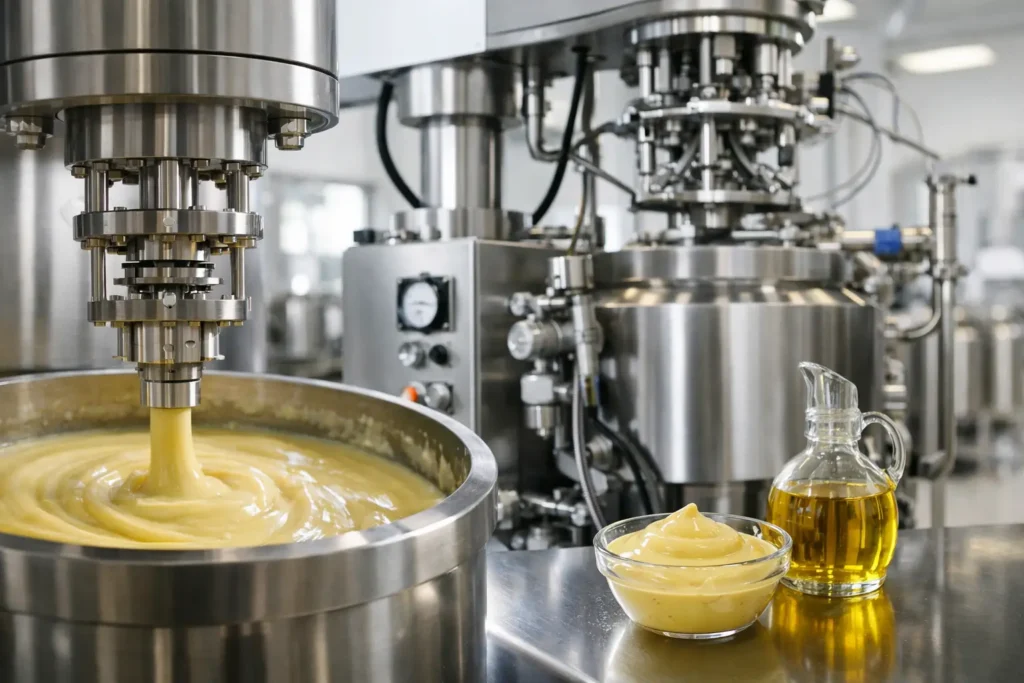
For commercial mayonnaise and dressing production, an in-vessel bottom-entry homogenizer is often an efficient choice because it processes product where circulation and emulsification are most critical. In some applications, an inline homogenizer may be added for recirculation, finishing, or more demanding particle-size control. The best configuration depends on formula sensitivity, batch volume, and required throughput.
Vacuum capability has a direct effect on product quality and operating efficiency. During sauce production, vacuum helps remove entrained air introduced through powder addition, agitation, and oil incorporation. Less air means a denser appearance, more accurate filling by weight or volume, improved color, and better stability during storage.
Vacuum also supports powder incorporation. When dry ingredients are drawn into the batch under controlled conditions, they can wet out faster and with fewer floating agglomerates. This is particularly relevant for modified starches, gums, milk powders, proteins, spices, and other ingredients that tend to form fisheyes or stubborn lumps.
The selection question is not simply whether a vessel has vacuum. Evaluate the achievable vacuum level, vacuum pump capacity, vessel sealing, condensate handling, and the system’s ability to maintain vacuum during ingredient addition. A poorly integrated vacuum system may remove some air after mixing but offer limited benefit during the actual dispersion stage.
Many sauce operations lose time at the ingredient-addition step. Operators manually add powders through an open manway, wait for lumps to break down, and increase mixing time in an attempt to recover uniformity. This approach can create dust, increase labor exposure, and make batch results dependent on operator technique.
A powder induction system improves control by drawing dry ingredients into the liquid phase under vacuum. The powder can be introduced at a controlled rate while high shear disperses it immediately. For difficult starches and hydrocolloids, this can reduce lumping, shorten processing time, and improve repeatability from one batch to the next.
Not every product needs the same induction arrangement. Free-flowing salt and sugar behave differently from fine gums or starch blends. If the facility runs multiple formulas, specify the powders by bulk density, particle behavior, addition quantity, and required feed rate. This prevents a system from being designed around easy ingredients while the most problematic ingredient remains a manual operation.
Equipment capacity should reflect usable working volume, not only total vessel volume. A vessel needs headspace for agitation, vacuum operation, foam control, and safe ingredient charging. Selecting a tank based on nominal volume alone can leave too little room for practical processing.
Consider the full production schedule as well. A 1,000-gallon batch vessel may appear sufficient, but its value depends on total cycle time: loading, heating or cooling, mixing, emulsification, vacuum deaeration, transfer, cleaning, and changeover. If the process requires multiple daily batches, the limiting factor may be cleaning time or transfer speed rather than vessel size.
Scale-up should also preserve the process conditions that made the product successful at smaller volume. Similar tip speed, power input, circulation pattern, shear exposure, and ingredient addition timing all matter. Simply increasing batch size without maintaining these relationships is a common cause of emulsion instability during commercialization.
Sauce equipment must be designed for the reality of food production, not just for a successful test batch. Product-contact surfaces should be smooth and drainable, with sanitary fittings, suitable seals, and access points that support reliable inspection and maintenance.
For frequent production, a clean-in-place configuration can improve consistency and reduce downtime. The vessel, homogenizer, powder induction line, transfer piping, valves, and ancillary components must all be considered. A CIP-ready main tank offers limited benefit if a difficult-to-clean powder line or dead-leg valve becomes the contamination risk.
Ask how the system handles allergen changeovers, acidic formulations, abrasive spice blends, and viscous product residues. Material selection, surface finish, gasket compatibility, and drainability affect long-term uptime as much as the mixer itself.
The most effective production systems turn critical recipe steps into controlled, repeatable actions. Variable-speed drives, temperature monitoring, load cells, vacuum measurement, timed oil addition, and recipe management reduce reliance on manual judgment.
Automation does not need to be excessive to deliver value. A regional producer may need dependable speed control and batch records, while a larger plant may require recipe automation, ingredient dosing, integrated CIP sequences, and plant-wide data collection. The right level depends on labor availability, product risk, audit requirements, and expected growth.
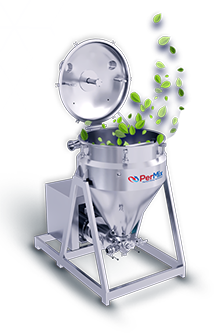
PerMix designs vacuum emulsifying mixer systems around these real production requirements, combining high-shear emulsification, vacuum processing, powder induction, and vessel agitation in application-specific configurations.
The lowest equipment price can become the highest operating cost if the system produces long cycles, unstable texture, excessive rework, or difficult cleaning. Conversely, a highly specified system is not automatically the right investment if its capacity and automation exceed the plant’s actual needs.
A sound selection process compares the expected product quality, batch time, labor demand, yield, cleaning burden, maintenance access, and expansion potential. Run representative formulations whenever possible, including the hardest formula in the portfolio rather than only a standard mayonnaise.
The equipment should make difficult sauces easier to manufacture at scale. When the mixer, vacuum, powder handling, and controls are selected as one process system, operators spend less time correcting batches and more time producing sauces customers reorder.

Get in touch with us today and learn how to we can help your business.