PerMix Mayonnaise Production
PerMix News
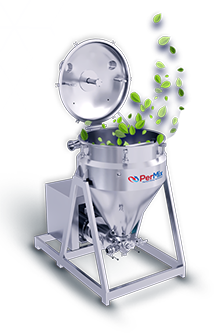

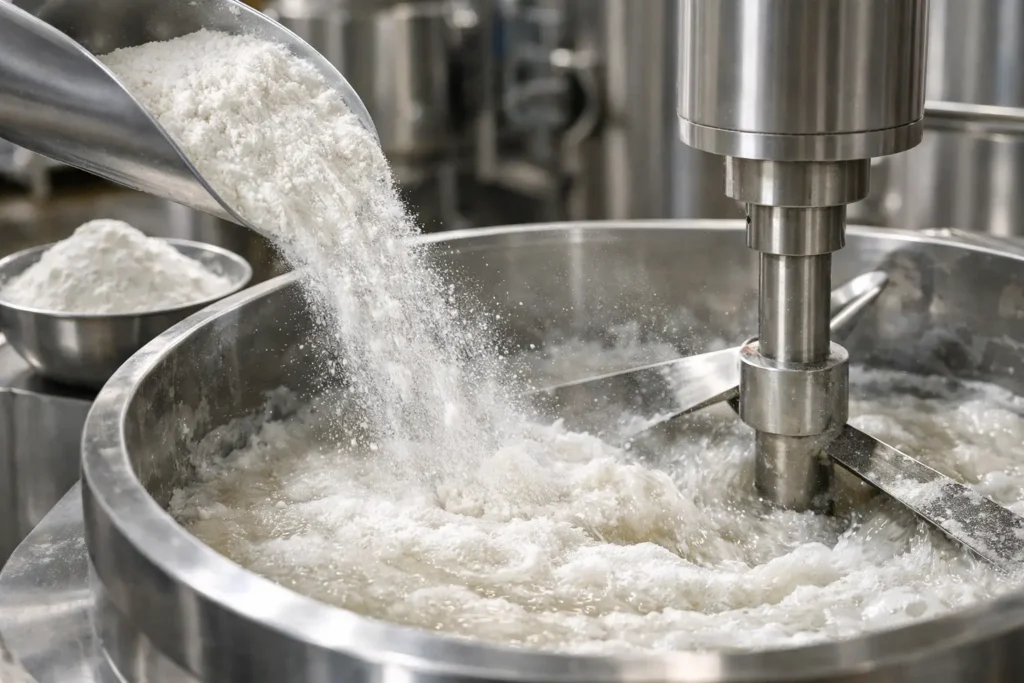
Anyone who has tried to pull starch, gum, protein, or seasoning powders into a liquid phase at production scale knows the problem shows up fast. Lumps form on contact, powders float on the surface, and what should be a controlled process turns into wasted time, inconsistent texture, and rework. If you are asking how to disperse dry powders more effectively, the answer starts with understanding wet-out, shear, batch sequence, and the right powder induction method for the product.
Dry powder dispersion is not just a mixing issue. It is a process issue tied to ingredient behavior, viscosity build, and equipment design. Many food powders hydrate instantly at the surface when they contact water or another liquid phase. That fast hydration creates fish eyes or agglomerates – dry material trapped inside a gelled outer layer. Once that happens, additional mixing may not fully recover the batch.
In mayonnaise, dressings, sauces, and similar systems, the risk increases because the formula often contains hydrocolloids, modified starches, milk powders, proteins, sugar, salt, and acidulants that all behave differently during incorporation. Some need rapid wetting. Others need controlled addition to prevent viscosity spikes. A process that works for one formulation may fail when you move to low-fat or vegan variants.
That is why dry powder dispersion should be treated as a critical control point, not a minor step in the mix cycle.
The core objective is simple: expose every particle to liquid quickly and uniformly before the powder can agglomerate. In practice, that means controlling how powder enters the batch, how fast it wets out, and how much localized shear is available at the moment of addition.
A basic top-entry agitator can move liquid in the tank, but it often does not create enough localized energy where the powder is added. Powders may raft on the surface, stick to vessel walls, or form partially hydrated masses that circulate without fully dispersing. Operators often respond by increasing mix time, but longer batch time is not the same as better dispersion.
A stronger approach is to combine controlled powder induction with high-shear mixing under conditions that pull powders directly into the liquid stream. This reduces airborne dust, improves wet-out, and shortens the time required to reach a uniform premix.
Poor wet-out is the first failure point. If the powder is not wetted immediately, no amount of downstream processing will deliver a fully consistent result. Powders with fine particle size, low bulk density, or strong water affinity are especially difficult. Starches and gums are common examples.
The best results come when the system creates a strong vacuum or suction effect at the powder entry point and disperses the material into a fast-moving liquid zone. This minimizes floating and gives the powder less opportunity to clump on the surface.
More shear is not always better. It depends on the ingredient and the product target. Hydrocolloids may require high initial shear for dispersion, while delicate emulsified systems may need controlled shear to avoid overprocessing. Protein systems can also be sensitive, especially where foaming is a concern.
For most condiment and sauce applications, the process window is built around enough shear to break agglomerates and achieve full hydration without damaging the final structure. That balance matters in commercial production because a batch that looks acceptable in the tank may still fail on texture, viscosity, or stability later.
When manufacturers struggle with powder incorporation, the root cause is often the equipment layout rather than the formulation itself. Vessel geometry, impeller design, powder feed location, recirculation rate, and vacuum capability all affect the outcome.
A properly engineered vacuum emulsifying mixer gives dry powders a major advantage during incorporation. Instead of relying on operators to add powders manually into an open vortex, the system can induct powders directly into the liquid under vacuum and expose them to immediate shear. This improves batch cleanliness and repeatability while reducing operator dependency.
For mayonnaise and dressing lines, this is especially important because dry ingredient dispersion is tied directly to emulsion quality. If stabilizers, starches, or proteins are not dispersed correctly before or during oil addition, the finished product can show poor body, weak suspension, or unstable texture.
Open tank mixing may be acceptable for simpler, low-viscosity products or small trial batches. It is usually less effective for difficult powders, high-viscosity formulations, or production environments where consistency matters batch after batch.
Vacuum powder induction offers practical advantages. It reduces dust, improves sanitation, shortens incorporation time, and gives tighter control over ingredient addition. It also supports more reliable scale-up from pilot to full production because the powder entry conditions are more consistent.
That is one reason process-focused manufacturers choose systems built around vacuum emulsification and powder induction rather than treating dry ingredient handling as an afterthought.
The sequence of addition has a direct effect on dispersion. Even with capable equipment, poor sequencing can create avoidable problems.
Start by preparing the liquid phase at the right temperature and circulation condition for the target ingredient. Some powders disperse more easily at elevated temperature, while others hydrate too quickly and need tighter control. If a formula contains multiple powders, do not assume they should all be added together. A gum, starch, salt, and protein blend may still require staged addition depending on hydration behavior.
Feed rate matters just as much as sequence. Dumping powder too quickly can overwhelm the wetting zone and create persistent agglomerates. A controlled feed rate allows the system to keep pace with dispersion. This is one of the clearest differences between a stable process and an operator-dependent one.
Pre-blending can also help, but only in the right context. Dry blending difficult powders with sugar or other free-flowing ingredients sometimes improves feed uniformity and reduces clumping. It will not solve a weak induction point or poor mixer design.
In mayonnaise and dressing production, modified starches and gums often cause the most visible issues. They hydrate rapidly, drive viscosity early, and can trap undispersed solids if introduced poorly. Vegan formulas add another layer of complexity because proteins and alternative stabilizer systems often behave differently from egg-based formulations.
Low-fat and fat-free products can be even less forgiving. These formulas depend heavily on precise hydration and dispersion to build body and mimic the mouthfeel of full-fat systems. When powder incorporation is inconsistent, the finished product usually shows it immediately.
A batch is not well dispersed just because visible lumps are gone. The better test is whether the process delivers repeatable product performance. Look at hydration time, final viscosity, texture uniformity, hold stability, and whether the batch reaches specification without extended mixing or rework.
Also pay attention to throughput. If operators need to slow additions, scrape vessel walls, or extend mixing cycles every time a certain powder is used, the process is carrying hidden cost. Labor rises, batch time grows, and line capacity drops.
A better dispersion process usually shows up in measurable ways: faster incorporation, lower reject rates, cleaner transfer, more consistent viscosity, and improved emulsion stability. Those are operational gains, not just mixing improvements.
Operators can compensate for a weak system only up to a point. If your team routinely battles floating powders, fish eyes, long hydration times, or inconsistent batches, the issue is probably built into the process design. That includes mixer type, powder induction method, and whether the system was sized for the actual viscosity and ingredient load of the product.
For manufacturers producing mayonnaise, sauces, and dressings at scale, powder handling should be engineered around the formulation, not improvised around the tank. PerMix addresses this with vacuum emulsifying and powder induction solutions designed for faster wet-out, controlled dispersion, and consistent commercial output.
The right approach to dry powder dispersion is not about forcing difficult ingredients into the batch and hoping shear fixes the problem later. It is about creating the right conditions at the exact moment powder meets liquid. Get that step right, and the rest of the process gets easier, faster, and more predictable.

Get in touch with us today and learn how to we can help your business.