PerMix Mayonnaise Production
PerMix News

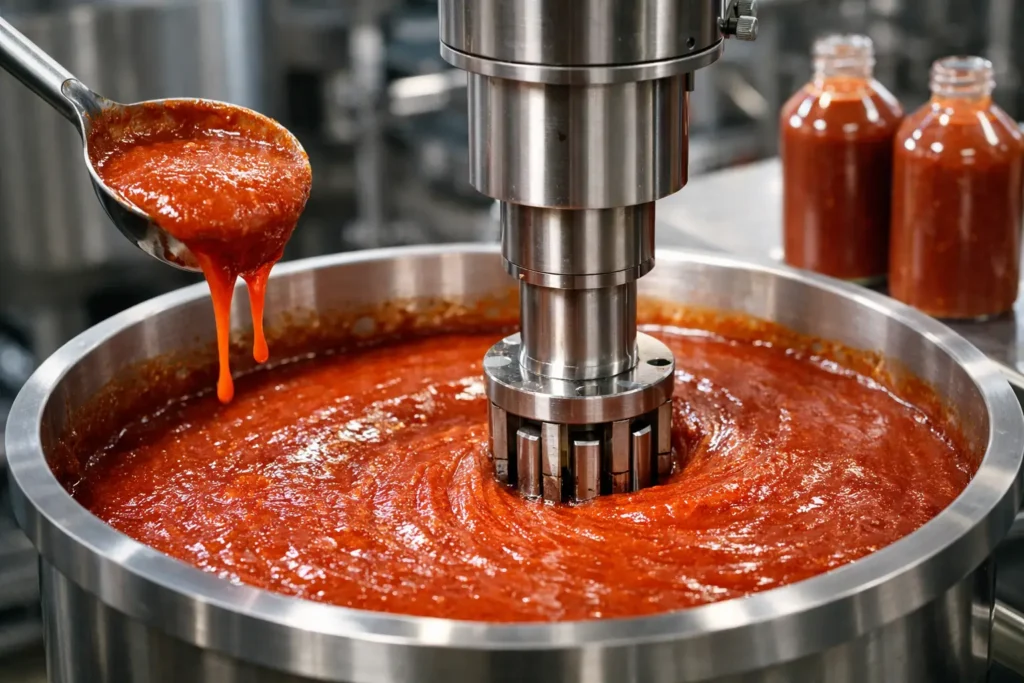
A sauce can look finished at the mixer and still fail on the filling line or after several weeks in storage. High viscosity sauce homogenization is the process step that determines whether oil droplets, hydrated gums, starches, and fine solids remain uniformly distributed in a product that is difficult to move. For commercial mayonnaise, ketchup, cheese sauces, dressings, and vegan emulsions, that difference directly affects texture, shelf stability, yield, and customer acceptance.
A conventional agitator can circulate a thick batch, but circulation is not the same as homogenization. As viscosity rises, the product resists flow, dead zones become more likely, and ingredients may pass through the vessel without receiving enough shear. The processing system must create controlled shear where it matters while keeping the entire batch moving through that high-energy zone.
Low-viscosity products can often be mixed effectively with moderate agitation because liquid flow carries ingredients throughout the tank. A thick sauce behaves differently. Its movement can become laminar rather than turbulent, so layers of product slide past one another instead of folding and dispersing. An impeller may form a visible vortex while material near the tank wall or bottom remains underprocessed.
This is especially critical when the formula contains oil, egg yolk or egg replacers, modified starch, xanthan gum, pectin, tomato solids, protein systems, or fine seasonings. Each ingredient has its own hydration, wetting, and dispersion requirement. If powders enter too quickly or meet insufficient shear, they can form fish eyes and dry centers that do not disappear later in the batch. If oil is added before the aqueous phase has developed the right structure, the emulsion may be weak even when the sauce initially appears smooth.
Homogenization must therefore be evaluated as a complete process, not as a single machine speed. Product viscosity, batch volume, ingredient order, temperature, vacuum level, recirculation path, and rotor-stator geometry all influence the result.
A stable high-viscosity sauce requires two things at the same time: macro-mixing to eliminate stagnant regions and high shear to reduce droplet size, break agglomerates, and fully disperse functional ingredients. Equipment that provides only one of these functions often creates a production compromise.
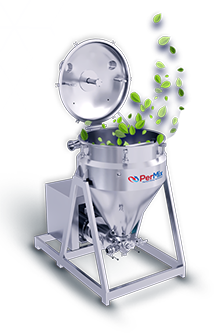
A properly designed vacuum emulsifying mixer combines an anchor or sweep agitator with a high-shear homogenizer. The anchor moves thick material from the vessel wall toward the active mixing zone and improves heat transfer at the jacket. The homogenizer applies intense mechanical shear where the product passes through the rotor-stator assembly. Together, these actions support a uniform batch rather than treating only a small portion of it.
For mayonnaise and oil-in-water dressings, smaller and more uniform oil droplets generally improve emulsion stability and give the product a cleaner, more consistent body. But more shear is not automatically better. Excessive processing can change the rheology of certain hydrocolloid systems, add unnecessary heat, or damage delicate inclusions.
The target is the shear level that produces the specified texture and stability without overworking the formulation. A high-fat mayonnaise may need a different processing window than a low-fat or egg-free mayonnaise, where stabilizers and starches carry more of the structural load. This is why equipment sizing should begin with the formulation, not only the planned batch volume.
Vacuum processing is particularly valuable for viscous sauces because entrained air is difficult to remove once the batch has thickened. Air can create a lighter appearance, inaccurate fill weights, foaming during transfer, oxidation risk, and an unstable texture. Under vacuum, powder induction and emulsification can be managed with less air incorporation, while the finished product can be deaerated before discharge.
Vacuum also assists with handling certain powders that otherwise float, bridge, or disperse poorly. It is not a substitute for correct powder addition and shear, but it gives the operator more control over a difficult stage of the batch.
Most homogenization problems are visible long before the product reaches the customer. Operators may see undispersed powder particles, an emulsion that thins after processing, inconsistent color, or a batch that requires extended mixing time to approach the target texture. These symptoms are often blamed on the recipe when the actual cause is a mismatch between process conditions and equipment capability.
One common issue is adding dry ingredients directly into a thickening batch without an effective induction method. Surface-added powders can hydrate on contact and create lumps before they are drawn into the high-shear zone. A powder induction system pulls ingredients into the liquid under controlled conditions, improving wet-out and reducing operator exposure to airborne dust.
Another issue is relying on a recirculation loop that is too small, too restrictive, or poorly positioned for the viscosity being processed. External homogenization can be effective for some applications, particularly when the product has enough mobility to circulate consistently. For very thick sauces, however, the system must maintain real flow through the loop. If the batch is not moving through the homogenizer at a predictable rate, processing time becomes difficult to control and batch uniformity suffers.
Temperature is equally important. Starch hydration, oil viscosity, emulsifier performance, and gum dispersion all change with temperature. Processing too cold can make the product difficult to circulate and homogenize. Processing too hot can alter flavor, stress sensitive ingredients, or produce a final viscosity that does not match the cooled product. The correct temperature profile depends on the formula and should be validated through pilot trials.
A large vessel with a powerful motor is not necessarily the right answer. The most useful specification starts with what the sauce must do after it leaves the mixer: hold its emulsion, meet a viscosity range, pump and fill reliably, retain its appearance, and remain stable through its intended shelf life.
Process engineers should define at least these operating conditions before selecting a system:
Those inputs determine the vessel geometry, agitator design, homogenizer type, motor power, jacket capacity, and whether powder induction or a recirculation loop should be included. They also help prevent oversizing. Excess capacity can increase capital cost and complicate small-batch performance, while undersizing creates slow cycles, inconsistent batches, and avoidable rework.
A formula that performs well in a pilot mixer may behave differently at production scale. The ratio of vessel diameter to liquid height changes, heat transfer changes, and the time required to move the full batch through the homogenization zone may increase significantly. Simply matching RPM is not a valid scale-up strategy because tip speed, energy density, flow pattern, and product residence time all matter.
A sound scale-up plan uses pilot data to establish a repeatable processing sequence. That sequence should define when water is charged, when powders are inducted, how long the aqueous phase is hydrated, when oil is introduced, when vacuum is applied, and how long the batch receives high shear. It should also record product temperature and viscosity at meaningful process points. This gives production teams a process window rather than a collection of operator habits.
For manufacturers expanding into low-fat, fat-free, or vegan sauces, this discipline becomes even more valuable. These formulas can be less forgiving than conventional full-fat mayonnaise. They often depend on multiple stabilizers, starches, proteins, or plant-based emulsifiers that need precise hydration and shear. The right mixer processor supports that precision without turning a complicated formula into an unnecessarily long production cycle.
Before approving a homogenization system, run representative trials using the actual formulation or the closest available version. Observe more than the appearance of the product immediately after mixing. Measure viscosity after cooling, check for air release, inspect the sauce for undispersed particles, evaluate pumpability, and retain samples for stability testing.
Ask whether the system can process both the current product and the next product line under consideration. A plant making standard mayonnaise today may introduce reduced-fat mayonnaise, chipotle dressing, or a vegan sandwich spread tomorrow. Flexibility has commercial value when it does not compromise the performance of the core product.
PerMix designs vacuum emulsifying and universal vacuum mixer processing systems around these real production conditions, including high-shear emulsification, powder handling, heating and cooling, and batch-scale requirements. The objective is not simply to mix a thick sauce. It is to deliver a repeatable process that supports dependable quality from the first commercial batch through daily production.
The best next step is to put the finished product specification beside the actual production sequence. When viscosity, ingredient behavior, thermal demands, and throughput are defined together, the right homogenization system becomes a measurable production decision rather than a guess based on tank size.

Get in touch with us today and learn how to we can help your business.