PerMix Mayonnaise Production
PerMix News

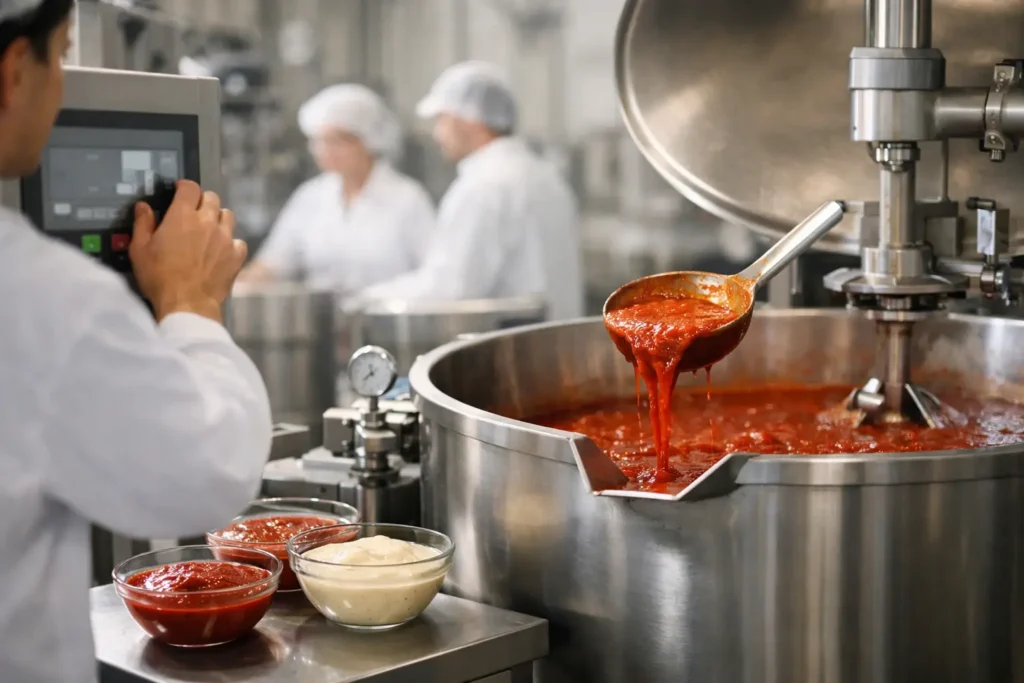
A sauce that performs perfectly in a 50-gallon pilot batch can fail when moved to 500 gallons, even when every ingredient is multiplied exactly. Learning how to scale sauce batches means scaling the process, not just the formula. Shear exposure, ingredient addition rate, heat transfer, vacuum level, and hold time all change as vessel size changes.
For mayonnaise, dressings, ketchup, cheese sauces, and other viscous products, the cost of getting this wrong is high: unstable emulsions, visible powder specks, inconsistent viscosity, long batch times, excessive rework, and lost yield. A controlled scale-up plan protects product quality while giving operations a repeatable path to higher throughput.
A formula sheet tells the production team what goes into the batch. It does not fully define how the batch must be made. Before increasing volume, identify the process conditions that have the greatest effect on the finished sauce.
For emulsified sauces, oil droplet size, phase addition sequence, rotor-stator shear, temperature, and vacuum performance are typically critical. In starch-thickened sauces, powder wet-out, hydration temperature, mixing energy, and residence time can matter even more. A vegan mayonnaise may require a different shear window and hydration profile than an egg-based formula, despite having a similar finished viscosity.
Document the successful pilot or current production process in operational terms. Record actual batch weight, vessel working volume, agitator and homogenizer speeds, processing time, product temperature at each stage, vacuum level, powder addition time, and final viscosity. Also capture observations that are not always present in a batch record, such as whether the emulsion visibly thickens during oil addition or whether powders require manual scraping at the vessel wall.
These details establish the baseline. Without them, scale-up becomes a trial-and-error exercise that can consume raw materials and production capacity.
One of the most common scale-up errors is copying agitator or homogenizer RPM from a small tank to a larger one. The same RPM does not create the same tip speed, flow pattern, or shear rate in a larger vessel. It may also produce insufficient turnover in the outer zone of the tank, leaving material poorly circulated even while the area near the mixer receives excessive energy.
The correct target depends on the product and mixer design. For a high-shear emulsification step, tip speed and the number of passes through the high-shear zone are often more useful than RPM alone. For bulk movement, the key question is whether the agitator is moving the entire vessel contents efficiently without air entrainment or dead zones.
A large sauce batch needs both functions. The system must circulate the product through the vessel, then expose it to controlled high shear where emulsification or dispersion occurs. If high shear is applied without sufficient bulk turnover, the mixer can overprocess a portion of the batch while other areas remain underprocessed.
This is why vessel geometry, impeller design, baffles, and the placement of the homogenizer matter. Equipment selection should be based on product rheology and the actual working volume, not nameplate capacity alone.
Adding 2,000 pounds of oil or 500 pounds of modified starch is not simply a larger version of adding 200 pounds or 50 pounds. The rate at which ingredients enter the batch changes local concentration and can determine whether a sauce remains smooth and stable.
During mayonnaise production, oil must be introduced at a rate the aqueous phase and emulsification system can accommodate. Add it too quickly, and the emulsion may become overloaded, creating large droplets, texture variation, or a complete break. Add it too slowly, and production time rises without necessarily improving quality.
Powders present a separate challenge. Starches, gums, proteins, salt, sugar, and seasoning blends can form fish eyes or agglomerates when they contact liquid without immediate wetting and dispersion. At larger scale, manual bag dumping usually becomes slower, less sanitary, and less consistent. It also increases the chance that operators will add material faster than the process can absorb it.
A properly designed powder induction system draws dry ingredients into the liquid under controlled conditions, improving dispersion while reducing dust and operator handling. For difficult dry starches and gum systems, this is often the difference between a predictable batch and recurring quality deviations.
Heating and cooling are frequently underestimated during sauce scale-up. A pilot vessel may reach target temperature quickly because of a high jacket-to-product ratio. A larger vessel has proportionally less heat-transfer surface relative to batch volume, so ramp times can increase significantly.
That difference affects more than production scheduling. Starch hydration, protein functionality, preservative distribution, flavor retention, and final viscosity can all shift when the heating curve changes. A sauce held at elevated temperature longer than intended may thicken beyond specification or lose fresh flavor notes. Rapid cooling can also create different viscosity behavior than gradual cooling, particularly in starch-based or fat-containing systems.
Set temperature targets for each stage, but also specify the acceptable heating rate, hold time, and cooling rate. Confirm product temperature with a validated sensor in the batch, not only through jacket temperature or utility readings. The process must be controlled at the product level.
Vacuum mixing supports more than cosmetic deaeration. In viscous sauces, vacuum can help remove entrained air, improve product density, reduce oxidation exposure, and support a cleaner finished appearance. It can also improve powder incorporation when the system is designed to draw ingredients into the batch under vacuum conditions.
However, vacuum must be managed carefully. Pulling excessive vacuum before adequate wetting or circulation can interfere with certain addition steps. Applying vacuum at the wrong point may increase foaming in products containing proteins, hydrocolloids, or surfactants. The best sequence depends on the formula and the equipment configuration.
For most operations, the practical approach is to define when vacuum begins, the target vacuum range, how long it is held, and whether the batch is under vacuum during high-shear processing, powder induction, cooling, or all three. These settings should be included in the standard operating procedure, not left to operator preference.
A successful batch is not one that merely looks acceptable at discharge. It must meet measurable specifications and remain stable through packaging, distribution, and shelf life. Before the first production-scale run, establish acceptance criteria for viscosity, pH, density, color, particle size where applicable, emulsion stability, and sensory attributes.
For mayonnaise and dressings, evaluate emulsion stability under storage and temperature stress. For ketchup and other tomato-based sauces, monitor viscosity development, serum separation, and consistency after filling. For cheese sauces or starch-thickened products, check for grit, gel formation, and viscosity drift after heating and cooling.
Run the first larger batch as a controlled validation trial. Keep raw material lots, process settings, samples, and observations traceable. If the product misses specification, identify whether the deviation came from formula tolerance, addition sequence, mixing energy, thermal history, or equipment limitations. Changing several variables at once makes the root cause difficult to isolate.
A larger tank does not automatically deliver proportionally more output. The usable working volume must allow headspace for agitation, vacuum operation, foaming potential, and ingredient additions. Filling a vessel too close to its maximum capacity can reduce circulation quality and create spill or foam-control risks.
Cycle time is equally important. A production plan should include loading, powder addition, mixing, heating, cooling, vacuum hold, quality checks, discharge, cleaning, and changeover. A vessel that can process 1,000 gallons but requires an extended cooling cycle may not provide the daily output expected from its nominal capacity.
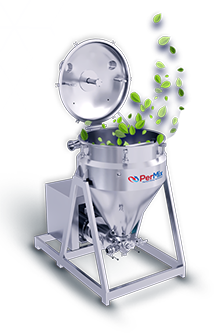
This is where engineered system design creates commercial value. PerMix vacuum emulsifying systems are specified around the actual sauce, batch target, viscosity range, and process sequence so manufacturers can improve throughput without trading away stability or texture.
The most reliable production teams do not rely on one fixed setting for every condition. They establish acceptable operating windows. Instead of stating that a homogenizer must run at one exact speed, define the validated speed range, temperature range, oil addition time, vacuum range, and endpoint criteria that consistently produce in-spec product.
That flexibility matters when raw-material behavior changes. Oil temperature, starch lot variation, egg replacement systems, ambient conditions, and solids content can all affect batch response. A documented operating window gives trained operators room to correct normal variation without drifting into uncontrolled processing.
Scale-up should make the operation easier to control, not more dependent on individual operator judgment. When the process, equipment, and validation plan are aligned, larger sauce batches become a repeatable manufacturing advantage: consistent product at the volume your market requires.

Get in touch with us today and learn how to we can help your business.