PerMix Mayonnaise Production
PerMix News
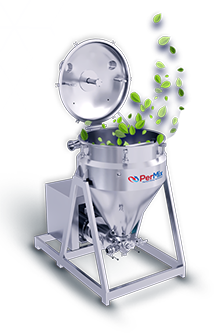

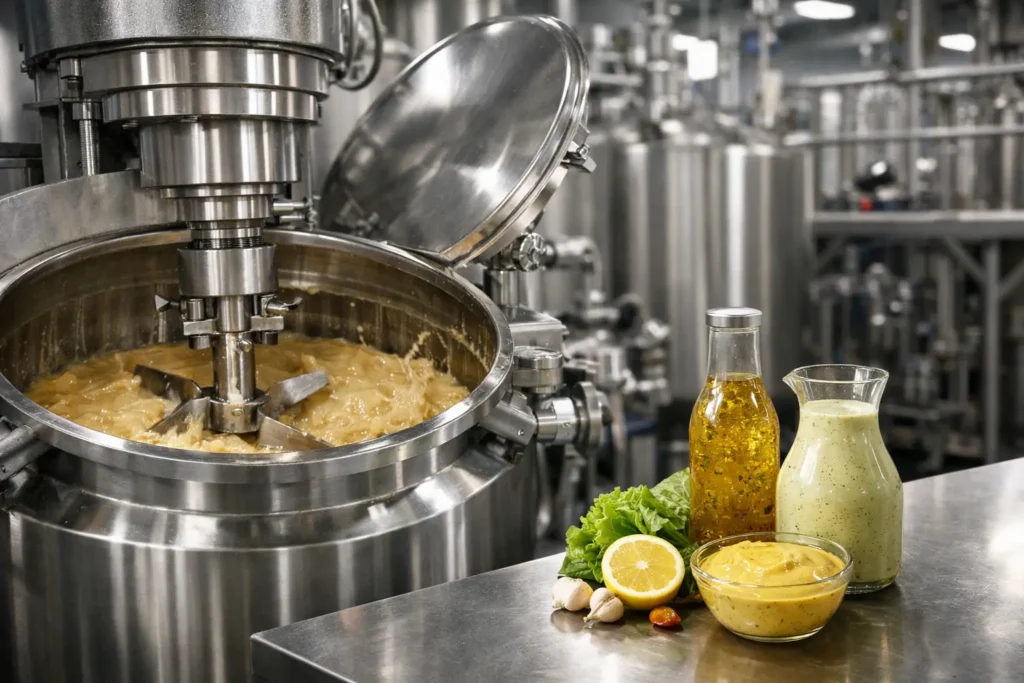
A dressing line usually starts showing its weak points before the lab formula does. The texture drifts from batch to batch. Oil separation appears too early. Powders fisheye instead of dispersing. Changeovers take too long. If you are evaluating the best mixer for dressings, the real question is not which machine can spin product. It is which system can produce a stable emulsion, handle difficult ingredients, and hold performance as volume increases.
For commercial dressing production, the best choice is usually not a simple agitator or a general-purpose tank mixer. Most manufacturers need a system built for emulsification, powder incorporation, vacuum processing, and repeatable shear control. That matters even more when the product range includes low-fat, fat-free, or vegan dressings, where formulation margins are tighter and instability shows up faster.
At production scale, dressings are not all mixed the same way. A thin vinaigrette has very different processing demands than a creamy ranch, Caesar, or plant-based emulsified dressing. Even within one category, ingredient behavior changes the process. Starches hydrate differently. Proteins can agglomerate. Hydrocolloids can clump. Oil phase addition rate affects droplet size and final stability.
That is why the best mixer for dressings is defined less by horsepower alone and more by process capability. A suitable system must create controlled shear, pull ingredients into the batch efficiently, limit air entrainment, and support a sanitary operation. If the mixer cannot do those jobs consistently, the result is usually rework, extended batch time, or a product that fails shelf-life expectations.
A strong dressing mixer should handle four core demands well. First, it must disperse powders quickly without building lumps. Second, it must emulsify oil and water phases into a stable, uniform structure. Third, it must maintain batch consistency from pilot to full-scale production. Fourth, it must support cleaning, changeover, and uptime requirements in a real manufacturing environment.
A basic top-entry agitator can work for light blending, but many dressing manufacturers outgrow that approach quickly. Standard agitation is often enough to circulate liquid, yet not enough to solve dispersion and emulsion challenges. Powders may sit on the surface, wet out unevenly, or form fisheyes. Oil can be mixed in, but not reduced into a stable droplet distribution. Air may be pulled into the batch, creating foam and affecting fill accuracy or oxidation.
These limitations become more expensive when formulas are more demanding. Low-fat and fat-free dressings often rely on starches, gums, and proteins to replace the mouthfeel and body that oil would normally provide. Vegan dressings introduce additional sensitivity because the emulsification system changes when egg is removed. In these cases, the mixer must do more than blend. It must manage structure.
That is where high-shear vacuum emulsifying systems have a clear advantage. They combine circulation, rotor-stator shear, and vacuum conditions to improve dispersion and emulsion quality while reducing entrained air. For many manufacturers, that shift improves both product quality and production efficiency.
Vacuum is not a luxury feature for emulsified dressings. In many applications, it is a process advantage with direct commercial value. When mixing under vacuum, the system reduces air incorporation during high-shear processing. That helps produce a smoother texture, more accurate density, and a cleaner finished appearance.
Vacuum also improves powder wet-out. Instead of floating on a foamy surface or requiring long mixing times to incorporate, powders can be drawn into the liquid phase more effectively. For dressings with starches, stabilizers, seasoning blends, or proteins, this can shorten batch time and reduce operator intervention.
There is also a quality benefit after the batch is complete. Less entrained air can mean better emulsion stability and more predictable filling behavior. If your current process struggles with foam, inconsistent viscosity readings, or post-mix deaeration delays, the mixer selection is likely part of the problem.
One of the most common production bottlenecks in dressing manufacturing is powder handling. Dry ingredients are often where batch time is lost and product variability begins. Operators add powders too fast, clumps form, and the system needs extra shear or hold time to recover. In some cases, the batch never fully recovers.
A mixer with integrated powder induction changes that dynamic. Instead of relying on open-top manual addition and surface wetting, the system draws powders directly into a high-shear zone. This improves dispersion speed and reduces waste, dust, and lump formation. It also gives operators a more controlled and repeatable process.
For manufacturers scaling from small batches to commercial output, powder induction is often the difference between a process that looks acceptable in development and one that performs reliably on the plant floor. Dressings with modified starches, xanthan gum, milk powders, or plant proteins benefit especially from this design.
There is no single answer for every dressing plant, because product portfolio matters. If your line is focused on low-viscosity vinaigrettes with minimal solids, a simpler mixing system may be enough. But once you move into creamy emulsified dressings, especially across multiple SKUs, a vacuum emulsifying mixer becomes much more compelling.
If your products include ranch, Caesar, blue cheese-style dressings, sandwich sauces, or vegan emulsified dressings, a vacuum emulsifying mixer is usually the better fit. These products require controlled droplet size, stable texture, and consistent body. A rotor-stator homogenizing action helps achieve that result more reliably than basic agitation.
These applications typically need stronger powder dispersion and better process control. Formula stability depends heavily on hydrocolloid hydration, starch functionality, and proper incorporation of functional ingredients. A universal vacuum mixer processor or similar high-shear system is generally the right direction because it supports both structure development and consistency.
If the plant runs mayonnaise, dressings, ketchup, and related emulsified products, flexibility becomes a major buying factor. In that case, the best mixer is often the one designed around multiple formulation needs rather than a single product viscosity. Versatility matters, but only if it does not compromise performance on the most demanding products.
When comparing systems, it helps to look past brochure claims and ask process-specific questions. Shear level matters, but so does how that shear is delivered through the batch. Tank geometry matters because poor circulation creates dead zones. Batch size range matters because some systems perform well only when full.
Sanitary design should also be examined closely. Dressings often involve allergens, dairy components, spices, and sticky functional ingredients, so cleaning performance is not a side issue. A mixer should support efficient CIP or manual cleaning access, depending on plant setup, while minimizing crevices and hold-up areas.
You should also assess how the system handles scale-up. A machine that works for a 50-gallon pilot batch is not automatically the best mixer for dressings at 500 or 1,000 gallons. Shear profile, ingredient addition sequence, heating or cooling requirements, and discharge efficiency all become more important as output grows.
Commercially, reliability matters just as much as product quality. A lower-cost mixer can become the expensive option if it lengthens batch times, increases rejects, or limits future SKUs. Equipment should be sized for the operation you are building, not only the one you have today.
For most industrial and mid-scale food manufacturers, the best mixer for dressings is a vacuum emulsifying system with strong high-shear capability and effective powder induction. That combination addresses the most common causes of instability, inconsistency, and production inefficiency. It also gives processors a better platform for handling modern dressing formulations, where low-fat, clean-label, and plant-based demands continue to increase process complexity.
PerMix focuses on exactly this type of application-specific mixing challenge, especially where manufacturers need reliable emulsion quality, powder incorporation, and scalable production performance.
If you are selecting equipment, the right decision usually comes down to one practical test: can the mixer deliver the same texture, stability, and throughput on your most difficult formula, not just your easiest one? That is the standard worth buying against.

Get in touch with us today and learn how to we can help your business.