PerMix Mayonnaise Production
PerMix News

A mayonnaise batch that looks fine at startup can still fail 20 minutes later – or worse, after filling. For manufacturers, that is not a cosmetic issue. It means wasted oil, lost throughput, inconsistent texture, and an unstable product that will not hold up in distribution. If you are evaluating how to prevent mayonnaise breaking, the answer is rarely a single adjustment. In commercial production, emulsion stability depends on formulation, process sequence, shear profile, and equipment capability working together.
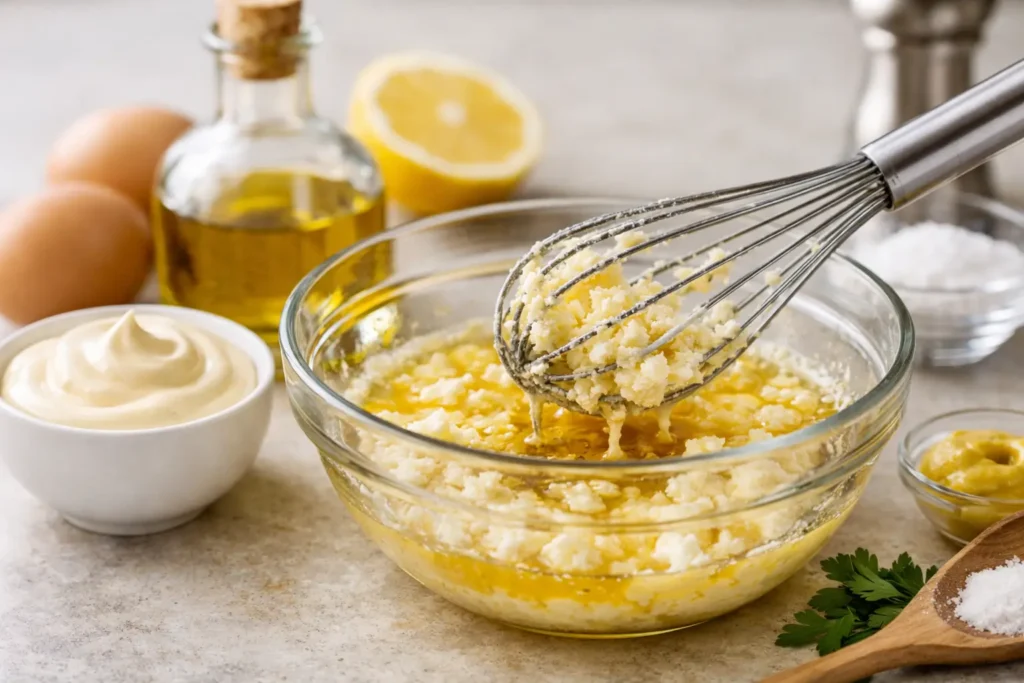
Mayonnaise breaks when the emulsion can no longer hold the oil phase in a stable dispersion. In practical terms, the droplets become too large, the emulsifier cannot cover new surface area fast enough, or the process introduces instability through poor ingredient incorporation, temperature drift, or incorrect shear. The result may appear as oiling off, thinning, graininess, or a complete collapse of structure.
At industrial scale, the root cause is often a mismatch between recipe behavior and processing conditions. A formula that performs adequately in a lab beaker may fail in a full production vessel if powder wet-out is incomplete, oil addition is too aggressive, or air is entrained during mixing. That is why stable mayonnaise is not just about ingredients. It is about controlled emulsification.
Egg yolk, modified starch, proteins, gums, and other stabilizers all contribute to emulsion strength, but they do not compensate for a weak process. If the continuous phase is not properly built before oil addition, the emulsion starts at a disadvantage. Water phase preparation matters because pH, salt, sugar, hydrocolloid hydration, and dry ingredient dispersion all influence viscosity and emulsifier performance.
This becomes even more critical in low-fat, fat-free, and vegan mayonnaise, where the system has less tolerance for process variation. These products often rely more heavily on hydrocolloids, starches, and plant-based emulsifiers. If those ingredients are not fully dispersed and hydrated, the batch may look acceptable initially but separate under storage or shear.
The first control point is ingredient order. In most commercial mayonnaise processes, the water phase should be fully prepared before meaningful oil incorporation begins. Acid, water-soluble ingredients, and functional powders need enough time and shear to disperse uniformly. Dumping powders too quickly or adding them into a poorly flowing vortex often creates fisheyes and undispersed pockets, which later weaken texture and stability.
Oil addition rate is the next major variable. If oil enters faster than the emulsifier system can stabilize the newly formed droplets, droplet size increases and the risk of breaking rises sharply. This is a common issue when scaling up from pilot to production. A feed rate that works in a small batch does not always translate to a larger vessel with different circulation patterns and residence times.
Shear level also has to be matched to the stage of the batch. Too little shear during droplet formation leads to coarse emulsions. Too much shear at the wrong point can damage structure, especially in formulations thickened with starches or sensitive hydrocolloids. The goal is not maximum shear at all times. The goal is controlled shear where and when it is needed.
Temperature should be treated the same way. Moderate, stable processing temperatures support hydration and flow, but excessive heat can reduce viscosity, alter ingredient functionality, and shift the balance of the emulsion. Cold processing is not automatically safer either. If viscosity becomes too high too early, ingredient dispersion and droplet formation can become inconsistent.
Manufacturers often focus on oil, emulsifier, and viscosity while overlooking aeration. Entrained air changes flow behavior, reduces effective mixing, and can accelerate oxidative issues. In mayonnaise, air also makes visual quality less consistent and complicates density control during filling.
Vacuum processing helps address this by limiting foam, improving ingredient incorporation, and supporting a more uniform emulsion structure. In high-viscosity systems, this is not a minor upgrade. It can be the difference between a repeatable batch and one that varies from shift to shift.
Dry starches, gums, proteins, and other functional powders are frequent sources of trouble. If they are not dispersed rapidly and completely, they form lumps that resist hydration. Those undispersed particles pull the process off target in two ways. First, they reduce effective thickening and stabilization. Second, operators may respond by increasing shear time, changing temperature, or making late-stage corrections that further stress the emulsion.
Powder induction technology is especially valuable here because it improves wet-out speed and consistency. In a well-designed system, powders are drawn in under controlled conditions and dispersed before they can agglomerate. That reduces batch-to-batch variability and shortens processing time while improving final stability.
This is particularly relevant for manufacturers producing multiple SKUs, including standard, low-fat, and vegan mayonnaise. The more formulation complexity in the plant, the more important it becomes to control powder handling and hydration instead of relying on operator judgment alone.
When teams ask how to prevent mayonnaise breaking, they often start with recipe troubleshooting. That is reasonable, but equipment design should be examined just as closely. Vessel geometry, rotor-stator configuration, vacuum capability, powder induction, and recirculation efficiency all affect droplet size distribution and ingredient dispersion.
A system built for general mixing may not provide the emulsification intensity needed for stable mayonnaise, especially at higher viscosities. Likewise, a mixer that creates strong top-surface agitation but weak bulk circulation can leave dead zones where ingredients remain partially dispersed. Those issues may not be obvious during processing, yet they show up later as separation, texture inconsistency, or shortened shelf life.
Vacuum emulsifying mixers are widely used for this reason. They combine controlled shear with deaeration and better product movement through the working head. For manufacturers pushing output, reducing labor dependence, and tightening quality control, that process consistency matters more than peak mixer speed on a specification sheet.
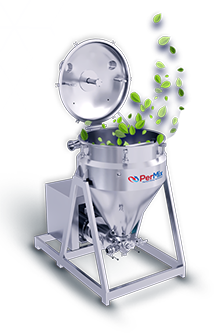
A specialized setup can also improve scale-up confidence. PerMix, for example, focuses on mayonnaise production systems that align emulsification performance with formulation demands, including difficult powder incorporation and high-viscosity processing under vacuum. For operations where a broken batch carries real commercial cost, that application-specific design approach is not optional. It is practical risk reduction.
If the same product breaks repeatedly, avoid treating it as a single-point failure. Review the full process window. Check whether powders are fully hydrated before oil addition, whether the oil feed rate changes between operators or shifts, and whether batch temperature rises during extended mixing. Look at the actual order of addition, not just the written SOP.
It also helps to compare pilot and production conditions beyond batch size. Tip speed, recirculation rate, vacuum level, and powder feeding method may all differ in ways that alter emulsion behavior. Many scale-up problems are not formulation problems at all. They are process translation problems.
If the issue appears late in the batch, the emulsion may be forming correctly but being overworked afterward. If it fails early, the continuous phase may not be ready when oil addition begins. If separation shows up after holding or filling, trapped air, incomplete hydration, or a coarse droplet distribution may be the real cause.
Even advanced equipment will not fully protect a weak operating method. Standardized timing, controlled ingredient staging, calibrated feed rates, and validated cleaning practices all support emulsion stability. Small deviations compound quickly in mayonnaise because the product depends on a narrow balance of viscosity, droplet size, and ingredient functionality.
That is why the strongest plants treat mayonnaise as a controlled process, not a simple blend. They define acceptable windows for temperature, shear exposure, vacuum, and addition rates, then build their operating procedures around those limits.
Preventing breakage starts long before a batch looks unstable. It starts with equipment that can disperse powders properly, form a fine emulsion consistently, control air, and scale predictably across products. It also starts with recognizing that mayonnaise stability is not one variable. It is the outcome of disciplined process design.
For food manufacturers under pressure to increase output while protecting product quality, the real objective is not just avoiding a broken batch. It is building a process that keeps stability, texture, and efficiency under control every time the vessel runs.
The most reliable mayonnaise lines are not the ones that rely on operator correction. They are the ones engineered to make instability less likely from the start.

Get in touch with us today and learn how to we can help your business.