PerMix Mayonnaise Production
PerMix News

A mayonnaise batch can look acceptable at the mixer and still fail on the filling line or after a few weeks in distribution. Entrained air, incomplete powder hydration, poor oil dispersion, and unstable texture often begin during mixing, not in packaging. Knowing when to use vacuum emulsification helps manufacturers prevent those problems before they become scrap, rework, or customer complaints.
Vacuum emulsification is not required for every sauce or dressing. It is a process choice for products where air removal, high-shear dispersion, controlled ingredient incorporation, and repeatable texture directly affect commercial performance. For mayonnaise, low-fat spreads, vegan emulsions, creamy dressings, ketchup, and starch-thickened sauces, it can make the difference between a workable formula and a stable, scalable product.
Use vacuum emulsification when the product contains an oil and water phase that must remain stable over its intended shelf life, especially when the formula also includes powders, gums, starches, proteins, or other difficult-to-disperse ingredients. The vacuum lowers the amount of air pulled into the batch while the emulsifying head applies the shear needed to reduce droplet size and distribute ingredients uniformly.
The strongest case for a vacuum system is not simply that a product is thick. It is that the product is sensitive to air, difficult to hydrate, prone to separation, or expected to maintain a highly consistent appearance and mouthfeel from batch to batch.
Traditional mayonnaise is a demanding oil-in-water emulsion. A large oil phase must be incorporated into an aqueous base while egg yolk, modified starch, stabilizers, salt, acid, and seasonings are dispersed correctly. If oil addition, shear, temperature, or air control is inconsistent, the emulsion can break or show oiling off later.
Vacuum emulsification is particularly valuable when manufacturers need a smooth, dense mayonnaise with controlled viscosity and minimal entrapped air. Removing air during processing can improve product appearance, reduce foaming, and support more accurate filling by limiting volume changes caused by bubbles. It also provides a more controlled environment for incorporating the oil phase under high shear.
For full-fat mayonnaise, this supports premium texture and visual consistency. For industrial producers running multiple batches per shift, it also supports repeatability. A recipe that works only when a highly experienced operator is present is not a reliable production process.
Lower-fat formulas frequently create greater processing difficulty than standard mayonnaise. When oil is reduced, the formula must replace some of the body, lubrication, and stability that oil normally provides. This often means more starch, hydrocolloids, protein systems, fiber, or combinations of functional powders.
Those ingredients can form fish eyes, lumps, or partially hydrated particles if they are added into a poorly controlled batch. Once a powder agglomerate forms, extra mixing time does not always correct it. Excessive processing can also damage the target texture or introduce more air.
Vacuum emulsification is a strong choice when developing low-fat, fat-free, or vegan mayonnaise because it combines powder handling capability with air removal and high shear. The process can help build a smoother matrix, improve dispersion, and reduce the variability that can make reduced-fat products appear weak, gummy, or unstable.
Creamy dressings and sauce systems often use emulsified oil, starches, gums, dairy alternatives, spices, particulates, and acidulants in the same batch. The right equipment must disperse functional ingredients without overworking delicate inclusions or creating a foam-heavy product.
Vacuum processing is often justified when a dressing needs a glossy appearance, uniform viscosity, clean flavor release, and stable texture through storage. It is also useful for ketchup and similar viscous sauces where powder incorporation and deaeration improve finished-product uniformity. However, products with large particulates require a process design that protects those particulates. High shear should be applied at the right stage, not indiscriminately from start to finish.
A vacuum emulsifying mixer does more than pull air from a tank. Its value comes from integrating vacuum conditions with circulation, high-speed emulsification, controlled addition, and efficient heat transfer. That combination addresses several production issues at once.
First, vacuum reduces entrained air. Air can cause foam, false volume, oxidation risk, inconsistent density, and an uneven surface after filling. In some products, it can also make viscosity readings less reliable because the sample contains bubbles rather than a fully consolidated product.
Second, vacuum supports more effective powder incorporation. When powders are pulled into the liquid phase through a suitable induction system, operators can reduce dusting, floating powders, and clumping. This is especially relevant for dry starches, xanthan gum, modified food starch, milk powders, plant proteins, and stabilizer blends.
Third, high-shear emulsification can produce finer droplets and a more uniform structure. Smaller, consistently distributed droplets generally support better emulsion stability, although the correct shear level depends on the formula. More shear is not automatically better. An optimized process applies enough energy to form and stabilize the emulsion without overheating the batch, damaging texture, or causing unnecessary wear.
Vacuum emulsification should be selected based on process need, not as a default specification. A conventional agitator may be sufficient for thin, water-based sauces with soluble ingredients, low sensitivity to air, and no demanding emulsion requirement. Simple brines, vinegar sauces, or products that do not depend on high-shear dispersion may not justify the investment in a vacuum process.
The same is true for formulas where air is intentionally incorporated or where a final texture depends on large, visible pieces. In those cases, vacuum may still play a role earlier in the process, but the complete system must be designed around the product’s final structure.
The question is not whether vacuum is a premium feature. The question is whether the absence of vacuum creates measurable operating costs through longer batch times, unstable product, difficult cleanup, rejected batches, or inconsistent fills.
Manufacturers should evaluate vacuum emulsification when recurring process symptoms appear. These symptoms commonly include foam during mixing or filling, oil separation after storage, variable viscosity between batches, visible powder specks, slow hydration, inconsistent color, or a product that changes texture after deaeration.
Scaling from a pilot mixer is another important signal. Small batches may tolerate manual powder additions and extended mixing. At commercial scale, the same approach can create large agglomerates, uneven shear zones, and inconsistent oil addition rates. A properly sized vacuum emulsifying system brings those variables under control.
Capacity requirements also matter. Batch volume alone is not enough for equipment sizing. Manufacturers should consider viscosity across the full recipe range, powder loading, oil percentage, heating and cooling needs, cleaning requirements, batch frequency, and future product plans. A system selected only for today’s standard mayonnaise may become a bottleneck when R&D introduces a vegan or reduced-fat line.
The best process begins with the formula and production target, then matches the equipment configuration to both. Ingredient order, powder induction method, rotor-stator shear level, oil feed rate, vacuum level, jacket performance, and discharge design all influence the result.
For example, starches may require precise hydration conditions before acid addition, while egg-based mayonnaise needs controlled emulsification as oil enters the aqueous phase. Vegan systems may require different shear and temperature management because plant proteins and hydrocolloids respond differently than egg yolk. There is no single mixer setting that produces every successful emulsion.
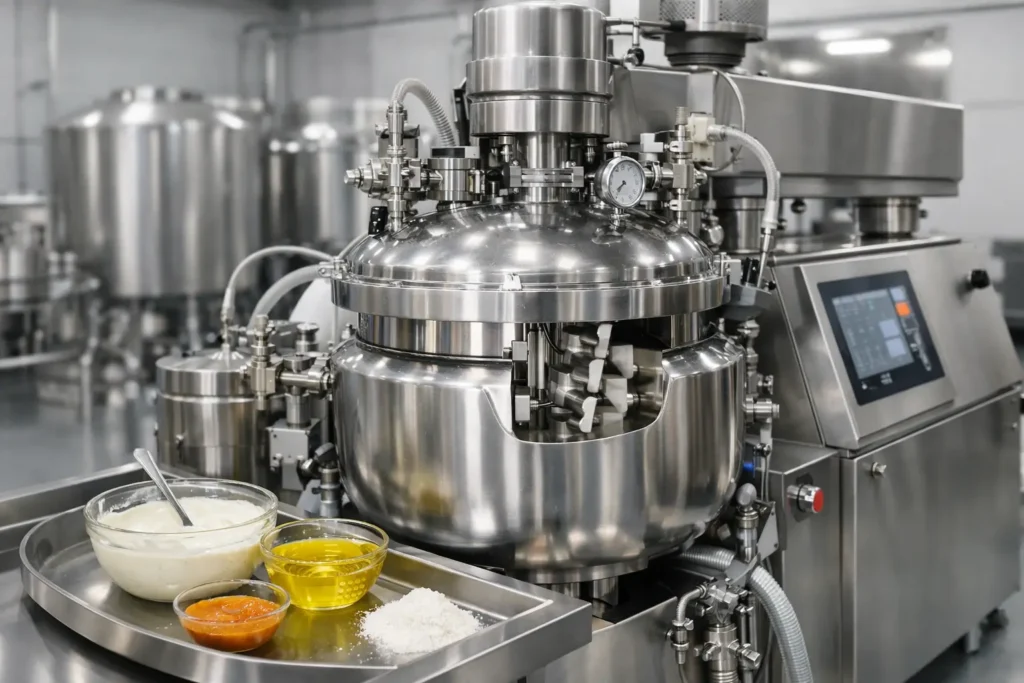
A purpose-built system such as the PerMix PVC Vacuum Emulsifying Mixer is designed for these realities: controlled vacuum processing, high-shear emulsification, efficient powder induction, and repeatable batch production for demanding condiment applications. The commercial benefit is straightforward – less uncertainty in the process and more confidence in every finished batch.
Choose vacuum emulsification when product quality depends on controlling the details that ordinary mixing leaves to chance. The right system should not merely mix ingredients; it should help your plant produce stable, consistent condiments at the speed and scale your market requires.

Get in touch with us today and learn how to we can help your business.