PerMix Mayonnaise Production
PerMix News
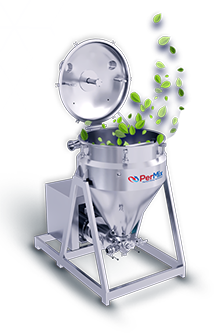

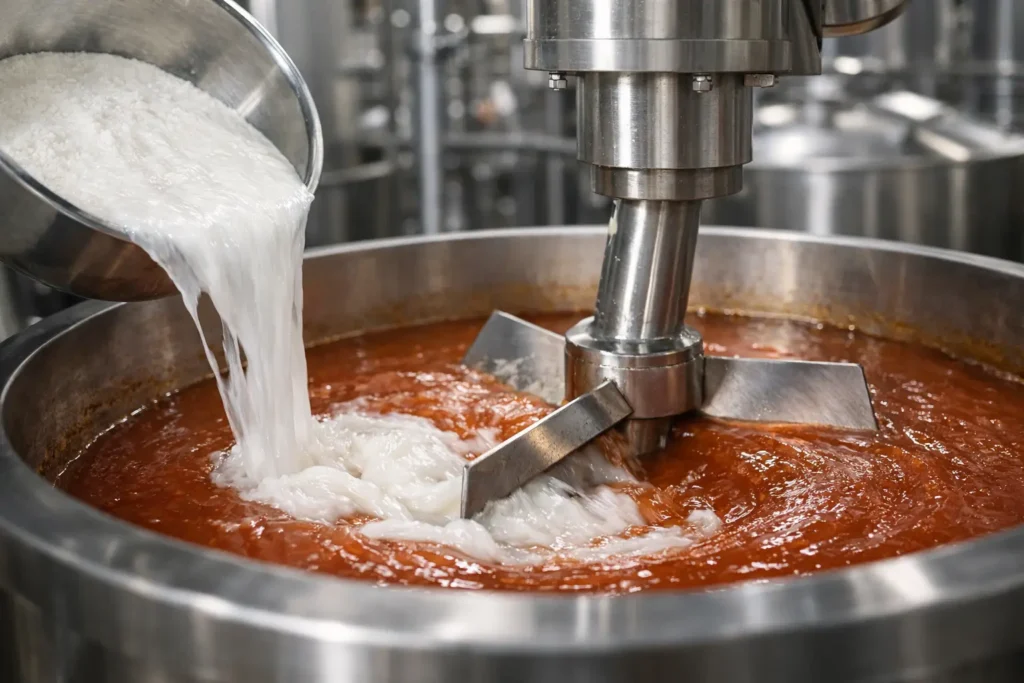
A dry starch addition can turn a well-designed sauce batch into a costly rework event within minutes. When operators ask, “what mixer handles starch,” the practical answer is not simply a high-speed mixer. The right system must wet every starch particle quickly, prevent agglomerates, control viscosity as the batch thickens, and support the heating or cooling profile required by the formulation.
For mayonnaise, dressings, ketchup, gravies, and starch-thickened sauces, a vacuum emulsifying mixer processor with an integrated powder induction capability is often the most effective production solution. It combines controlled powder charging, high-shear dispersion, low-speed wall sweeping, vacuum deaeration, and process temperature control in one sanitary vessel.
A vacuum emulsifying mixer with a high-shear homogenizer and anchor or sweep agitator is the preferred configuration for many commercial starch applications. This combination addresses the two jobs that matter most: dispersing powder before it forms fisheyes and maintaining uniform circulation as viscosity rises.
The high-shear homogenizer creates localized turbulence that breaks apart powder clusters and distributes starch through the liquid phase. The anchor agitator moves the bulk batch, continually sweeps product from the vessel wall, and prevents thick material from sitting outside the high-shear zone. Under vacuum, the system can also limit entrained air, which improves appearance, fill-weight consistency, and product stability.
For direct dry addition, powder induction is especially valuable. Rather than dumping starch through an open manway and relying on an operator to control the powder cloud and feed rate, an induction system draws powder into a controlled liquid stream. Proper wetting occurs before particles can form dry-centered lumps. This is a major advantage when processing modified food starch, pregelatinized starch, gums, stabilizer blends, and other difficult powders.
Starch is not one processing behavior. A mixer that performs well with a low-use-level modified starch may be undersized for a high-solids cook-up starch system. The formulation, addition method, batch size, and thermal cycle all affect equipment selection.
Native cook-up starches need to be dispersed before the batch reaches gelatinization temperature. If powder enters too slowly, it can hydrate on the surface and form lumps. If it enters too quickly, the liquid may not have enough available circulation to wet the addition uniformly. Once the starch begins to swell and viscosity rises, poor mixing becomes more visible: dead zones develop, wall buildup increases, and the product may show inconsistent body from one area of the vessel to another.
Pregelatinized starches create a different challenge. They can build viscosity almost immediately in cold process applications. That makes rapid wetting and controlled dosing essential. A basic propeller mixer may create a surface vortex, but it often cannot generate enough powder wet-out performance or vessel-wide movement to protect against agglomerates in a thick sauce base.
Modified starches can offer improved process tolerance, but they still require the correct sequence. Acid, salt, sugar, oil, protein, and hydrocolloids can change hydration behavior. In mayonnaise and dressing production, starch may be part of a broader stabilization strategy alongside egg, modified starch, gums, and emulsifiers. The mixer must protect both starch dispersion and the finished emulsion.
A purpose-built system for starch handling uses multiple mixing actions, not one impeller performing every task. The best configuration depends on the product, but commercial sauce manufacturers commonly benefit from three coordinated functions.
First, a high-shear rotor-stator homogenizer disperses starch and other functional powders. It is particularly useful during the early wetting stage, when small agglomerates must be broken apart before they become visible defects. Homogenizer speed should be matched to the batch volume and product viscosity. Excessive shear is not automatically better, especially in formulations containing shear-sensitive components.
Second, an anchor agitator or wall scraper provides gentle but complete bulk movement. As the starch hydrates and the batch thickens, the anchor keeps product moving through the vessel and transfers heat efficiently across the jacketed wall. This action is critical for cook-up sauces, where localized overheating can cause scorching, uneven gelatinization, or undesirable color development.
Third, a powder induction system provides a controlled entry point for dry starch. A well-designed induction setup allows operators to meter powder into the process at a repeatable rate while the liquid phase is circulating. This improves batch-to-batch consistency and reduces the labor and housekeeping issues associated with open powder dumping.
Vacuum is a fourth capability with strong commercial value. It helps remove air introduced during powder charging and mixing. Lower air content can improve sauce gloss, reduce foam, support accurate filling, and create a cleaner finished appearance. For emulsified products, vacuum processing also supports a dense, stable texture without relying on excessive post-mix holding time.
Both routes can work, and the right choice depends on production requirements. Direct powder induction is efficient when the equipment has enough circulation and shear to wet starch immediately. It reduces the need for a separate slurry tank and can shorten material handling steps. It is often a strong fit for plants producing multiple dressing or sauce varieties where flexibility matters.
A pre-slurry approach may be preferable for certain native starches, high-use-level formulations, or processes with limited main-vessel powder induction capacity. Preparing a starch slurry can give the operator greater control over hydration before heating. The trade-off is added equipment, cleaning, transfer time, and another point where formulation errors can occur.
The wrong approach is usually uncontrolled addition. Adding several bags of starch to a partially mixed batch may seem fast, but it often creates lumps that remain hidden until heating or final filling. By that point, more shear may not correct the issue without damaging product texture or delaying the entire production schedule.
Equipment sizing should start with the actual process, not only the final batch volume. A 500-gallon mayonnaise line and a 500-gallon starch-thickened barbecue sauce line can require very different mixing power, recirculation, and heating capacity.
For cold-process dressings using pregelatinized starch, focus on rapid powder wetting, high-shear dispersion, vacuum capability, and reliable agitation at final viscosity. For hot-process sauces using cook-up starch, jacket performance, wall scraping, temperature control, and bulk mixing become equally important. If the product also contains particulates, the system must provide enough movement to suspend them without damaging their size or shape.
The formulation sequence matters as much as hardware. In many applications, water-phase ingredients are charged first, followed by controlled starch induction and hydration. Heating is applied according to the starch supplier’s specification. Oil, acid, and sensitive ingredients may be added before or after the cook step depending on the product. A process engineer should validate this sequence at pilot scale before transferring it to a larger vessel.
Plants often recognize a starch-mixing limitation through finished-product symptoms rather than mixer data. Repeated lumps, visible fisheyes, inconsistent viscosity, wall deposits, extended batch times, and excessive foam all point to a process that needs stronger powder handling or better vessel-wide circulation.
Another warning sign is operator dependence. If only one experienced operator can add starch without creating defects, the process is not sufficiently controlled. Commercial equipment should make the correct method repeatable through engineered powder feeding, programmed mixing speeds, vacuum control, and reliable heating and cooling performance.
A mixer may also be technically capable but commercially inefficient. If the line requires frequent manual intervention, long hold times, or repeated viscosity adjustments, the real cost appears in lost capacity and variable product quality. The goal is not simply to mix the batch. It is to produce the same texture, stability, and yield every shift.
For food manufacturers producing starch-containing sauces, dressings, and emulsified condiments, the most capable answer is typically a vacuum emulsifying mixer processor with high shear, anchor agitation, powder induction, and thermal control. PerMix systems are engineered around these combined process demands, helping manufacturers manage dry powder incorporation while maintaining the texture and emulsion quality their customers expect.
The final equipment decision should be based on starch type, target viscosity, thermal profile, batch size, and the full ingredient system. A process trial using the actual formula will reveal more than a generic horsepower comparison ever can. When starch is treated as a controlled process step rather than a simple powder addition, production becomes faster, cleaner, and far more predictable.

Get in touch with us today and learn how to we can help your business.