PerMix Mayonnaise Production
PerMix News
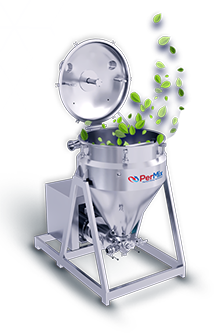

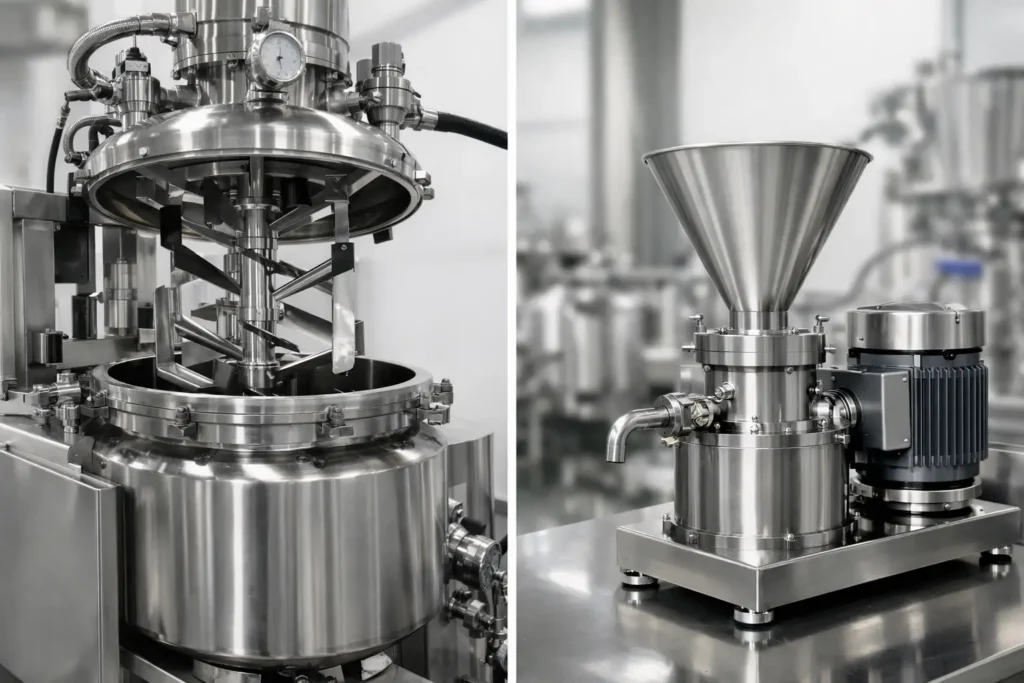
If your mayonnaise line is fighting fish eyes, air entrainment, or unstable texture after scale-up, the vacuum mixer versus colloid mill question is not academic. It directly affects batch time, emulsion stability, ingredient incorporation, and how much rework your plant has to absorb. In condiment production, the right choice depends less on machine category alone and more on when shear is applied, how ingredients enter the process, and what quality target the finished product has to meet.
At a basic level, both machines can reduce particle size and help build a stable emulsion. That is where the similarity starts to thin out. A vacuum emulsifying mixer is designed to combine ingredients, disperse powders, control aeration, and create emulsion structure inside one vessel. A colloid mill is primarily a high-shear rotor-stator device used to reduce droplets and particles by forcing product through a tight gap.
For food manufacturers, that distinction matters. Mayonnaise, dressings, and similar products are not just about shear intensity. They are about the sequence of oil addition, hydration of gums and starches, deaeration, temperature control, and repeatable batch development. A colloid mill can be effective in the right process, but it does not replace vessel-based mixing functions on its own.
A vacuum mixer is built around integrated processing. The vessel handles liquid blending, powder incorporation, emulsification, and deaeration as part of one controlled batch. Under vacuum, trapped air is reduced during mixing, which helps improve density control, visual finish, and emulsion stability. For mayonnaise and creamy dressings, that can be the difference between a smooth, glossy product and one that looks whipped or inconsistent.
This setup is especially valuable when formulations include challenging dry ingredients. Modified starches, milk powders, proteins, hydrocolloids, and seasoning blends can create lumps if wet-out is slow or uneven. A properly configured vacuum mixer with powder induction addresses that issue at the point where it starts. Instead of chasing agglomerates later with more shear, the process is designed to prevent them.
For manufacturers running low-fat, fat-free, or vegan formulations, this matters even more. These products often rely on tighter process control to build viscosity and mouthfeel without the cushioning effect of higher oil content. The mixer has to hydrate, disperse, and emulsify with precision. Excessive recirculation or poorly timed shear can damage the texture you are trying to create.
A colloid mill is a focused tool. Product is pumped through a narrow rotor-stator gap, where intense mechanical shear reduces droplet size and breaks down soft particles. In some processes, that is exactly what is needed. It can be useful as a finishing step, a post-mix homogenizing stage, or part of a continuous line where upstream systems already handle ingredient blending and powder wetting.
In simpler emulsions, a colloid mill can improve smoothness and tighten droplet distribution. In sauce applications with pre-dispersed ingredients and stable feed consistency, it may deliver good results with relatively compact equipment. Procurement teams often notice its smaller footprint and direct mechanical action.
But the trade-off is that a colloid mill is not a full process environment. It does not inherently provide vacuum, batch-level powder induction, vessel scraping, or ingredient sequencing control. If product enters the mill with lumps, entrained air, or uneven hydration, the mill may reduce some defects but it may not solve the root cause. In some formulations, aggressive milling can also generate heat or overwork the structure.
For mayonnaise production, the comparison usually leans toward the vacuum mixer when the goal is a complete, controlled batch process. Mayonnaise is highly sensitive to formulation order and emulsion build. Oil addition rate, aqueous phase preparation, egg or protein functionality, acid addition, and stabilizer hydration all interact. Vacuum processing supports this sequence while minimizing foam and entrained air.
A colloid mill can still play a role in mayonnaise systems, especially in continuous or hybrid process designs. Some plants use it downstream to refine texture after pre-emulsification. That approach can work, but the result depends on what the upstream mixer has already achieved. If the pre-mix is weak, the colloid mill will not consistently rescue it.
For standard full-fat mayonnaise, both technologies may appear capable on paper. The gap widens with difficult formulations. Low-fat and vegan mayonnaise often require stronger control over hydration, viscosity development, and air management. In those cases, integrated vacuum emulsification is typically more forgiving and easier to scale with consistency.
A common mistake in equipment evaluation is to reduce emulsion quality to one metric. Fine droplet size matters, but so do gloss, density, spoonability, water binding, and resistance to separation over shelf life. A product can test well at discharge and still fail later because the process introduced too much air or did not properly hydrate a functional powder.
That is why process engineers often prefer equipment that manages the whole batch environment, not just the peak shear event. In commercial mayonnaise and dressing production, repeatability usually beats raw shear intensity.
The best choice depends on what problem you are trying to solve. If your current issue is poor powder incorporation, long batch cycles, foam, and inconsistent final texture, a vacuum mixer addresses those problems at process level. It reduces the need to correct defects after they appear.
If your process already has strong premix control and you only need additional particle reduction or texture refinement, a colloid mill may be sufficient. That can make sense in facilities with established continuous lines or in applications where ingredient handling is simple.
Maintenance and sanitation also deserve attention. A colloid mill has a tight shear zone that must be monitored for wear and set correctly. Clearance changes can affect performance. A vacuum mixer has more integrated functions, so the equipment package is broader, but it can reduce the number of separate process steps and transfer points. In food plants, fewer interventions can support cleaner, more repeatable production.
Energy and throughput should be judged carefully. High shear through a mill can be effective, but running product through extra loops or corrective passes adds time and cost. A vacuum mixer may require a larger capital decision upfront, yet it can remove process inefficiencies that do not show up in a simple equipment quote.
This is not always an either-or decision. Some manufacturers combine a vacuum emulsifying mixer with a colloid mill to get the benefits of controlled batch formation and downstream refinement. That approach is more common in larger plants, specialty textures, or lines that produce a wide range of viscosities.
Still, hybrid systems should be designed intentionally. Adding a colloid mill to a weak batch process can create more complexity without fixing the real issue. The stronger approach is to define the product target first, then assign each machine a clear function. Mixing, powder induction, deaeration, and primary emulsification should happen where they can be controlled. Final polishing, if needed, can happen downstream.
Before choosing a vacuum mixer versus colloid mill, start with the formulation and the failure mode. Are you dealing with dry starch lumps, poor hydration, broken emulsion, excess air, or uneven viscosity from batch to batch? The answer changes the equipment logic.
Then look at scale. Pilot success does not always transfer directly to industrial output. The larger the batch, the more important ingredient entry, vessel flow pattern, and air control become. A bench test that works with manual addition may not survive a production environment.
Finally, consider product range. If your plant runs mayonnaise, salad dressing, vegan emulsions, ketchup, and thicker sauces on shared assets, flexibility has real value. Equipment that handles multiple formulations with predictable results often delivers a stronger commercial return than equipment selected for one idealized recipe.
PerMix typically sees the best long-term results when processors evaluate the full production objective, not just the machine nameplate. Better emulsion quality starts with better process design.
The practical question is simple: choose the equipment that solves your actual bottleneck, not the one that only adds more shear. In mayonnaise and dressing production, consistency is usually built upstream, one controlled batch at a time.

Get in touch with us today and learn how to we can help your business.