PerMix Mayonnaise Production
PerMix News
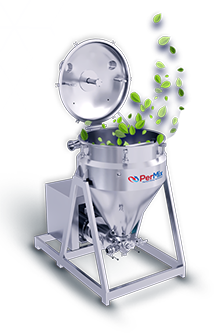

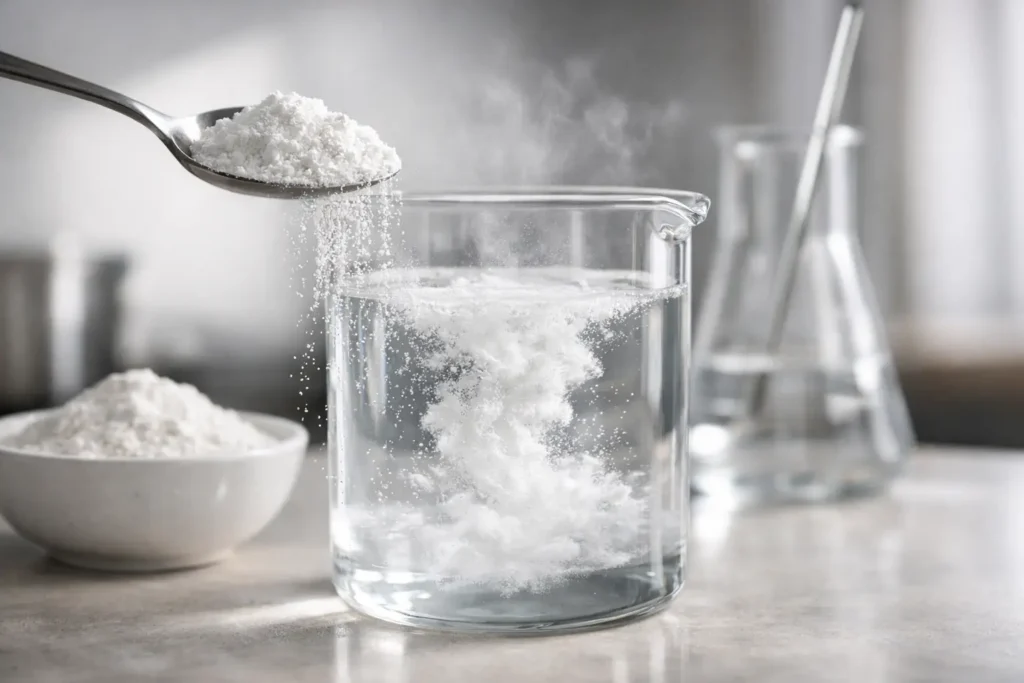
A starch addition that looks simple on paper can become the point where a sauce or dressing batch starts losing time, yield, and consistency. If you need to know how to disperse starch powders in commercial food production, the real answer is not just mix faster. It is about controlling wetting, shear, feed rate, liquid movement, and the order in which ingredients enter the vessel.
In mayonnaise, dressings, ketchup, and other viscous systems, starch is rarely forgiving. Add it too quickly and you get fisheyes. Add it into the wrong phase and you trap dry powder inside a hydrated shell. Run too little circulation and the powder floats, agglomerates, or sticks to the vessel wall. At pilot scale, an operator may work around that problem. At production scale, the same mistake becomes rework, downtime, or an out-of-spec texture.
Starch does not behave like a simple free-flowing powder once it touches water. The particle surface hydrates quickly, and that first layer can form a barrier around dry material inside the agglomerate. That is why a batch can appear mixed from the top while still carrying undispersed starch lumps downstream.
The challenge gets larger in high-solids or high-viscosity formulations. In water-thin systems, you have a better chance of distributing powder before viscosity rises. In emulsified foods and prepared sauces, available free water may be limited, and other hydrocolloids, gums, sugars, or proteins may already be competing for hydration. The result is slower wetting, more lumping, and less process tolerance.
Temperature also matters, but not always in the same way. Some starches disperse more easily in cool water before cooking. Others are pregelatinized and start building viscosity almost immediately. Modified starches can behave differently again. That means the correct dispersion method depends on the starch type, the formulation, and when viscosity development is supposed to begin.
The most reliable method is to create strong liquid movement first, then introduce starch at a controlled rate where it is pulled immediately into a high-shear zone. The goal is fast wetting and deagglomeration before the powder has time to sit on the surface or hydrate unevenly.
In practical terms, that usually means charging the liquid phase, establishing circulation, and feeding starch in gradually rather than dumping bags directly into the vessel. A vortex alone is not enough. In many tanks, a visible vortex gives operators confidence, but powder still rides the surface, bridges at the rim, or falls into low-energy areas. Good dispersion depends more on where the powder enters and how quickly it meets shear than on how dramatic the surface looks.
For starches used in dressings or sauce systems, pre-blending with other dry ingredients can help when the formulation allows it. Sugar, salt, or other powders may separate starch particles and reduce the tendency to form clumps on first contact with water. This is useful, but it is not a cure-all. If the powder addition point and shear conditions are poor, even a dry blend can still form fisheyes.
A slurry approach can also work. Some processors disperse starch into oil or another compatible liquid phase before adding it to the main batch. This can improve initial wetting and reduce airborne dust, but it depends on the formulation and the starch. In an emulsion process, the trade-off is that one improvement in powder handling can complicate phase balance or downstream hydration if the sequence is not designed correctly.
When teams struggle with starch, the issue is often blamed on the ingredient. More often, the root cause is process design.
Shear level is one factor, but residence time in the shear zone matters just as much. If powder is added faster than the system can wet and disperse it, lumps still form even with a high-speed mixer. Feed rate must match the actual capacity of the mixer, not the target batch time.
Viscosity profile is another major factor. If starch is added after the batch is already thick from gums, oil, egg, or other solids, powder incorporation becomes harder. In many formulations, the best window for starch addition is early, when the continuous phase is still mobile enough to carry particles into circulation.
Vacuum can improve results in systems where air entrainment interferes with wetting or final texture. It helps reduce foam, improves ingredient draw-in in the right equipment configuration, and supports more consistent product quality. That matters in mayonnaise and dressing production, where trapped air can affect both appearance and process stability.
Particle size distribution and powder condition should not be ignored either. Starch that has absorbed moisture in storage, formed soft lumps, or compacted during transport will not feed like fresh, dry material. Plants sometimes try to solve a storage problem with more mixer speed. That usually adds energy without fixing the real issue.
There is a practical limit to what operators can achieve with manual powder dumping and a standard agitator. Once batch sizes grow and product ranges expand, repeatable starch dispersion requires equipment designed for powder induction and high-shear incorporation.
A well-designed system pulls powder into the liquid stream quickly, minimizes floating, and disperses the material before it can form stubborn agglomerates. This is especially important in commercial mayonnaise, dressing, and sauce production, where a single batch may include starches, gums, proteins, acids, oils, and emulsifiers that all affect hydration behavior.
That is where integrated vacuum emulsifying and powder induction systems offer a measurable advantage. They reduce dependence on operator technique, shorten addition time, and improve batch-to-batch consistency. For manufacturers running multiple SKUs, including low-fat or vegan formulations that can be less forgiving than full-fat products, this level of control is not a convenience. It is process protection.
PerMix focuses on this kind of application-specific performance because difficult powders are not a side issue in viscous food manufacturing. They are often the difference between a stable, scalable process and a line that spends too much time correcting avoidable problems.
One of the most common mistakes is adding starch too fast to save time. In reality, this usually extends the batch by creating lumps that require more mixing, more heating, or even filtration and rework.
Another is adding starch into stagnant or poorly circulating liquid. If the mixer creates dead zones, powder will find them. The result is wall build-up, bottom accumulation, or partially hydrated clusters that appear later in the process.
Plants also run into trouble when they use the same addition sequence for every formulation. A standard mayonnaise, a low-fat dressing, and a starch-thickened sauce can require different timing. What works for one product may fail in another because the hydration environment changes.
Finally, many teams underestimate the cost of inconsistency. A few visible lumps are only the obvious symptom. The bigger cost may be texture variation, unstable viscosity, reduced yield, and longer sanitation cycles from starch deposits left in the vessel or transfer line.
Start by looking at the full process, not just the mixer RPM. Review starch type, batch order, available free water, temperature, and the exact powder addition point. If operators are still hand-adding from the top, ask whether the current method is scalable or simply familiar.
Then evaluate whether your system gives powder immediate contact with high-energy mixing. If not, a powder induction upgrade or a vacuum emulsifying platform may deliver a better return than continuing to troubleshoot every batch. In most production environments, the right equipment reduces variation faster than operator retraining alone.
It also helps to validate changes with measured outcomes. Watch dispersion time, final viscosity range, rework rate, air content, and cleaning time. Good starch incorporation should improve more than one number. It should make the entire batch more predictable.
The best starch process is not the one with the highest mixer speed or the most aggressive operator. It is the one that wets fast, disperses cleanly, and repeats the same result every shift. If starch powders are slowing your line down, that is usually a sign to improve the process design, not just push the batch harder.

Get in touch with us today and learn how to we can help your business.