PerMix Mayonnaise Production
PerMix News
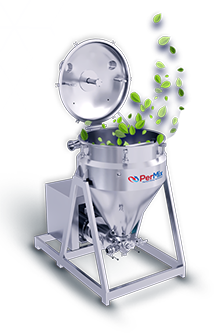

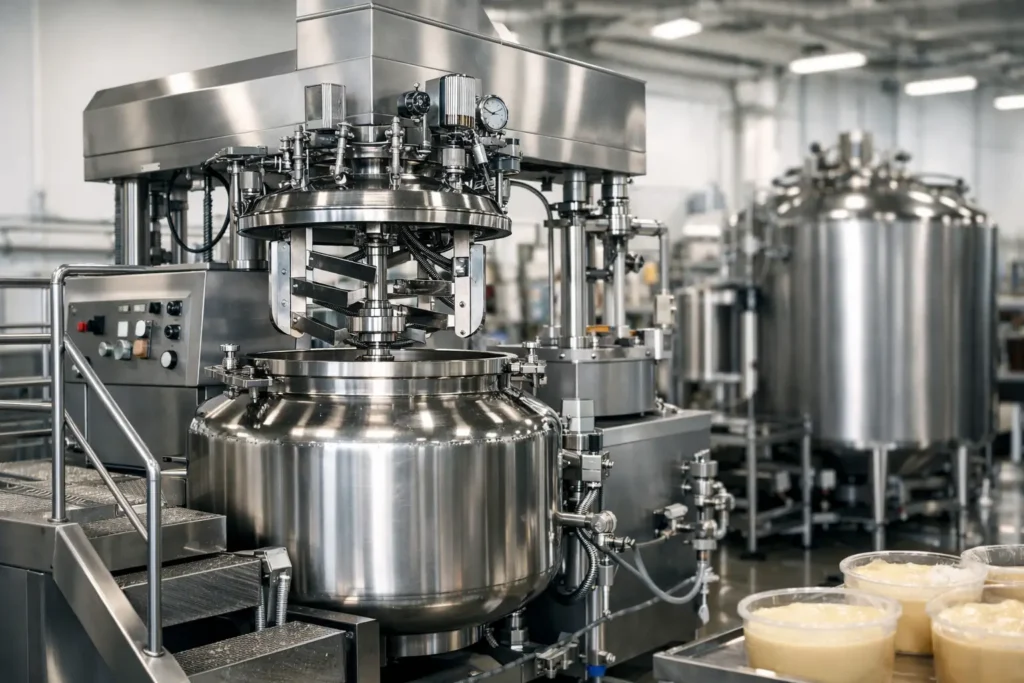
A vacuum emulsifier machine review is only useful if it reflects what happens on a production floor, not just what appears on a spec sheet. For mayonnaise, dressings, sauces, and other viscous emulsified foods, the real test is whether the machine can deliver stable product, shorten batch time, handle powders cleanly, and repeat the same result day after day at commercial scale.
That is where many reviews fall short. They focus on motor size, tank volume, or headline rpm numbers without asking harder process questions. Can the system disperse starches and gums without fisheyes? Can it pull oil into the batch fast enough without destabilizing the emulsion? Can it deaerate effectively under vacuum so the finished product has the right texture, appearance, and shelf stability? For serious food manufacturers, those are the questions that matter.
A proper review starts with application fit. Not every vacuum emulsifier is built for mayonnaise production, and not every mixer that can produce a lab sample can support efficient plant output. If your line runs full-fat mayonnaise today and expects to add low-fat or vegan formulations later, the machine has to manage wider viscosity swings and more difficult ingredient behavior.
In practical terms, the best systems are judged on five things: emulsion quality, batch cycle time, powder incorporation, sanitation, and scale-up reliability. If one of those areas is weak, the machine may still run, but it will not perform well enough to protect margins.
Emulsion quality comes first because it affects everything downstream. A machine may create a visually smooth batch, but if droplet size distribution is inconsistent, the product can break in the tank, separate in storage, or show texture drift over time. For mayonnaise and dressing manufacturers, this is not a minor issue. Product instability means rework, waste, customer complaints, and line disruption.
Batch cycle time matters because capacity is not just vessel size. A 1,000-liter tank that needs excessive time for charging, powder wet-out, emulsification, vacuum deaeration, and discharge may underperform a smaller but better-designed system. This is why an honest review looks at total throughput per shift, not only nominal batch volume.
The mixing head configuration deserves close attention. High shear is necessary, but high shear alone is not enough. Rotor-stator design, recirculation pattern, and how the system moves product through the shear zone all affect final texture and stability. In food applications, the goal is controlled emulsification, not simply aggressive agitation.
Vacuum performance is equally important. A system operating under stable vacuum can improve ingredient uptake, reduce entrapped air, and support a denser, cleaner finished product. This matters especially in mayonnaise and similar emulsions where trapped air can distort viscosity readings, lighten appearance, and create filling inconsistencies. A weak or inconsistent vacuum system often becomes visible in the product long before it shows up in maintenance records.
Powder induction is another major separator between average and high-performing machines. Many formulations depend on dry starches, gums, proteins, or seasoning blends that are difficult to incorporate efficiently. If powders float, clump, or hydrate unevenly, the process slows down and product quality suffers. A machine with effective powder induction and rapid wet-out can reduce manual handling, shorten processing time, and improve repeatability.
Heating and cooling control also deserve review, especially for processors handling multiple sauce and dressing formats. Some products require precise thermal support for hydration, viscosity adjustment, or ingredient solubility. Poor jacket design or slow heat transfer can stretch cycle times and introduce variation from batch to batch.
Then there is discharge. It sounds simple, but with high-viscosity products, discharge efficiency affects yield and cleanup. Dead zones, poor outlet placement, or weak transfer performance can leave valuable product in the vessel and create extra sanitation work between runs.
Most vacuum emulsifier machines look strong during demonstrations with simple formulas. Water, oil, and standard emulsifiers are not hard to process under controlled conditions. The gap appears when formulations become more demanding.
Low-fat mayonnaise is a common example. It often requires stronger control over hydration, powder dispersion, and viscosity development. A machine that performs well with higher oil content may struggle when the formula depends more heavily on starches, hydrocolloids, or protein systems. The same issue appears with vegan mayonnaise, where egg replacement systems can be less forgiving and process sensitivity tends to increase.
Machines also disappoint when they are sized incorrectly for the actual operating range. Oversized equipment can process too far below optimal working volume, reducing shear effectiveness and making smaller batches inconsistent. Undersized equipment creates bottlenecks, longer shift hours, and pressure to rush critical process stages. In both cases, the machine is not necessarily poor in design. It is simply a poor fit for the production target.
Sanitary design is another area where buyers should be demanding. In food plants, a machine should not only produce a good emulsion. It should also support practical cleaning and hygienic operation. Weld quality, surface finish, seal selection, valve arrangement, and accessibility all affect maintenance burden and cleaning validation. A machine that saves a few dollars upfront can become expensive fast if sanitation takes too long or remains difficult to verify.
When comparing options, manufacturers should review the machine in the context of their own formulations and shift requirements. A strong supplier should ask about oil phase percentage, powder load, target viscosity, allergen considerations, and expected batch frequency. If those questions never come up, the review is incomplete.
Start with your process objectives. Are you trying to increase output, improve stability, reduce labor, or bring in a new product family such as vegan dressings? Different objectives can point to different machine priorities. If labor reduction is a key target, powder induction and automated recipe control may matter more than maximum rpm. If product stability is the main issue, shear profile and vacuum integrity may deserve more weight.
Pilot validation is often the most useful checkpoint. A supplier that understands emulsification should be able to discuss how the machine will behave with difficult ingredients, not just with standard recipes. This is where specialized experience matters. In mayonnaise and condiment manufacturing, process knowledge can be as important as the mechanical package itself.
A serious comparison should also include support after installation. Start-up, training, process tuning, and spare parts availability all affect real equipment value. Food manufacturers do not buy a vacuum emulsifier to admire its construction. They buy it to run predictable batches, hit production schedules, and protect finished product quality.
So what does a realistic vacuum emulsifier machine review say? It says the best machine is rarely the cheapest and is not always the one with the most aggressive headline specifications. The right machine is the one engineered around your product family, your batch sizes, your ingredient challenges, and your sanitation standard.
For mayonnaise, ketchup, dressings, and related emulsified foods, the strongest systems combine stable vacuum, efficient high-shear emulsification, reliable powder induction, and practical vessel design for cleaning and discharge. They help reduce common production failures such as broken emulsion, incomplete hydration, texture inconsistency, and excessive cycle times.
It also says there are trade-offs. Higher automation can improve consistency but increase initial investment. Greater flexibility across multiple products may add system complexity. More aggressive shear can improve dispersion but may not suit every texture target. Good equipment selection depends on balancing those factors against operating goals.
Manufacturers looking at dedicated emulsified food production equipment should favor suppliers that understand formulation behavior, not just mixer fabrication. That is especially true when product lines include low-fat, fat-free, or vegan systems. In those applications, process margins tend to be tighter and machine design has a more direct impact on product quality. This is one reason specialists such as PerMix focus so heavily on vacuum emulsification performance, powder handling, and application-specific sizing rather than generic mixing claims.
A good buying decision comes from watching beyond the demo batch. Ask how the machine performs with difficult powders, how vacuum is maintained through the cycle, how fast the system can turn batches under real sanitation conditions, and how repeatable the emulsion remains after scale-up. If those answers are clear, you are reviewing the right machine. If they are vague, keep looking.
The best equipment earns its place by making production easier, more consistent, and more profitable long after installation. That is the standard worth using.

Get in touch with us today and learn how to we can help your business.