PerMix Mayonnaise Production
PerMix News

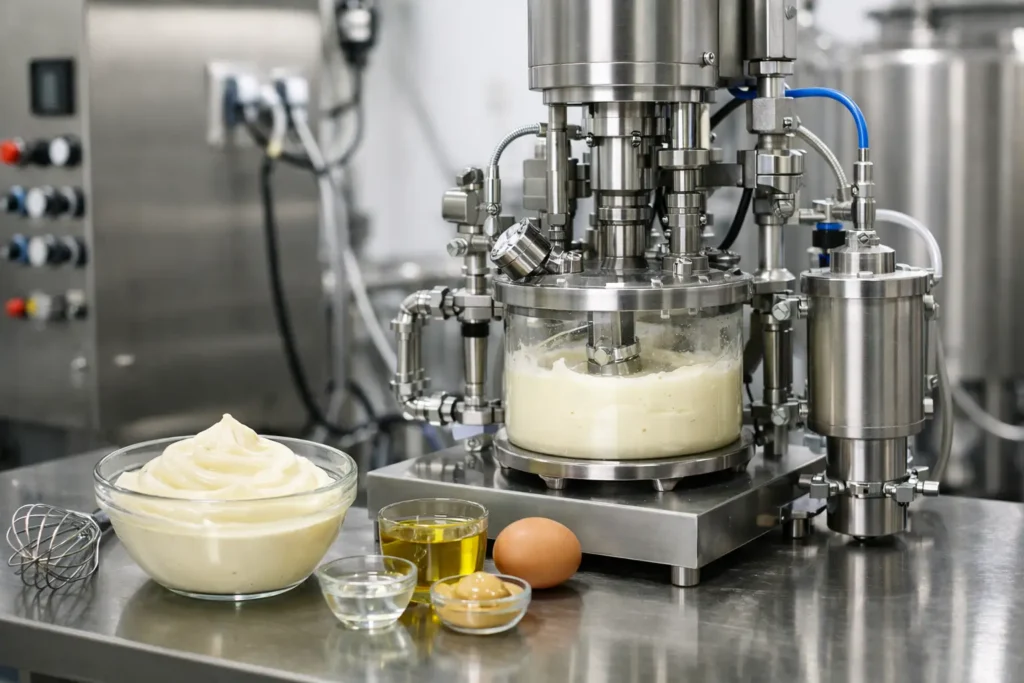
A pilot plant mayonnaise mixer is where a promising bench formula either becomes a repeatable manufacturing process or exposes the weaknesses that would become expensive on a production line. For mayonnaise producers, the challenge is not simply blending oil, egg, water, and seasonings. It is controlling a stable emulsion while managing viscosity, powder hydration, air removal, sanitation, and batch-to-batch consistency.
A properly specified pilot system gives R&D and process teams a meaningful bridge between laboratory trials and commercial production. It allows manufacturers to prove formulations under realistic shear, vacuum, temperature, and ingredient-addition conditions before committing product, labor, and capital to a larger system.
Mayonnaise is sensitive to process conditions. A formula can look acceptable in a small laboratory vessel but fail when batch volume, oil addition rate, shear exposure, or powder loading changes. The result may be a thin product, a broken emulsion, trapped air, uneven texture, or poor finished-product stability.
A pilot plant mixer is designed to make those conditions visible early. It gives the team control over the process variables that matter at scale: how quickly oil enters the batch, where powders are introduced, how long the product sees high shear, and how vacuum affects deaeration and ingredient incorporation.
This is particularly valuable for manufacturers developing low-fat, fat-free, or vegan mayonnaise. Reduced-fat systems often depend more heavily on starches, gums, proteins, and other functional ingredients. These materials can form fish eyes, agglomerate, or hydrate inconsistently if they are not dispersed correctly. Vegan formulas can introduce their own emulsification challenges, especially when replacing egg yolk with plant proteins or specialty emulsifiers.
The pilot plant should therefore replicate the intended production method, not just produce a small batch of product. That distinction determines whether scale-up data is useful.
The most effective pilot equipment combines controlled agitation with high-shear emulsification. An anchor or sweep agitator moves high-viscosity product through the vessel and supports uniform heat transfer. A high-shear rotor-stator homogenizer reduces droplet size and distributes emulsifiers, stabilizers, starches, and other functional ingredients throughout the batch.
For mayonnaise, oil addition is equally critical. Introducing oil too quickly can overload the emulsification system and lead to instability. A well-designed pilot setup uses controlled addition through a dedicated feed arrangement, allowing the operator to match oil flow to the formula and the available shear energy.
Vacuum is another essential capability for many applications. During mixing, air can enter with powders, liquid transfers, and surface agitation. Entrained air affects appearance, density, filling accuracy, and shelf-life performance. Vacuum processing helps remove air from the product and can support cleaner powder incorporation, particularly when working with difficult dry ingredients.
Temperature management also matters, even for products that do not require extensive heating. Starch activation, gum hydration, preservative dissolution, and viscosity development may depend on a tightly controlled temperature profile. A jacketed vessel with heating and cooling capability gives the process team the flexibility to test these effects instead of treating them as fixed assumptions.
There is no single pilot plant configuration that fits every mayonnaise producer. A company running classic full-fat mayonnaise may prioritize high-shear emulsification, precise oil dosing, and fast cleaning between flavor variations. A manufacturer focused on low-fat products may need stronger powder induction and more deliberate hydration capability. A vegan line may require additional testing around protein functionality, pH response, and the order of ingredient addition.
Batch size should be selected with purpose. A vessel that is too small may not generate representative flow patterns or provide enough product for pilot filling, shelf-life trials, sensory review, and customer samples. A vessel that is too large can waste expensive ingredients and limit the number of trials a development team can complete in a day.
The target is a practical scale that creates meaningful data while remaining flexible enough for formulation work. It should also reflect the commercial production strategy. If the final line will use vacuum emulsification and powder induction, the pilot system should be able to duplicate those functions. Testing a powder-heavy formula in an open vessel with a basic disperser may not predict what happens in the plant.
A pilot mixer purchase should begin with the formulation and process, not a generic capacity number. The equipment supplier needs to understand expected batch volume, viscosity range, oil percentage, powder types, temperature requirements, and the number of product changeovers planned each week.
The following capabilities have a direct effect on mayonnaise development and scale-up:
Controls should not be treated as an afterthought. Recipe management, speed control, temperature logging, vacuum monitoring, and timed addition steps help the team document the process that created a successful batch. That record becomes the foundation for commercial-scale process development.
The value of pilot work comes from disciplined trials. Instead of changing multiple variables at once, process teams should identify the few factors most likely to affect emulsion quality and test them deliberately. Oil addition rate, homogenizer speed, mixing time, vacuum level, powder addition method, and temperature profile are common starting points.
A useful pilot trial does more than confirm that the product looks good at discharge. It evaluates viscosity after aging, emulsion stability, air content, texture, color, filling behavior, and performance under expected storage conditions. For products headed to foodservice or retail, the team should also consider how the mayonnaise behaves in pumps, depositor systems, sachet fillers, and other downstream equipment.
The process should be measured, not remembered. Record ingredient order, feed rates, equipment speeds, temperatures, vacuum levels, and hold times for every successful batch. When a formula must be transferred to a larger machine, these details are far more valuable than a recipe sheet alone.
One frequent error is using excessive high shear for too long. High shear is necessary to build a fine, stable emulsion, but more is not automatically better. Overprocessing can alter texture, raise product temperature, and create a process that is difficult to reproduce at commercial scale. The right shear level depends on the formula, batch size, and target viscosity.
Another mistake is adding dry ingredients directly into a viscous batch without adequate induction or dispersion. Powders may wet on the surface and form lumps that remain visible even after extended mixing. The best approach depends on the material. Some powders benefit from pre-blending, while others require controlled vacuum induction or a dedicated liquid phase before entering the main vessel.
Teams also underestimate the impact of air. A mayonnaise that appears smooth in the vessel may later show density variation, poor filling weights, or an unstable appearance because of entrained air. Vacuum capability is not a decorative specification. For many products, it is a practical tool for producing a denser, cleaner, more consistent finished emulsion.
Finally, do not select a pilot system solely because it is compact or inexpensive. A low initial price has limited value if the system cannot reproduce the production process, handle the planned ingredient range, or provide credible scale-up information.
Scale-up is not a matter of multiplying ingredient quantities. Larger vessels have different flow patterns, energy distribution, surface area, and transfer times. The production system must preserve the operating principles proven at pilot scale while accounting for those physical differences.
This is why equipment design and process expertise must work together. A supplier should be able to review the formulation, identify the difficult process steps, and recommend a configuration that supports both development and future production. PerMix applies this approach through vacuum emulsifying and universal vacuum mixer processor systems designed around actual mayonnaise processing requirements, not generic mixing claims.
The strongest pilot plant programs give manufacturers the confidence to move faster with new formulas while protecting product quality. Choose equipment that makes each batch a credible production trial, and the path from R&D to a stable commercial mayonnaise becomes far more predictable.

Get in touch with us today and learn how to we can help your business.