PerMix Mayonnaise Production
PerMix News

A mayonnaise batch can look acceptable at discharge and still fail the real test a few days later – viscosity drift, slight oiling off, uneven gloss, or a mouthfeel that does not match the target. In most cases, oil droplet size mayonnaise is the hidden variable behind those results. For commercial producers, droplet size is not a lab curiosity. It is a direct driver of texture, stability, process repeatability, and line efficiency.
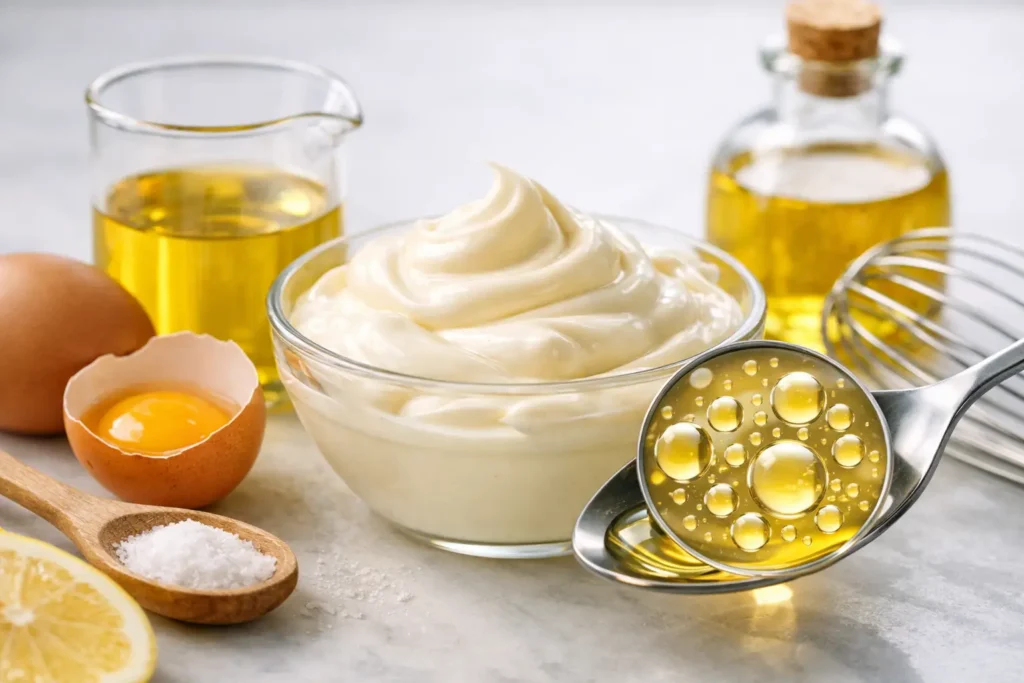
Mayonnaise is an oil-in-water emulsion. The oil phase is dispersed into tiny droplets and held in place by emulsifiers, typically egg yolk components or plant-based alternatives in vegan systems. The smaller and more uniform those droplets are, the more stable and structured the product usually becomes.
That relationship shows up across multiple quality attributes. Smaller droplets generally create a thicker body because they increase total surface area and strengthen interactions within the emulsion. They also improve visual appearance, often producing a smoother, more homogeneous gloss. When droplet size distribution is broad, the product may still appear acceptable at first, but it is more likely to show inconsistency from batch to batch and a higher risk of coalescence during storage.
There is a limit, though. Chasing the smallest possible droplets is not always the right goal. Overprocessing can damage the emulsion system, generate excess heat, or create a texture that feels overly pasty rather than creamy. In production, the target is not simply small droplets. It is the right droplet size distribution for the formulation, shelf-life requirement, and sensory profile.
A full-fat mayonnaise behaves differently from a low-fat or fat-free product. So does a vegan mayonnaise built around starches, hydrocolloids, and plant proteins. That is why droplet size targets cannot be separated from formulation design.
In a conventional high-oil mayonnaise, the emulsion structure depends heavily on dense packing of dispersed oil droplets. A fine and consistent droplet population contributes to the expected firmness and spoonable texture. In lower-fat systems, there is less oil available to build that structure, so stabilizers and thickeners carry more of the load. Even with good mixing, the ideal droplet profile may be different because the continuous phase is doing more work.
Vegan systems add another layer of complexity. Plant proteins and non-egg emulsifiers often respond differently to shear, pH, and order of ingredient addition. Some systems can produce excellent fine emulsions, but the processing window may be narrower. A setup that performs well for standard mayonnaise may not deliver the same result for vegan SKUs without adjustment in rotor-stator speed, vacuum level, powder induction, and oil addition rate.
This is why process development has to connect formulation and equipment behavior. If the product range includes standard, low-fat, and vegan mayonnaise, the production platform must be flexible enough to control droplet size under different rheological conditions.
The most obvious factor is shear. High-shear mixing breaks larger oil droplets into smaller ones, but only when the system is feeding oil into the aqueous phase at the right rate and under the right conditions. If oil is added too quickly, the emulsifier may not cover the new droplet surface efficiently, and larger unstable droplets can survive the process.
Emulsifier availability is equally important. Egg yolk, plant proteins, modified starches, and other surface-active ingredients need time and proper dispersion before the oil phase is fully built. Poor hydration of powders can reduce emulsification performance before the main oil addition even starts. In industrial production, that is one reason powder induction and pre-dispersion design matter so much.
Temperature also affects outcome. Higher temperature may reduce viscosity and make droplet breakup easier, but it can also change ingredient functionality and increase instability if the process runs too warm. For mayonnaise, careful thermal control is part of droplet size control, not a separate issue.
Vacuum conditions can improve consistency by minimizing air incorporation. Entrained air interferes with visual quality, skews density, and can complicate apparent viscosity and filling performance. More importantly, a vacuum emulsification process supports cleaner droplet formation because it reduces foaming and helps maintain a more controlled mixing environment.
Oil addition rate is often underestimated on the plant floor. Even a well-designed mixer can produce weak results if the oil feed outruns the emulsification capacity of the system. Controlled addition allows the emulsifier to adsorb at the newly created interface and lets the mixer reduce droplet size progressively instead of fighting large oil pockets.
For scale-up, this becomes critical. A bench formula that works with manual pouring may fail at production volume if the feed system dumps oil too aggressively into the vessel. Commercial reliability depends on synchronizing feed rate, mixer intensity, and batch viscosity development.
Before oil enters the system, the water phase has to be right. Hydrated gums, dissolved salts and sugars, dispersed starches, and fully incorporated proteins all influence how the emulsion forms later. Lumps, fisheyes, or poorly wetted powders create local defects that can disrupt shear conditions and compromise uniform droplet formation.
This is especially relevant in low-fat and vegan applications, where dry ingredient functionality is central to final texture. A weak pre-mix usually means a weak emulsion, even if the final homogenization step is aggressive.
When oil droplets are too large, the first problem is usually reduced stability. Larger droplets have a stronger tendency to cream and merge. Over time, that can lead to oil separation, viscosity loss, and shortened shelf life.
A broad droplet size distribution creates a different issue. Even if the average size looks acceptable, a population that includes too many oversized droplets can produce inconsistent mouthfeel and visual defects. One batch may seem dense and smooth, while the next feels thinner or less creamy despite using the same formula.
This inconsistency affects more than quality control. It affects depositor performance, filling accuracy, and customer acceptance. For manufacturers supplying retail, foodservice, or co-pack channels, that variability can turn into claims, rework, or unnecessary formulation changes when the real issue is process control.
At industrial scale, mayonnaise quality is not determined by mixer speed alone. The equipment has to create repeatable shear, strong circulation, efficient powder handling, and controlled oil incorporation in one integrated process.
Rotor-stator geometry, vessel design, vacuum capability, and recirculation pattern all influence droplet breakup and residence time. Dead zones reduce uniformity. Poor circulation means some of the batch sees high shear while other portions do not. Weak powder induction creates hydration issues that show up later as emulsion instability.
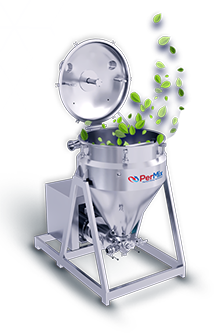
For that reason, purpose-built vacuum emulsifying systems have a practical advantage over general-purpose mixing equipment. They are designed to manage the full sequence – liquid preparation, powder incorporation, emulsification, deaeration, and final texture development – under controlled conditions. That matters when the goal is not just to make mayonnaise, but to make the same mayonnaise every batch at commercial throughput.
PerMix focuses on this exact production challenge with vacuum emulsifying and universal vacuum mixing systems engineered for mayonnaise, dressings, and related emulsified products. For processors balancing product quality with throughput, that engineering approach is what turns lab-scale success into plant-scale consistency.
Droplet size can be measured directly with particle size analysis or microscopy, but producers should also connect those numbers to practical line outcomes. A useful process target is not only a particle measurement. It is a repeatable combination of droplet profile, viscosity, appearance, and shelf-life behavior.
R&D and production teams should evaluate droplet size alongside batch time, temperature rise, vacuum stability, and ingredient addition sequence. If a process achieves fine droplets but requires excessive cycle time or creates too much thermal load, it may not be the right commercial setting. The best process window is the one that protects quality and supports efficient throughput.
Oil droplet size is one of the clearest indicators of mayonnaise process performance, but it should be treated as part of a broader emulsion strategy. The target is controlled structure: stable enough for shelf life, smooth enough for the intended sensory profile, and repeatable enough for industrial production.
When processors struggle with separation, poor body, batch inconsistency, or difficult scale-up, the answer is often found in the relationship between formulation and emulsification mechanics. Better droplet control does not come from more shear alone. It comes from the right process design, the right sequence, and equipment built for the realities of commercial mayonnaise manufacturing.
If your mayonnaise process is being judged by stability, texture, and repeatability, oil droplet size is not a secondary detail – it is where performance starts.

Get in touch with us today and learn how to we can help your business.