PerMix Mayonnaise Production
PerMix News

A mayonnaise batch can look perfect at the start of oil addition and still lose viscosity, gloss, or long-term stability after heating. That is why direct steam versus jacket heating is not a utility decision alone. It affects formula balance, emulsifier performance, sanitary design, batch time, and the consistency of every tote or jar leaving the plant.
For mayonnaise, dressings, ketchup, and other emulsified foods, the right answer depends on what is being heated, when heat is applied, and how tightly the finished solids and moisture specification must be controlled. Fast heat is valuable. Controlled heat is valuable. They are not always the same thing.
Direct steam heating injects steam into the product or process phase. As the steam condenses, it transfers a large amount of energy quickly. The result is rapid temperature rise with no need to wait for heat to travel through a vessel wall.
That speed can be useful when heating a water phase, preparing a starch-containing phase, or bringing a sauce batch to a target temperature in a short cycle. However, condensed steam becomes part of the product. Every pound of injected steam adds water. For a formula with a narrow moisture target, that addition must be calculated and accommodated in the recipe.
Jacket heating keeps the heating medium separate from the product. Steam, hot water, or thermal fluid circulates through the jacket around the vessel while product-side agitation moves material across the heated wall. No condensate enters the batch, so the formula remains unchanged by the heating method.
The trade-off is heat-transfer rate. A jacket must transfer energy through the vessel wall and then into the product. As viscosity rises, product movement at the wall becomes more critical. A poorly agitated high-viscosity batch can develop slow heating, uneven temperatures, and extended cycle times even when the jacket itself has ample utility capacity.
Mayonnaise is an oil-in-water emulsion, not simply a liquid that needs to reach a temperature. Oil droplet size, emulsifier hydration, acid addition, shear profile, vacuum level, ingredient sequence, and temperature all interact. A heating choice that works well for a thin sauce may create avoidable risk in a full-fat, low-fat, or egg-free mayonnaise process.
Direct steam introduces two concerns after an emulsion is established. First, the added water can lower final solids and alter the oil-to-water ratio. Second, the injection point can create localized thermal exposure if steam distribution and mixing are insufficient. A sensitive emulsion may show a change in viscosity or texture before the operator sees an obvious break.
Jacket heating gives processors more separation between thermal energy and product composition. It is generally the more controllable approach when maintaining a defined finished moisture level is essential, especially for products that must perform consistently after filling, shipping, and shelf-life storage.
This does not mean direct steam has no place in a mayonnaise system. It can be highly effective for heating a pre-emulsion aqueous phase, dissolving certain ingredients, or preparing a cooked component before final emulsification. The key is to treat steam condensate as a formulation ingredient, not as an invisible source of heat.
Direct steam is often selected when throughput and fast heat-up are the primary constraints. It can reduce batch time substantially in low-viscosity phases and can be a practical choice where vessel jacket area is limited. For starch-based sauce systems, rapid heating may also support the desired cooking profile when the process is designed around it.
Its performance depends on steam quality and distribution. Culinary steam should be appropriate for direct food contact, and the injection assembly must be designed for sanitary operation and cleanability. Poor-quality steam can introduce contaminants. Poorly placed injection can create noise, foaming, localized overheating, or inconsistent results.
Recipe management is equally important. If direct steam adds measurable water, the water charge must be reduced accordingly. A process team should calculate the expected condensate addition across the temperature rise, validate it at production scale, and establish an operating range. Relying on an operator to judge final thickness by appearance is not a controlled process.
Direct steam is usually less attractive when the product is already highly viscous or when it contains an established, shear-sensitive emulsion. Steam bubbles must disperse and condense effectively. In a thick finished mayonnaise, that is harder to achieve uniformly than in a moving aqueous phase.
Jacket heating is the preferred choice when formulation precision, product protection, and repeatability outweigh the need for the fastest possible temperature ramp. It allows a manufacturer to apply heat without changing water content, which is especially valuable for premium mayonnaise, reduced-fat products, and vegan formulations with carefully balanced hydrocolloids, proteins, and starches.
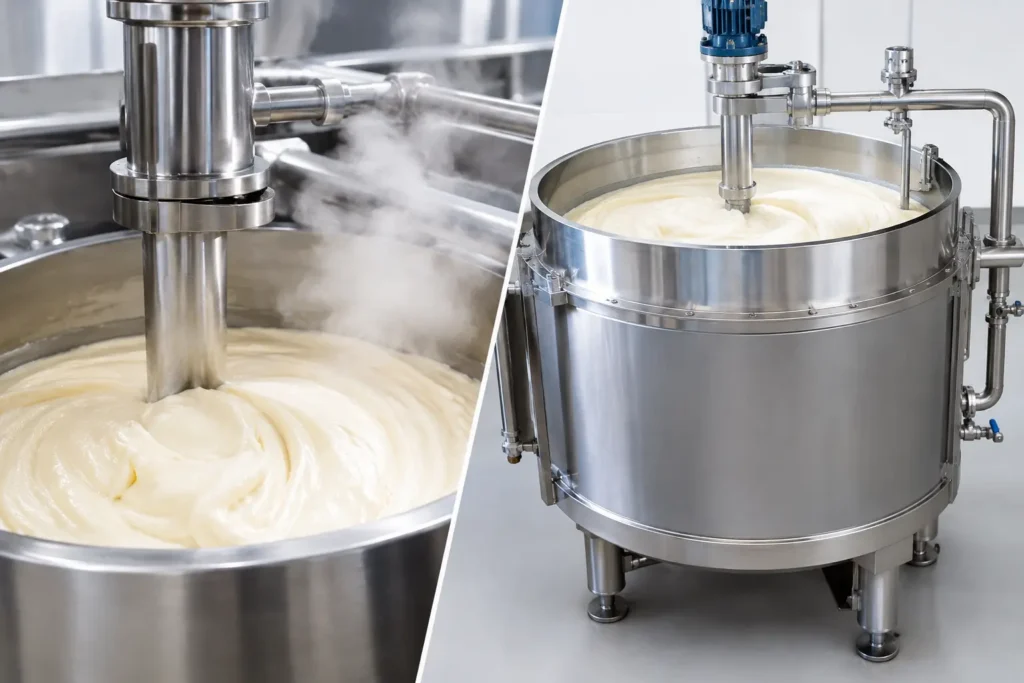
A properly designed jacketed vacuum emulsifying mixer combines heat transfer with product circulation and controlled shear. The agitator must continuously sweep or move product near the vessel wall, while the homogenizer creates the droplet size and dispersion needed for a stable emulsion. Heat transfer and mixing cannot be specified independently.
For high-viscosity dressings and mayonnaise, anchor agitation with wall-scraping action is often central to jacket performance. It limits product buildup on the heated surface and helps reduce temperature gradients. Vacuum operation can further support deaeration, improve product appearance, and reduce foam, but it also requires the heating and cooling system to be sized around the actual process conditions.
Jacket heating also provides a cleaner path to staged temperature control. A processor can heat the water phase, hold at a defined temperature if required, cool before sensitive ingredient addition, and manage final batch temperature before filling. That sequence is valuable when formulation behavior changes sharply across a narrow temperature range.
The decision should begin with the product specification, not with the available boiler capacity. Ask whether moisture content can vary, whether heat is applied before or after emulsification, how viscous the batch becomes during processing, and what batch time is commercially acceptable.
For a relatively thin aqueous phase where the recipe can absorb condensate, direct steam may provide a cost-effective speed advantage. For a finished emulsion where water content, texture, and stability must remain tightly controlled, jacket heating usually offers the safer process window.
Many facilities benefit from a combined strategy. The aqueous phase may be heated efficiently before oil addition, while the jacket manages the temperature of the main vessel through emulsification, vacuum deaeration, and cooling. This approach avoids forcing one heating method to solve every thermal requirement in the process.
Equipment sizing must reflect the actual batch profile. A vendor needs the batch size, target temperatures, initial ingredient temperatures, viscosity range, available utilities, required cycle time, and product family. Low-fat and vegan mayonnaise can be more demanding than conventional high-oil mayonnaise because powders, gums, starches, and plant proteins must disperse completely before the system reaches final viscosity.
At PerMix, heating design is evaluated as part of the full emulsification process: powder induction, agitation, homogenization, vacuum, heating, cooling, and discharge. That is the level of integration required to avoid solving a heat-transfer problem while creating a mixing or stability problem downstream.
A heat-transfer choice should be proven with representative ingredients and a documented production sequence. Record temperature rise, actual utility use, vacuum behavior, mixing speed, homogenizer settings, final moisture, viscosity, particle or droplet characteristics, and finished product stability. The goal is not merely to reach a setpoint. The goal is to reach it repeatedly without compromising the product.
Pay close attention to startup and end-of-batch conditions. A system may heat well at mid-batch volume but perform differently at minimum fill. It may also develop slow cooling at high viscosity, extending the time before filling. These details affect labor scheduling, line utilization, and the consistency of the first and last packages.
Choose direct steam when speed and formula flexibility support it. Choose jacket heating when product control is non-negotiable. The strongest processing system is the one that treats thermal design as part of emulsion quality, then proves that performance at the batch sizes your business plans to run.

Get in touch with us today and learn how to we can help your business.