PerMix Mayonnaise Production
PerMix News
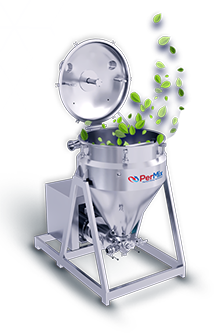

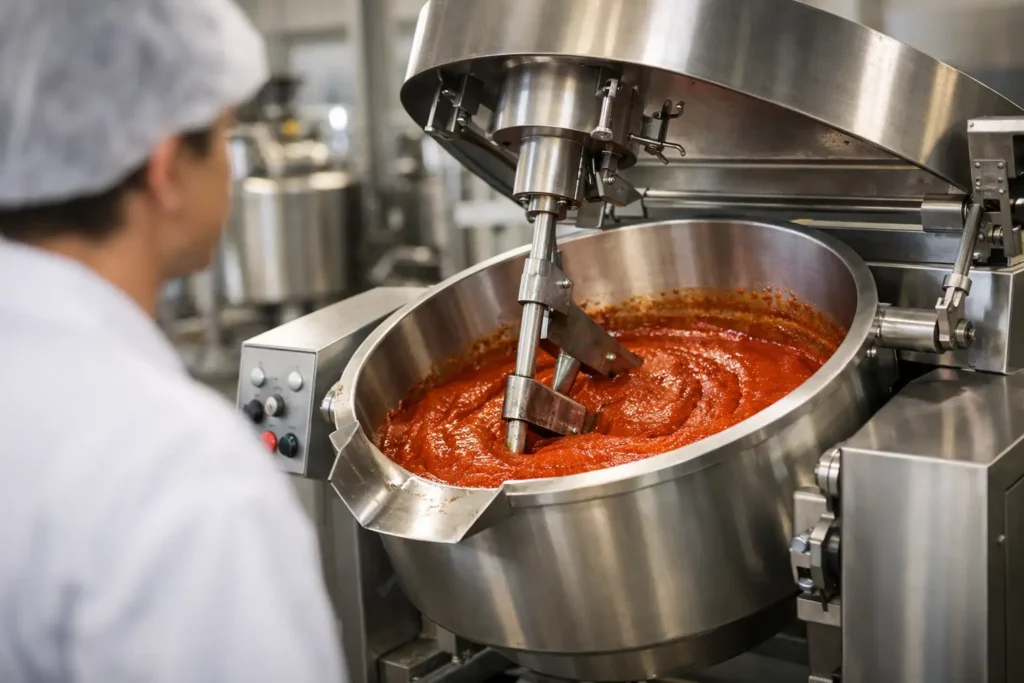
A commercial sauce mixer machine earns its keep long before the first batch ships. If ketchup is separating, starch is fisheyeing, or a vegan mayo line loses texture from batch to batch, the problem is usually not the recipe alone. It is often the way ingredients are introduced, dispersed, sheared, and held under process conditions that match the product.
For food manufacturers, that distinction matters. Sauce production is not just mixing. It is controlled hydration, dispersion, emulsification, deaeration, heat transfer, and repeatability at commercial scale. The right machine improves stability, shortens batch times, protects texture, and reduces waste. The wrong one creates workarounds, longer cleaning cycles, and quality variation that shows up in every tote, pouch, or bottle.
Many buyers start by looking at batch size and motor power. Those matter, but they are not enough. A sauce system has to match the behavior of the product during the full process, from initial liquid charging to final discharge.
Thin marinades and pourable sauces demand different mixing energy than high-viscosity dressings, mayo, or starch-thickened condiments. A machine that performs well on simple liquid blending may struggle once oil loading increases, powders are added quickly, or viscosity rises during hydration. This is where process design becomes more important than basic agitation.
For emulsified sauces, the machine must create reliable droplet reduction and stable dispersion without overprocessing. For starch-based products, it must wet out powders fast enough to prevent lumps while maintaining efficient circulation through the vessel. For products with sensitive gums, proteins, or egg systems, it must balance shear with control. High shear is useful, but uncontrolled shear can change the finished texture in ways that are expensive to fix downstream.
A standard tank with a top-entry mixer can handle simple blending. It is often not enough for modern sauce production. Once manufacturers move into mayonnaise, creamy dressings, fat-free systems, vegan emulsions, or products with challenging dry ingredients, limitations become obvious.
The first limitation is powder incorporation. Dry starches, gums, stabilizers, and seasonings do not simply disappear into liquid under a basic agitator. They float, clump, or stick to vessel walls. Operators compensate by slowing additions, scraping manually, or extending batch time. That adds labor and still may not solve hydration problems.
The second limitation is emulsion quality. A stable sauce depends on controlled droplet formation and uniform ingredient distribution. Without the right shear profile and vessel circulation, one zone may be overmixed while another remains underprocessed. The result can be inconsistent viscosity, poor mouthfeel, oiling off, or shortened shelf life.
The third limitation is air. Entrapped air affects density, fill accuracy, appearance, and product stability. In sauces and emulsions, vacuum capability is often a major performance advantage because it improves deaeration while supporting cleaner mixing conditions.
When evaluating a commercial sauce mixer machine, buyers should focus on features that solve production problems, not features that only look good on a specification sheet.
Vacuum matters when the product is prone to air entrapment or when appearance and stability are critical. In mayonnaise, creamy dressings, and similar emulsified sauces, vacuum processing can improve smoothness and reduce foam. It also supports more controlled ingredient intake and more consistent finished product density.
Not every sauce requires aggressive shear through the entire batch cycle. The better approach is targeted shear combined with vessel-wide turnover. This allows powders to disperse quickly and emulsions to form efficiently, while the rest of the product remains under controlled mixing conditions. That balance is especially valuable for low-fat and vegan systems, where formulation margins are often tighter than in conventional full-fat products.
Powder addition is one of the most common bottlenecks in sauce manufacturing. A machine with effective powder induction can pull ingredients into the liquid phase rapidly and reduce clumping. This shortens batch time, improves hydration, and lowers operator intervention. For plants working with starches, thickeners, proteins, and seasoning blends, this is not a convenience feature. It is a production requirement.
A high-performing mixer that is difficult to clean will create its own inefficiencies. Food manufacturers need sanitary construction, appropriate surface finish, reliable seals, and vessel geometry that does not trap material. Cleanability affects uptime, changeover speed, allergen management, and inspection confidence.
A good batch in the test kitchen is not the same as a good batch on the plant floor. Commercial sauce production requires process control that scales. Mixer speed, shear exposure, vacuum level, temperature, ingredient sequencing, and batch timing should be repeatable from run to run. If the machine cannot hold those variables consistently, the process becomes operator-dependent.
There is no single best commercial sauce mixer machine for every application. The right choice depends on the product family, ingredient behavior, and production target.
A ketchup or barbecue sauce line may prioritize fast powder wet-out, solid suspension, and reliable viscosity development. A mayonnaise line will place more emphasis on emulsification performance, vacuum operation, and oil phase incorporation. A fat-free dressing may require stronger control over hydrocolloid hydration and shear management because the formula has less structural forgiveness. Vegan emulsions often need especially careful process design because plant-based proteins and stabilizer systems can react differently than egg-based formulas.
This is why equipment selection should start with the actual product set, not a generic category such as sauce or dressing. If a manufacturer plans to run multiple SKUs on one system, that flexibility should be discussed early. A machine optimized only for one viscosity range may create compromise elsewhere.
Procurement teams often focus on current volume. That is reasonable, but undersizing a mixer can become expensive quickly. If the machine requires extra batches to meet demand, labor climbs, utility consumption increases, and scheduling becomes tighter. If the line is expected to support new products later, a narrow equipment choice can limit growth.
Oversizing has trade-offs too. Very small batches in a large vessel can reduce mixing efficiency, especially if the system is not designed for a wide operating range. Dead zones, poor turnover, and inconsistent shear exposure can appear when fill levels drop too low. The best decision usually comes from balancing current throughput, expected expansion, and minimum practical batch size.
Before approving a machine, buyers should push beyond generic claims. Ask how the system handles powder induction at commercial loading rates. Ask what happens as viscosity climbs through the batch. Ask how vacuum is maintained during ingredient additions. Ask whether the machine can support both pilot validation and full-scale production logic.
It also helps to discuss known failure points in the product. Does the sauce tend to break? Does starch form lumps? Does the finished product hold too much air? Does scale-up change texture? Those are the questions that separate a useful mixer discussion from a catalog review.
A specialist manufacturer can usually identify whether the issue is primarily about shear, circulation, vacuum, ingredient order, or a combination of all four. That level of process understanding often matters more than one extra horsepower on paper. PerMix positions well in this area because the discussion centers on emulsified food applications, not just on selling a vessel with a motor.
The value of a sauce mixer is measured in outcomes. Batch consistency should improve. Hydration time should drop. Emulsions should hold. Texture should remain uniform from the first container to the last. Cleaning should be manageable, and operators should not need improvised steps just to get through the run.
For manufacturers producing mayonnaise, ketchup, dressings, and other viscous or emulsified products, the machine is part of product quality control. It influences shelf stability, appearance, viscosity, mouthfeel, and line efficiency all at once. That is why equipment selection should be treated as a process decision, not just a capital purchase.
A strong commercial sauce mixer machine does more than mix ingredients. It gives the plant a more stable process to build on, which is exactly what growing sauce manufacturers need when quality, throughput, and repeatability all have to improve at the same time.
The best buying decisions usually come from one simple question: what process problem must this machine solve every day, without operator workarounds? Start there, and the right specification becomes much easier to define.

Get in touch with us today and learn how to we can help your business.