PerMix Mayonnaise Production
PerMix News

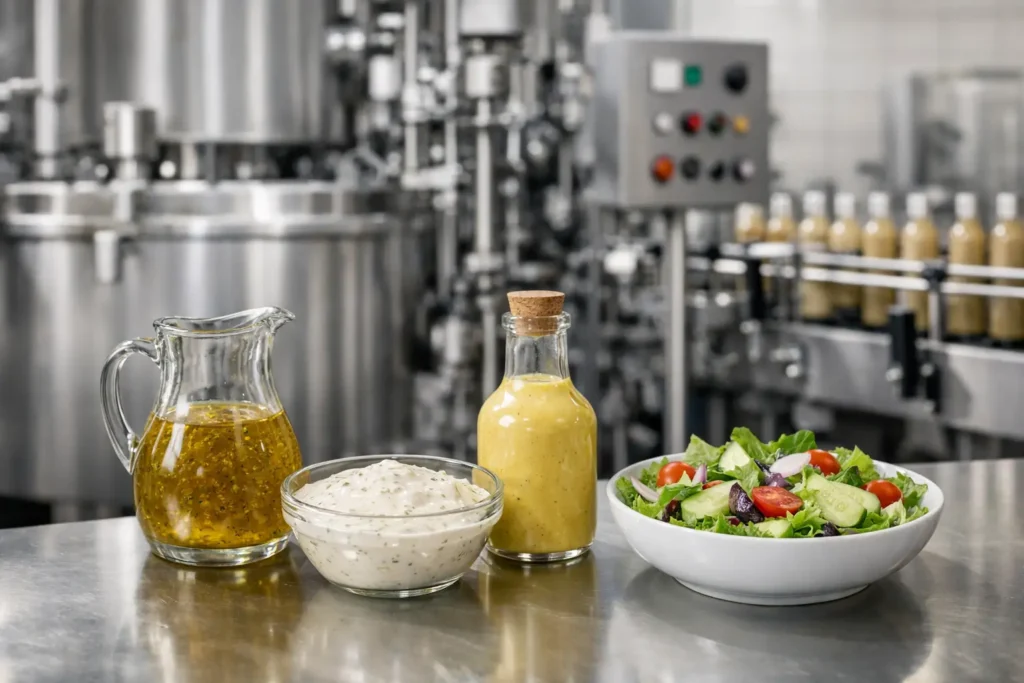
A dressing line that looks adequate on paper can still fail on the floor. The usual problems show up fast – broken emulsions, fisheyes from dry starch, oil separation in storage, slow batch times, and cleanup that steals production hours. That is why salad dressing production equipment should be evaluated as a process system, not just a mixer with a tank attached.
For manufacturers running creamy dressings, vinaigrettes, reduced-fat formulas, or vegan emulsions, equipment selection has a direct effect on texture, shelf stability, throughput, and labor efficiency. The right system improves dispersion, shortens batch cycles, and gives operators tighter control over repeatability. The wrong one creates ongoing correction work that no formulation tweak can fully solve.
Salad dressings are not one product family from a processing standpoint. A high-oil ranch, a starch-thickened Caesar, a pourable vinaigrette, and a fat-free emulsion all behave differently under shear, vacuum, and ingredient addition. Even when they fill into the same bottle size, they may require different mixing intensity, hydration time, and powder incorporation methods.
That is why equipment should be matched to the formulation set, not only to target batch volume. If the plant runs multiple SKUs, the key question is whether the system can handle the most difficult product in the portfolio without slowing every easier product around it.
In practice, dressing production equipment must do four things well. It has to create a stable emulsion, incorporate powders efficiently, control viscosity development, and support sanitary, repeatable operation. If one of those areas is weak, the process becomes operator-dependent, and consistency suffers from batch to batch.
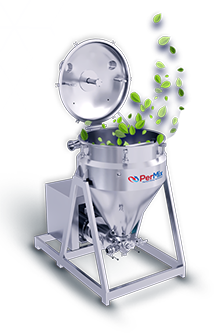
At the center of most dressing systems is the mixer processor. For emulsified products, this is where most process success or failure begins. A standard agitator may move product, but it often cannot deliver the shear profile needed for fine droplet size, fast powder wet-out, or strong batch consistency. That matters even more in formulas containing gums, starches, proteins, egg alternatives, or high solids.
A vacuum emulsifying mixer is often the preferred choice for creamy dressings and other products where texture and stability are critical. Vacuum helps reduce entrapped air, which improves appearance, density control, and emulsion quality. It also supports cleaner powder induction and can reduce foaming issues that complicate processing and filling.
High-shear mixing is another critical piece. Oil phase dispersion, hydrocolloid hydration, and particle reduction all depend on controlled shear energy. Too little shear can leave the product unstable or grainy. Too much shear can damage the target texture or create unnecessary heat. Good equipment gives processors enough range to handle different formulations without overprocessing them.
Powder induction deserves special attention. Many dressing lines struggle when dry ingredients are dumped directly into the vessel. The result is clumping, poor hydration, and long correction cycles. Integrated powder induction equipment improves wetting speed and helps pull ingredients into the liquid stream under controlled conditions. For plants handling starches, gums, milk powders, spices, and seasoning blends, this feature can make a major difference in both yield and cycle time.
Downstream, the line usually includes holding tanks, transfer pumps, filtration where needed, and filling integration. These support components matter, but they should not be chosen before the mixing process is defined. A fast filler does not help if the mixer cannot produce a stable, fill-ready product on schedule.
Creamy emulsified dressings usually place the highest demands on the system. These products need controlled oil droplet formation, reliable stabilization, and smooth texture without visible defects. Vacuum emulsification and high-shear mixing are often the most effective combination here, especially when the product line includes low-fat or vegan formulas that are less forgiving than traditional full-fat systems.
Vinaigrettes can appear simpler, but they still require the right approach. If the product is designed to separate naturally, the process requirement is different from a semi-stable or permanently emulsified vinaigrette. In some cases, moderate agitation is enough. In others, especially when stabilizers are used, more precise shear and ingredient dispersion are needed to maintain appearance and suspension.
Reduced-fat and fat-free dressings often present the toughest processing conditions. These formulas rely more heavily on starches, gums, and proteins to build body and mouthfeel. That increases the importance of powder incorporation, hydration control, and mixing precision. Equipment that performs well on standard oil-rich formulas may not deliver the same results on these more sensitive systems.
Mixer design should be judged by what it does under load, not by motor size alone. Vessel geometry, rotor-stator configuration, agitator style, scraper design, vacuum capability, and powder handling all affect final product quality. A technically sound system balances circulation with shear so the whole batch receives uniform treatment.
Temperature control is another factor that should not be overlooked. Some dressing formulas need heating to hydrate starches or dissolve ingredients efficiently. Others require tight thermal control to protect flavor, color, or emulsion structure. Jacketed vessels and accurate process controls give operators more predictable outcomes, especially when scaling from pilot to production.
Sanitary design also has direct commercial value. Poor drainability, dead zones, and difficult-to-clean internals extend downtime and raise contamination risk. For food manufacturers, cleanability is not a secondary feature. It affects labor, changeover time, allergen control, and audit readiness. Equipment should support efficient cleaning without forcing maintenance teams into constant disassembly.
Automation level depends on plant goals. Some operations need semi-automatic systems that give operators flexibility. Others benefit from recipe-driven controls, automated ingredient sequencing, and repeatable vacuum and mixing profiles. The right answer depends on SKU count, labor availability, and the cost of batch deviation. For high-volume or multi-formula production, tighter automation usually improves consistency and reduces reliance on operator judgment.
One of the most common mistakes is sizing only for current throughput. If the equipment barely covers today’s demand, it leaves little room for growth, seasonal surges, or new product launches. On the other hand, oversizing can reduce process efficiency on smaller batches. The best approach is to size around realistic production planning, including batch frequency, shift structure, and future formulation needs.
Another mistake is focusing too heavily on capital price without measuring process cost. Lower-cost equipment can become expensive if it extends batch times, increases waste, or requires manual correction during every run. Procurement teams do not just buy steel. They buy yield, uptime, consistency, and production confidence.
It is also risky to assume that all emulsifying systems perform the same. Two machines may appear similar in basic specification, but perform very differently when processing difficult powders or sensitive emulsions. This is where application knowledge matters. A supplier that understands dressing rheology, emulsion stability, and scale-up challenges will usually provide better long-term value than one selling general-purpose mixing equipment.
The most effective evaluation starts with the product set. Define viscosity range, oil content, powder load, particle expectations, batch size, and cleaning requirements. Then assess how the equipment handles the hardest formula, not the easiest one. If a system can run the most demanding dressing cleanly and repeatably, it will usually perform well across the broader line.
Ask practical questions about batch cycle time, vacuum performance, powder induction method, shear control, and clean-in-place compatibility. Review how the system supports ingredient staging and operator workflow. Small process inefficiencies become expensive very quickly in commercial production.
Where possible, trial data or process consultation should guide the final decision. For manufacturers running multiple emulsified products, equipment flexibility can be just as valuable as maximum output. PerMix focuses on this application-specific approach because dressing, mayonnaise, and sauce production all reward equipment that is engineered around real formulation behavior.
The best equipment choice is the one that gives your plant control. Control over emulsion quality, control over batch time, and control over what happens when the product line expands. That is what turns a mixer into a production asset rather than a constant source of adjustment.

Get in touch with us today and learn how to we can help your business.