PerMix Mayonnaise Production
PerMix News
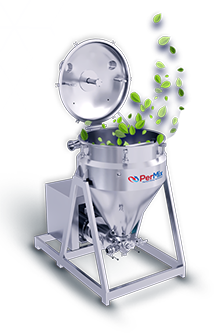

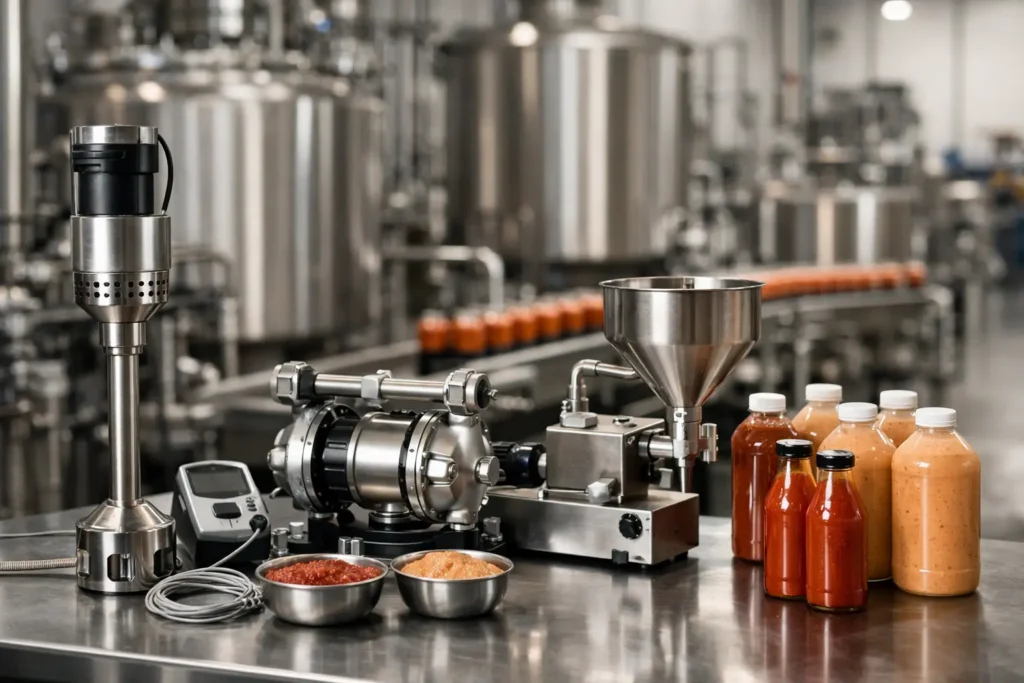
When a sauce line misses target viscosity by a few hundred centipoise or shows oiling off after filling, the problem is rarely just the recipe. In most cases, the real issue is equipment fit. Choosing the best equipment for sauce plants means selecting machinery that matches the product’s rheology, ingredient behavior, sanitation standard, and production volume – not just buying a bigger tank and a faster pump.
Sauce manufacturing covers a wide range of products: mayonnaise, ketchup, dressings, marinades, cooking sauces, vegan emulsions, and starch-thickened systems. These products do not behave the same way in process. Some need aggressive powder incorporation. Some require tight shear control to build stable emulsions. Others need gentle transfer to protect texture. That is why equipment selection should start with process demands, not a generic line layout.
At plant level, equipment has to deliver four outcomes consistently: batch uniformity, reliable throughput, sanitary operation, and repeatable finished-product quality. If one of those fails, the line becomes expensive very quickly.
Uniformity starts in the mixing stage. A sauce plant cannot afford dead zones, poor powder wet-out, or long batch times caused by underpowered agitation. Throughput depends on more than vessel size. It also depends on how quickly powders can be inducted, how efficiently the batch can be heated or cooled, and how fast the product can move downstream without separation or excessive shear.
Sanitation is equally critical. Sauces often contain oil, egg, starch, sugar, acids, and particulates. Residue builds differently depending on formulation, which means poor hygienic design creates cleaning delays and contamination risk. The best equipment for sauce plants is designed for cleanability from the start, with proper surface finishes, drainability, and process compatibility with CIP routines.
For most sauce plants, the mixer is the most important capital decision on the floor. If the mixing system is wrong, downstream equipment cannot fix the batch.
For mayonnaise, salad dressings, creamy sauces, and other emulsified products, a vacuum emulsifying mixer is usually the strongest option. Vacuum processing improves ingredient incorporation, reduces entrapped air, supports a smoother finished texture, and helps build a more stable emulsion. That matters in products where gloss, mouthfeel, and shelf stability are tied directly to droplet size and dispersion quality.
Vacuum also improves powder handling. Dry ingredients such as starches, gums, proteins, and stabilizers are easier to pull into the liquid phase when the system is engineered for controlled induction. In practical terms, this means fewer fisheyes, less powder floating, shorter hydration time, and more predictable viscosity development.
The trade-off is cost and complexity. A vacuum emulsifying system is not always necessary for every hot-fill cooking sauce or low-viscosity marinade. But for manufacturers producing mayonnaise, vegan mayo, dressings, and other critical emulsions, it is often the difference between acceptable and commercially competitive.
Plants producing multiple sauce categories usually benefit from a universal mixer processor rather than a single-purpose vessel. This type of system handles heating, cooling, mixing, emulsifying, and in many cases deaeration within one platform. It is particularly useful for co-manufacturers and product developers dealing with short runs, changing formulas, and varied viscosities.
The benefit is flexibility. The limitation is that flexibility still needs to be engineered correctly. A universal system that is too generalized may not deliver the shear intensity needed for a demanding emulsion, or the gentle handling required for sauces with inclusions. Equipment sizing and agitator design matter just as much as the label on the machine.
Many sauce issues begin when powders hit liquid. Starch, xanthan gum, modified food starch, milk powder, protein systems, and seasoning blends can all create agglomerates if they are not introduced properly. Once lumps form, extra mixing time often does not solve the problem. It just adds labor, heat history, and inconsistency.
That is why high-performance powder induction should be treated as a core capability, not an add-on. A well-designed induction system shortens batch cycles, improves hydration, and reduces operator dependency. It also supports difficult formulations such as low-fat and fat-free systems, where water-phase structure is doing more of the work normally provided by oil.
For manufacturers working with vegan emulsions, this becomes even more important. These systems can be less forgiving than traditional egg-based mayonnaise and often rely on tight control of hydrocolloid and protein dispersion. Equipment that handles powders badly will show up later as poor body, instability, or texture defects.
Many sauces need controlled thermal processing during mixing. Heating may be required for hydration, dissolution, pasteurization, or viscosity build. Cooling may be needed before filling or after emulsification to protect product structure.
Jacketed vessels are standard, but not all jackets perform equally. The real question is whether the system can transfer heat efficiently across the viscosity range of the product. A thin cooking sauce behaves very differently from a heavy mayonnaise. If heat transfer is slow, batch time increases and product quality can drift from the target.
Scraped-surface support or optimized agitator geometry may be necessary for viscous products where wall heat transfer becomes a bottleneck. This is one of the areas where under-specifying equipment looks cheaper up front and becomes expensive in production.
Once the batch is finished, it still has to move through the plant without damage. That sounds simple until a carefully built emulsion breaks in the transfer loop.
Positive displacement pumps are commonly the right choice for viscous sauces because they provide controlled flow and better handling of thicker products. Centrifugal pumps may work for lower-viscosity liquids, but they are not ideal for every sauce application. The wrong pump can introduce excess shear, aeration, or throughput limitations.
Pipe sizing also matters. Narrow lines can create pressure drop and product stress. Oversized lines can hurt velocity and cleaning performance. The best setup depends on viscosity, temperature, particulates, and required flow rate. There is no one-size-fits-all answer, which is why transfer design should be treated as part of the process, not an afterthought.
A stable batch still needs accurate filling. Sauce plants typically need filling systems that can handle viscosity variation, maintain portion control, and avoid dripping or stringing. Piston fillers, servo fillers, and pump-based systems each have a place depending on product type and container format.
For mayonnaise and heavy dressings, clean cutoff and deposit accuracy are usually more important than maximum speed alone. For ketchup or cooking sauces, line speed may take priority if the product flows consistently. Plants running multiple SKUs should also consider changeover time, since frequent format changes can quietly reduce effective capacity.
Packaging equipment should be matched to upstream consistency. If the product temperature or viscosity swings from batch to batch, filler performance suffers. Good filling starts with good process control in the tank.
No equipment list for a sauce plant is complete without cleaning considerations. Sanitary performance affects uptime just as much as production speed does.
Tanks, mixers, valves, and pipelines should be designed for full drainability and reliable CIP coverage. Dead legs, poor welds, and hard-to-clean seals create risk. Sauce plants dealing with allergens, egg systems, and frequent flavor changes have even less margin for compromise.
This is also where cheaper equipment often reveals its true cost. If a system takes longer to clean, needs more manual intervention, or fails validation standards, the savings disappear quickly. The best equipment for sauce plants supports fast turnaround and predictable hygiene performance.
The right equipment package depends on three variables: formulation complexity, production volume, and product portfolio.
If the plant produces mostly emulsified products such as mayonnaise, sandwich spreads, and creamy dressings, vacuum emulsification should be near the center of the decision. If the product range includes both emulsified and cooked sauces, a universal processing platform may offer better total value. If powders drive frequent process issues, induction capability should move higher on the priority list than vessel size alone.
Capacity planning should also be realistic. Oversizing can reduce efficiency in small batches. Undersizing leads to overtime, extra shifts, and line congestion. The right design is the one that meets demand while protecting process conditions that create product quality.
This is where a specialist approach matters. Companies such as PerMix focus on the actual behavior of mayonnaise, dressings, ketchup, and related products, not just on generic mixing theory. That difference shows up in batch times, emulsion quality, and how easily the line scales from development to commercial output.
A sauce plant does not win on equipment count. It wins on process control. The best investment is the equipment that gives your team cleaner dispersion, tighter consistency, faster cycles, and fewer surprises at filling time. If the line makes quality easier to repeat, it is the right line.

Get in touch with us today and learn how to we can help your business.