PerMix Mayonnaise Production
PerMix News

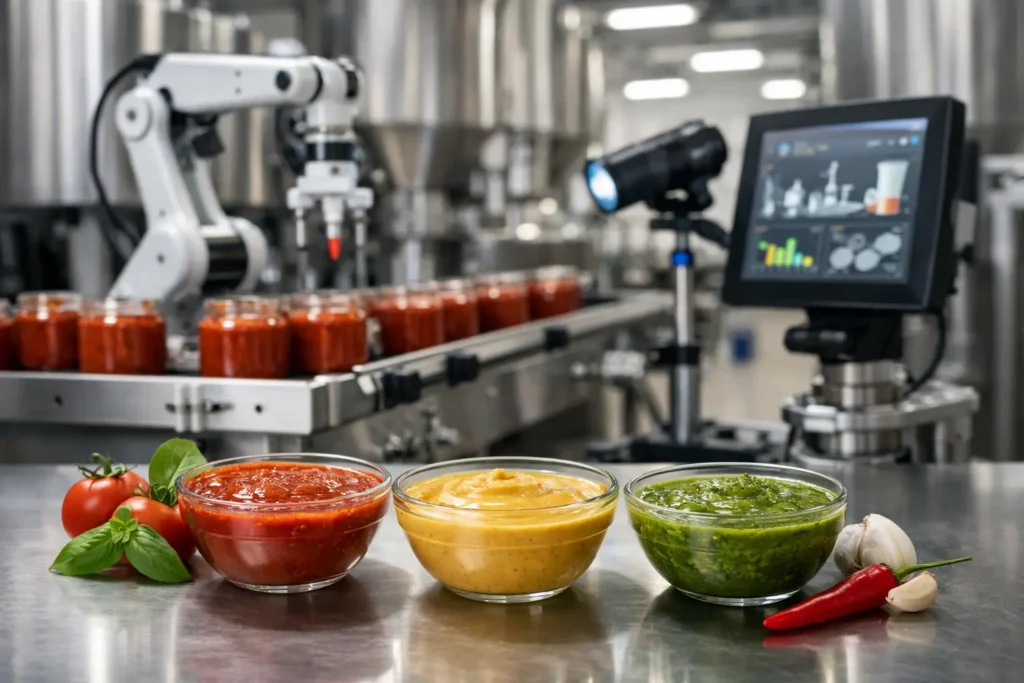
A mayonnaise batch can look acceptable at discharge and still fail on the shelf. A ketchup line can meet its hourly target while wasting time on powder additions, cleanup, and texture corrections. That is why sauce processing technology trends matter to manufacturers: the value is not in adding more equipment features. It is in controlling the process variables that determine emulsion stability, viscosity, flavor release, throughput, and repeatability.
For producers of mayonnaise, dressings, ketchup, and specialty sauces, the strongest technology investments are centered on better dispersion, controlled vacuum processing, hygienic design, faster changeovers, and production systems that can handle a wider formulation range. These changes are especially relevant as low-fat, fat-free, egg-free, and vegan products place more stress on mixing and emulsification equipment.
Vacuum processing is no longer reserved for premium or highly specialized sauce lines. It is increasingly specified because it addresses practical production problems that affect both product quality and operating cost.
During mayonnaise and dressing production, vacuum helps remove entrained air created during powder addition, agitation, and high-shear mixing. Reduced air improves product appearance, supports more accurate filling by volume, and can improve emulsion quality. It also helps limit oxidation in formulations containing sensitive oils, flavors, colors, or botanical ingredients.
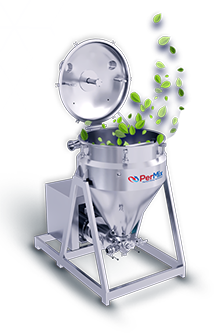
The benefit depends on the formulation and process sequence. A simple, high-oil mayonnaise may emulsify well with a basic system under the right conditions. But when formulations include stabilizer systems, proteins, fibers, starches, sugar alternatives, or challenging oil phases, a vacuum emulsifying mixer provides far more process control. It combines deaeration, high-shear homogenization, and controlled blending in one enclosed vessel.
For plants making multiple products, vacuum capability also provides flexibility. The same processor can support traditional mayonnaise, reduced-fat dressing, vegan emulsions, and thick sauces where air removal and smooth texture are commercially important.
Powder addition remains one of the most common sources of batch variability. Dry starches, gums, salt, sugar, milk powders, proteins, and functional ingredients can form fish eyes, hydrate unevenly, or stick to the vessel wall. Manual dumping also introduces dust, labor exposure, inconsistent addition rates, and longer batch times.
Modern powder induction systems use vacuum or controlled liquid flow to draw powders directly into the process stream. The objective is fast wetting and dispersion before agglomerates have time to form. For sauce manufacturers, this can reduce rework and improve texture consistency without requiring excessive mixing time.
The equipment selection must match the ingredient behavior. A low-dose gum addition requires different handling than high-volume modified starch or sugar. Some materials bridge easily in hoppers. Others need controlled feed devices, bag dumping stations, or liquid recirculation conditions that keep the induction line clear. Good equipment design starts with the actual formula, addition order, particle characteristics, and target batch size.
High shear is essential for many emulsified products, but more shear is not automatically better. The trend is toward applying the right shear at the right stage, rather than operating a homogenizer at maximum intensity throughout the batch.
In mayonnaise production, the process must create fine oil droplets and distribute them evenly through the continuous phase without destabilizing the emulsion. In ketchup and starch-thickened sauces, high shear may be needed to disperse ingredients efficiently, yet overly aggressive or prolonged processing can affect body, viscosity, and product character.
Manufacturers are increasingly evaluating mixer geometry, rotor-stator design, recirculation rate, and batch residence time as a complete system. A well-designed vacuum emulsifying mixer can combine slow-speed wall scraping with high-shear homogenization. This allows effective heat transfer, uniform blending, and controlled particle size development while preventing material buildup on the vessel surface.
That distinction matters at scale. A recipe proven in a pilot mixer does not always behave the same way in a larger vessel. Scale-up requires attention to tip speed, power input, circulation, vessel shape, and the order in which water, oil, acids, and powders enter the batch.
Consumer demand for cleaner labels and alternative formulations is changing sauce production more than any single automation feature. Reduced-fat mayonnaise, for example, contains less oil to create body and depends more heavily on hydrocolloids, starches, proteins, and stabilizer systems. These ingredients are often harder to disperse and more sensitive to hydration conditions.
Vegan mayonnaise presents another set of process requirements. Egg-free formulations may use plant proteins, aquafaba, modified starches, or other emulsifying systems. Their performance can vary with pH, temperature, shear exposure, and ingredient addition timing. A processor designed only for conventional mayonnaise may not deliver the same stability across a plant-based portfolio.
This is why flexible processing systems are gaining preference over single-purpose equipment. Manufacturers need to test and commercialize products without building a separate line for every formulation. A Universal Vacuum Mixer Processor can be configured to handle blending, heating, cooling, vacuum deaeration, powder incorporation, and high-shear mixing in a controlled batch environment. The commercial advantage is faster product development and fewer compromises when production schedules change.
Sanitation has always been fundamental in food processing, but the current expectation is higher: equipment must be hygienic by design and fast to return to production. Dead zones, difficult-to-clean valves, exposed seals, and poorly drained piping increase cleaning time and create unnecessary risk.
Sauce manufacturers are prioritizing systems with smooth internal finishes, sanitary connections, clean-in-place capability, complete drainage, and components that can be inspected and maintained without excessive downtime. This is particularly relevant for lines that alternate between allergen-containing and allergen-free products, or between egg-based and vegan recipes.
The trade-off is that hygienic design must not sacrifice processing performance. A vessel can be easy to clean but still perform poorly if it lacks adequate agitation near the wall, ineffective powder induction, or insufficient homogenization. The best specification evaluates cleanability and processing capability together, not as separate purchases.
Automation in sauce processing is shifting from basic timer control toward recipe-driven repeatability. Modern control systems can manage vacuum level, temperature ramps, agitator speed, homogenizer speed, mixing time, and ingredient addition sequences. This reduces dependence on operator judgment for critical steps and makes batch records easier to review.
For a plant operating only one stable product, advanced automation may not deliver an immediate return. For manufacturers with multiple SKUs, frequent changeovers, or strict consistency targets, the benefit can be substantial. Recipe control helps protect the process when experienced operators are unavailable, and it supports a more disciplined scale-up from R&D to commercial batches.
Useful automation should remain practical. Operators need clear screens, meaningful alarms, and controls that reflect the actual process. Data that does not lead to better decisions becomes another maintenance burden. The priority should be visibility into variables that drive quality: temperature, vacuum, batch time, mixing intensity, and addition sequence.
Energy efficiency is increasingly part of capital planning, but the lowest motor rating does not necessarily produce the lowest operating cost. A mixer that takes longer to disperse powders, requires repeated correction batches, or leaves residue that extends cleaning cycles can cost more over its service life than a higher-performance system.
The more useful calculation includes batch time, product yield, labor, cleaning duration, utility use, and maintenance access. Efficient heat transfer through a properly designed jacket and agitation system can shorten heating and cooling stages. Effective wall scraping can reduce material loss and improve temperature uniformity. Reliable powder induction can reduce both labor and wasted ingredients.
Throughput also depends on the full production sequence, not only mixer volume. A 1,000-gallon vessel is not a 1,000-gallon-per-hour system if filling, processing, discharge, and cleaning create long gaps between batches. Manufacturers should define realistic production targets before selecting equipment and account for the highest-viscosity products in the portfolio.
The right technology roadmap begins with the failure points on the current line. If batches contain air, focus on vacuum capability. If starches and gums form lumps, prioritize powder induction and effective recirculation. If emulsions break or vary by shift, evaluate homogenization performance, recipe control, and ingredient sequencing. If changeovers consume the day, hygienic design and clean-in-place performance may provide the strongest return.
PerMix approaches these decisions as formulation and process challenges, not simply vessel-sizing exercises. The right equipment must match the product viscosity, emulsification target, powder load, thermal requirements, sanitation standard, and planned production volume.
The most productive sauce lines are built around control rather than correction. When mixing, vacuum, powder handling, and sanitation work together, operators spend less time rescuing batches and more time producing sauces that perform the same way every time.

Get in touch with us today and learn how to we can help your business.