PerMix Mayonnaise Production
PerMix News

A mayonnaise line can meet its batch target and still lose money through oil separation, uneven texture, trapped air, slow powder addition, or excessive cleanup. The question of how to choose mayonnaise mixer equipment is therefore not a question of vessel size alone. It is a process decision that affects product stability, throughput, labor requirements, sanitation, and the ability to launch new formulations without rebuilding the line.
For commercial producers, the right mixer must create a fine, repeatable emulsion while handling the actual realities of the recipe: high oil content, egg or egg-free systems, starches, gums, acids, sweeteners, and dry ingredients that tend to clump. Start with the product and production target, then specify the mixing system around those requirements.
Standard full-fat mayonnaise is usually more forgiving than low-fat, fat-free, or vegan alternatives. A conventional oil-rich formula has a relatively strong emulsified structure when the process is controlled correctly. Reduced-fat products often rely more heavily on starches, hydrocolloids, proteins, and other functional ingredients to deliver body and mouthfeel. Those ingredients create a different mixing challenge.
Before comparing equipment, define the formulations the system must run now and in the next three to five years. Include target viscosity, oil percentage, batch size, expected annual volume, particulate requirements, and shelf-life expectations. A mixer selected only for one current SKU may become a bottleneck as soon as R&D introduces a clean-label dressing, a vegan mayonnaise, or a starch-thickened low-fat product.
The most useful specification is not simply “mayonnaise mixer.” It is a process brief that states what must be dispersed, emulsified, heated or cooled, and transferred at each stage of production.
Full-fat mayonnaise requires controlled oil incorporation and enough shear to reduce droplet size without overprocessing the emulsion. Low-fat and fat-free formulas commonly require stronger powder wetting and dispersion because starches, gums, and stabilizers carry much more of the texture-building burden.
Vegan mayonnaise can add another layer of complexity. Plant proteins, modified starches, aquafaba, fibers, and alternative emulsifiers can respond differently to pH, temperature, hydration time, and shear exposure. If these products are part of the plan, choose a mixer designed for formulation flexibility rather than a basic agitator with a high-speed head added as an afterthought.
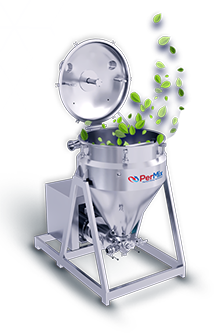
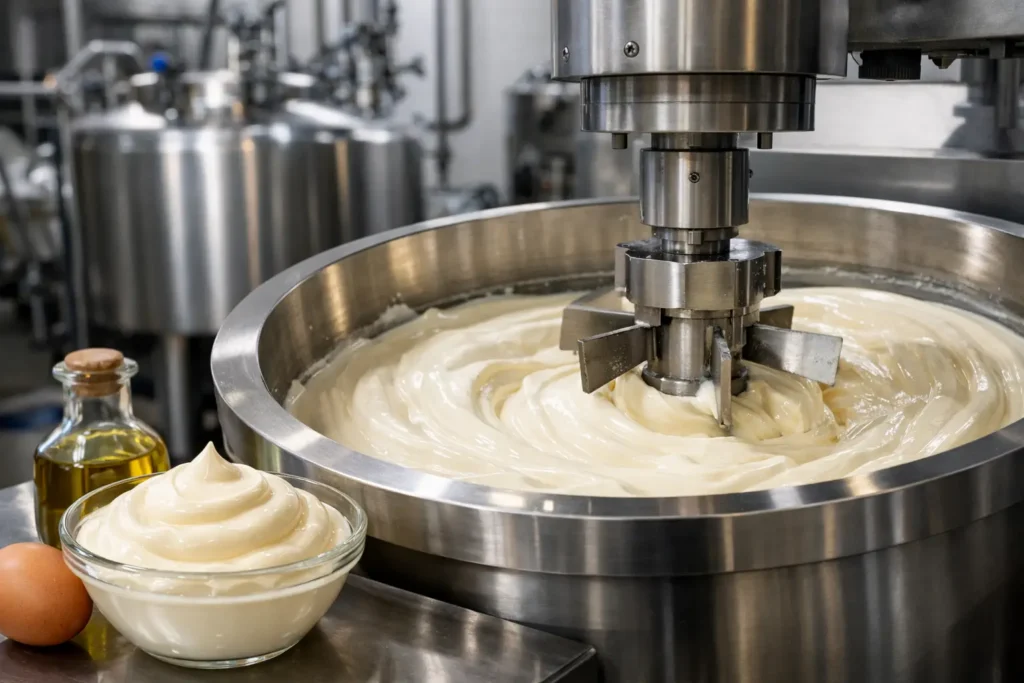
A tank with an agitator can blend liquid ingredients, but blending is not the same as emulsifying. Stable mayonnaise production typically requires a coordinated system: an anchor or sweep agitator for bulk circulation, a high-shear emulsifying head for droplet reduction and dispersion, and vacuum capability for deaeration and controlled ingredient handling.
A vacuum emulsifying mixer is often the strongest fit for manufacturers producing mayonnaise, dressings, ketchup, and similar viscous emulsions. Under vacuum, the system can reduce entrained air, improve product appearance, support smoother texture, and help prevent oxidation-related quality issues. Vacuum processing also supports more controlled powder charging and can limit dust during ingredient addition.
The exact configuration depends on the formula. Some operations need a bottom-mounted high-shear homogenizer to process thick products efficiently. Others benefit from an external recirculation loop that allows repeated passes through a high-shear zone. For difficult powders, a vacuum powder induction system can be more valuable than simply increasing mixer speed.
Do not assume higher RPM automatically means better mayonnaise. Excessive or poorly directed shear can create heat, damage sensitive structures, introduce unnecessary air before vacuum removal, or produce inconsistent results from batch to batch. The goal is sufficient, well-applied shear combined with reliable bulk movement throughout the vessel.
Dry ingredient addition is one of the most common sources of mayonnaise inconsistency. Starches, gums, salt, sugar, protein powders, and stabilizer blends can form fisheyes or agglomerates when they contact liquid too quickly. Once a gum particle develops a hydrated outer layer around a dry center, extra mixing time may not fully correct the problem.
A properly designed powder induction arrangement pulls dry material into the liquid stream under controlled conditions. This improves wetting, reduces airborne dust, shortens addition time, and helps operators maintain a repeatable process. It is especially relevant for low-fat, fat-free, and vegan mayonnaise, where powder functionality has a major effect on viscosity and stability.
Ask equipment suppliers to explain how the system handles your most difficult ingredient, not just water-soluble powders. Provide representative samples when possible. A mixer that performs well with oil and vinegar may not be adequate for a formula containing pregelatinized starch, xanthan gum, pea protein, or a proprietary stabilizer package.
Nominal vessel capacity is only one part of sizing. Every mixer has a practical working range, and operating too far below or above that range can reduce mixing effectiveness. A 500-gallon vessel may not deliver the same circulation pattern in a 150-gallon pilot batch. Likewise, filling it too high can limit headspace needed for vacuum operation, ingredient addition, and product movement.
Define the smallest and largest batches you expect to run, then confirm that the mixer can perform consistently across that range. This matters for plants that run both large-volume core SKUs and smaller R&D, seasonal, or customer-specific batches.
Throughput should include the complete batch cycle: charging, powder induction, emulsification, vacuum deaeration, heating or cooling where required, discharge, and cleaning. A machine that mixes rapidly but takes too long to load, cool, or clean may not improve daily output. Request cycle-time assumptions tied to your product viscosity and production temperature.
Mayonnaise is sensitive to process conditions. A formula that looks excellent in a small pilot tank can separate or change texture when transferred to a larger system with a different shear profile, residence time, or oil addition rate.
If you are scaling a new product, look for equipment and technical support that preserve critical process parameters as closely as possible. These include tip speed, shear intensity, oil feed rate, temperature profile, vacuum level, and the order of addition. The objective is not to duplicate every laboratory condition. It is to create a commercial process that delivers the same product attributes reliably.
Mayonnaise equipment must support food safety without creating unnecessary downtime. Product-contact surfaces should be suitable for food processing, with sanitary welds, cleanable geometry, and minimal areas where product can collect. For most commercial applications, stainless steel construction and a properly engineered clean-in-place approach are baseline requirements.
Ask to review the vessel internals, agitator design, seals, valve arrangement, and discharge path. Dead zones can hold product and complicate cleaning. Poor access can turn routine inspection or seal replacement into an extended maintenance event. The lowest initial equipment price can become expensive if sanitation labor, lost production time, or replacement parts are excessive.
Also evaluate the controls package. Operators need clear recipes, repeatable setpoints, alarm handling, batch records where required, and the ability to manage oil addition, vacuum, mixing speed, and temperature in a controlled sequence. Automation should fit the plant’s operating model. A highly automated line may be justified for high-volume production, while a flexible semi-automated system may better serve a co-manufacturer or multi-SKU operation.
A credible mixer supplier should discuss your formula, viscosity range, batch profile, utilities, sanitation standard, and expansion goals before proposing a model. If the conversation begins and ends with tank volume and motor horsepower, the equipment may be underspecified.
Use the evaluation process to ask direct questions:
These questions move the discussion from equipment features to manufacturing outcomes. They also make it easier to compare proposals fairly, since two mixers with similar capacities may have very different powder handling, vacuum, automation, and service capabilities.
The best mayonnaise mixer is not necessarily the largest or the most complex. It is the system that consistently produces the intended emulsion, handles your ingredients without delay, fits the plant’s sanitation practices, and leaves room for the next product launch.
PerMix approaches mayonnaise processing as an emulsification application, not a generic tank sale. For manufacturers running demanding low-fat, fat-free, vegan, or conventional formulas, that application focus can make the difference between a line that merely blends ingredients and one that delivers stable, market-ready product batch after batch.
Bring your actual formulation, production target, and operational constraints into the equipment review. A well-chosen mixer should give your team a repeatable process today and the confidence to develop the next profitable mayonnaise product tomorrow.

Get in touch with us today and learn how to we can help your business.