PerMix Mayonnaise Production
PerMix News

A mayonnaise line can hit the right viscosity in the tank and still disappoint in the drum. A dressing can look smooth at discharge, then show oiling off days later. In many cases, the problem starts with emulsion droplet size control. For manufacturers producing mayonnaise, sauces, and dressings at commercial scale, droplet size is not a lab-only metric. It is a production variable that directly affects texture, stability, appearance, shelf life, and batch repeatability.
When droplet size is too large, the emulsion is more vulnerable to creaming, coalescence, and separation. When size distribution is too broad, one batch may fill cleanly while the next behaves differently under the same downstream conditions. And when process settings are pushed too hard in an attempt to force smaller droplets, operators can create excess heat, overprocess sensitive ingredients, or waste cycle time without improving product quality. Good control is not about chasing the smallest possible droplet. It is about producing the right droplet size, consistently, for the product and the process.
In high-volume food manufacturing, droplet size affects more than visual smoothness. Smaller and more uniform droplets generally improve physical stability because the oil phase is better dispersed and less likely to separate. They also influence mouthfeel. A fine, narrow droplet distribution typically supports a creamier texture and a cleaner, more consistent appearance in mayonnaise and premium dressings.
But the target depends on the formulation. Full-fat mayonnaise often has different processing behavior than low-fat, fat-free, or vegan systems. Once fat content drops, or when egg is replaced, the emulsion usually becomes less forgiving. Hydrocolloids, starches, proteins, and stabilizer systems start carrying more of the structural load. That changes how droplets form, how they survive shear, and how stable they remain over time. The right process for one product can be the wrong process for another, even on the same line.
This is why plant teams should treat droplet size as part of process design, not just quality inspection. If the only time droplet size comes up is after a failed batch or shelf-life complaint, the line is reacting too late.
The first driver is shear intensity, but shear alone does not tell the whole story. Rotor-stator design, tip speed, residence time, recirculation pattern, and the point at which oil enters the system all influence how droplets break down. A mixer can generate high energy input and still deliver inconsistent results if the flow pattern is poor or ingredients are introduced in the wrong sequence.
Viscosity also matters at every stage. As the continuous phase thickens, droplet breakup can become harder even while stability improves after formation. This creates a common production tension. If viscosity builds too early, dispersion and size reduction may suffer. If structure develops too late, the emulsion may not hold well during the rest of the batch. The order of addition is often the difference between a stable process and a recurring troubleshooting issue.
Emulsifier availability is another major factor. In mayonnaise systems, emulsifiers must reach the new oil-water interface quickly enough to stabilize droplets as they form. If oil is added faster than the emulsifier system can cover the new surface area, freshly created droplets can recombine. The result is not just larger droplets. It is often a wider distribution and weaker stability.
Temperature plays a quieter but important role. Warmer conditions can reduce viscosity and improve flow, which may support droplet breakup. At the same time, excess temperature can damage sensitive ingredients, shift hydration behavior, and alter final texture. In commercial plants, temperature control must support both processing efficiency and formulation integrity.
It is easy to frame emulsification as a power problem. In practice, many droplet size issues are process design problems. The wrong feed point, poor powder wet-out, trapped air, or uneven recirculation can all undermine results before the mixer reaches its full potential.
Vacuum processing is especially relevant in mayonnaise and similar products. Air entrainment interferes with stable processing, affects density and appearance, and can complicate both droplet formation and measurement. A well-designed vacuum emulsifying system improves ingredient incorporation and helps create more controlled, repeatable conditions. That matters when batches need to match from startup through scale-up.
Powder incorporation is another common weak point. Starches, gums, proteins, and other dry ingredients change phase viscosity and emulsion behavior quickly. If these powders are not dispersed properly, the system can develop fisheyes, local thickening, and non-uniform hydration. That makes droplet size harder to control because the continuous phase itself is inconsistent. In difficult formulations, especially low-fat and vegan systems, powder induction and wet-out are not side concerns. They are part of emulsion quality.
Oil addition rate should match the system’s ability to disperse and stabilize droplets. If oil is dumped in too quickly, the emulsion may overload locally, even when the batch eventually looks acceptable in the tank. That hidden instability often shows up later in storage or under thermal stress.
The same principle applies to acids, starches, gums, and egg replacers. Their timing affects pH, viscosity build, protein behavior, and hydration state. Small sequencing changes can produce meaningful shifts in droplet size distribution and product stability.
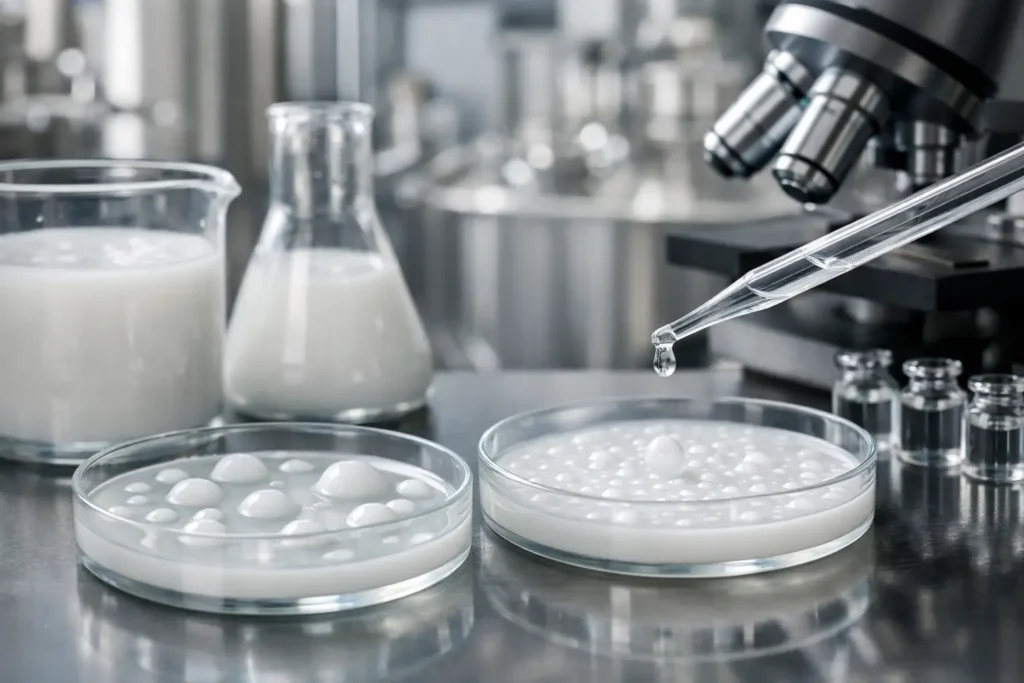
If a plant wants better emulsion droplet size control, it needs more than occasional visual checks. Texture and gloss can be useful indicators, but they do not replace actual measurement. Laser diffraction, microscopy, and other particle characterization methods help teams understand both average droplet size and distribution width.
Distribution matters because two products can share the same average and perform very differently. A narrow distribution usually points to a more controlled process. A broad distribution often signals unstable conditions, poor ingredient addition strategy, or inadequate dispersion upstream.
That said, data is only useful when tied to production settings. If QC sees drift but no one connects it to oil feed rate, batch temperature, mixer speed, vacuum level, or hold time, the data stays academic. The most effective plants build process windows around real product targets. They identify acceptable ranges, then run the line to stay inside them.
Pilot success does not automatically transfer to industrial production. Larger vessels change circulation patterns, batch turnover, heat transfer, and ingredient contact time. A formula that emulsifies well in a small R&D setup may behave very differently when powders are inducted at full scale and oil is added through a different path.
This is where equipment selection becomes commercial, not theoretical. A system built for viscous emulsified foods should maintain predictable shear and flow conditions as volume increases. It should also support repeatable ingredient handling, especially where dry powders and high oil loads are involved. If scale-up requires constant operator correction, production cost rises and consistency falls.
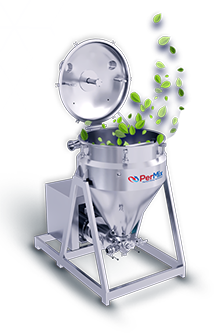
PerMix addresses this challenge with application-specific vacuum emulsifying and universal mixing systems designed for mayonnaise, dressings, and related products. The value is not just mixing power. It is controlled processing that supports repeatable texture, stability, and throughput across demanding formulations.
There is a tendency to assume finer droplets always mean a better product. That is not necessarily true. Extremely fine droplets can increase viscosity beyond the desired target, change sensory character, or require longer processing than the economics justify. In some systems, aggressive shear can also destabilize the ingredients meant to support the emulsion.
The real objective is functional control. The best droplet size is the one that delivers the required shelf life, mouthfeel, appearance, and filling performance at the right production cost. That answer depends on the formula, the line, and the market position of the product.
For manufacturers looking to improve results, the fastest gains usually come from tightening process discipline around a few variables: ingredient sequence, oil addition rate, vacuum consistency, powder dispersion, and actual shear exposure. These are not glamorous adjustments, but they often have more impact than simply increasing mixer speed.
It also helps to separate formulation problems from equipment limitations. Some products are unstable because the emulsifier system or solids balance is not strong enough. Others fail because the equipment cannot create uniform process conditions at the required batch size. Treating every issue as either a formula issue or a machine issue leads to wasted time. Strong troubleshooting looks at both.
In mayonnaise and sauce production, droplet size control is one of the clearest indicators of whether the process is truly under control. When the line produces the intended droplet profile batch after batch, quality becomes easier to predict, scale-up becomes more reliable, and product claims become easier to protect. That is where good emulsification stops being a technical detail and starts becoming a manufacturing advantage.

Get in touch with us today and learn how to we can help your business.