PerMix Mayonnaise Production
PerMix News
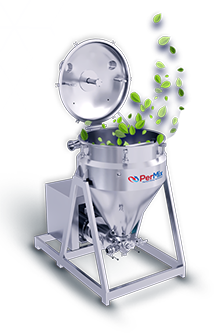

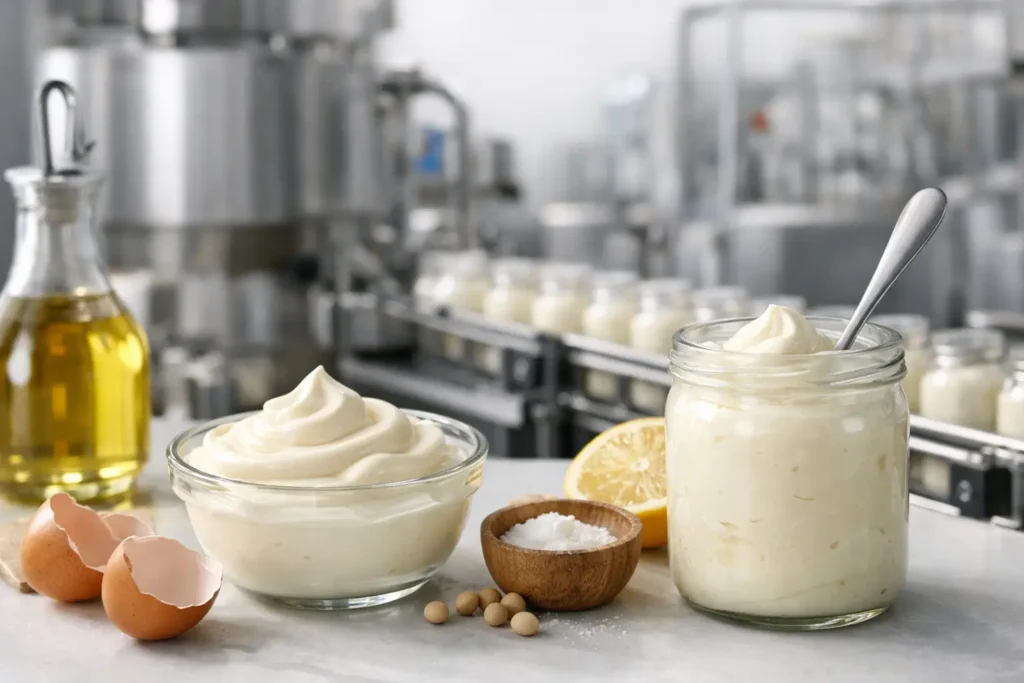
Egg free mayonnaise processing looks simple on paper until the first commercial batch starts showing weak body, oiling off, or a texture that shifts from one run to the next. Removing egg takes away a forgiving emulsifier system, which means process design matters more. For manufacturers scaling vegan or allergen-free formulations, the difference between a stable product and a costly rework often comes down to how ingredients are dispersed, hydrated, emulsified, and deaerated.
Traditional mayonnaise benefits from egg yolk functionality that supports emulsification, mouthfeel, and stability. In an egg-free system, those jobs are reassigned across starches, hydrocolloids, plant proteins, emulsifier blends, and carefully structured oil phases. That can work very well, but it creates a narrower operating window.
Small deviations in shear rate, ingredient addition sequence, hydration time, or temperature can change the final product in ways that are immediately visible on the line and even more visible after storage. A batch may look acceptable at discharge, then lose viscosity after 24 hours or separate during filling. This is why egg-free production should be treated as a process engineering challenge, not just a formula substitution.
At pilot scale, operators can often compensate manually. At commercial scale, that approach breaks down. Consistency requires controlled vacuum, repeatable powder induction, predictable droplet size development, and reliable batch-to-batch timing.
For most manufacturers, egg free mayonnaise processing is judged against four outcomes: emulsion stability, target viscosity, clean flavor release, and repeatable throughput. Those targets are interconnected.
A finer emulsion can improve stability, but too much shear at the wrong stage may damage texture-building systems or create an overly tight mouthfeel. Aggressive mixing may help disperse powders, yet it can also introduce excess air if the process is not under vacuum. That air affects density, appearance, oxidation risk, and filler performance. The right process is not simply high shear everywhere. It is controlled energy applied at the right step.
This is where equipment selection becomes strategic rather than transactional. A system built for true vacuum emulsification and efficient powder incorporation gives operators more control over the variables that matter most.
Egg-free formulas often rely on dry ingredients that are harder to wet out than operators expect. Modified starches, gums, fibers, plant proteins, sugar, salt, preservatives, and seasoning systems all behave differently in the vessel. If they are added directly into an agitated liquid phase without strong induction, fisheyes and partial hydration become likely.
Once that happens, the mixer works harder but the batch performs worse. Undispersed powder pockets can later show up as graininess, inconsistent viscosity, or unstable emulsion structure. In some formulations, poor hydration also reduces the full functionality of the stabilizer system, so the process appears acceptable during production but fails during shelf-life testing.
Powder induction is especially important when manufacturers are running multiple SKUs with different viscosity targets. A process that handles one formula adequately may struggle with a lower-fat or starch-heavy variant. The plant then ends up tuning around equipment limits instead of optimizing product performance.
Vacuum is not an accessory in this application. It is a process control advantage.
When air is pulled out during mixing, the system can develop a cleaner, denser emulsion with better visual quality and more predictable filling behavior. Vacuum also improves powder draw-in and wetting, especially when combined with a properly designed induction setup. For egg-free products, this matters because the stabilizing network is already doing more work than in an egg-based system.
Air entrainment creates several downstream issues. It can lighten apparent viscosity in the vessel, then cause variation after deaeration or during holding. It can increase oxidation exposure in oil-rich systems. It can also contribute to foam, which slows production and complicates transfer. In practical terms, vacuum helps protect both product quality and line efficiency.
Mayonnaise is not just mixed. It is built.
The oil phase must be introduced and dispersed in a way that creates the target droplet size distribution without destabilizing the rest of the system. In egg-free formulations, this often requires closer attention because the emulsifier package may be less tolerant of process swings.
If oil is added too quickly, the system may not absorb it efficiently and local overloading can occur. If shear is too low, the emulsion may remain coarse and unstable. If shear is too high for too long, the final texture can become thin, pasty, or inconsistent depending on the stabilizer matrix. There is no single rule that fits every formula, which is why process trials matter.
Manufacturers should evaluate shear in context with oil level, water phase composition, powder hydration state, and the timing of acid addition. pH shift can change functionality in plant proteins and hydrocolloids, so the point at which vinegar or acidulants are introduced can affect final body just as much as mixer speed.
Many egg-free products perform well in the lab because small batches hide process weaknesses. Hand addition is slower, heat transfer is different, and the operator can react instantly to visual changes. None of that scales automatically.
Commercial processing introduces longer transfer distances, different tip speeds, larger powder loads, and more demanding cycle times. A formula that tolerated incomplete hydration in a benchtop setup may not survive a 500-gallon run. Likewise, a product that looked stable after a short lab hold may separate after industrial pumping or filling.
This is why scale-up should focus on process equivalence, not only formula percentages. The key questions are straightforward. Can the production mixer create the same or better powder wetting? Can it maintain controlled vacuum throughout the critical phases? Can it deliver repeatable shear and circulation at the target batch size? If not, the plant may spend months adjusting ingredients to compensate for a processing gap.
For industrial mayonnaise lines, the mixer processor is doing more than turning a shaft. It is managing flow patterns, shear exposure, powder incorporation, deaeration, sanitation, and cycle time in one integrated operation. That is why generic mixing equipment often underperforms in this category.
A vacuum emulsifying system with strong recirculation and powder induction capability gives manufacturers a more reliable path to stable egg-free production. It reduces the chance of fisheyes, shortens hydration time, and improves emulsion uniformity. It also gives operations teams a better foundation for running multiple products on the same platform, whether they are standard, low-fat, fat-free, or vegan.
PerMix approaches this application with that reality in mind. The objective is not simply to agitate ingredients. It is to build a repeatable process that delivers commercial texture, stability, and throughput.
In most plants, the biggest gains do not come from changing the entire formula. They come from tightening the sequence and mechanics of production.
A better powder addition method can eliminate hydration defects that were being mistaken for ingredient quality problems. Improved vacuum control can reduce foam and density variation. A more disciplined oil addition profile can improve droplet development and reduce the risk of breakage. Shorter, more efficient batch cycles can also protect sensitive ingredients from unnecessary exposure to shear.
That said, there are trade-offs. Some formulations prioritize spoonable body, while others need pumpability for high-speed filling. Some customers want a glossy, rich appearance, while others are targeting a lighter salad dressing style. The best process is the one aligned with the product brief, not the one with the most aggressive settings.
When reviewing an egg-free mayonnaise process, decision-makers should look beyond stated batch volume. The real question is whether the system can manage the formulation challenges the plant actually faces.
That includes difficult powders, higher solids loading, multiple viscosity ranges, sanitation requirements, and the need to hold consistency across shifts and operators. It also includes future product development. A line sized only for one current SKU may become a limitation if the business expands into clean label vegan spreads, lower-oil emulsions, or more complex sauce systems.
The strongest equipment investment is usually the one that reduces process risk while keeping room for growth. In this category, that often means a vacuum-capable mixer processor designed specifically for emulsified foods rather than a general-purpose vessel adapted after the fact.
Egg free mayonnaise processing rewards precision. When powder hydration, vacuum, shear, and addition sequence are engineered correctly, manufacturers can produce a stable, market-ready product with far less trial-and-error. That is where processing stops being a bottleneck and starts becoming a competitive advantage.

Get in touch with us today and learn how to we can help your business.