PerMix Mayonnaise Production
PerMix News

A mayonnaise batch can look perfect in the tank and still fail hours later in the hold vessel, filler, or finished package. That is why does mayonnaise separate is not a simple kitchen question for commercial producers. It is a process control question tied directly to droplet size, ingredient hydration, shear profile, temperature, and the order in which the system builds the emulsion.
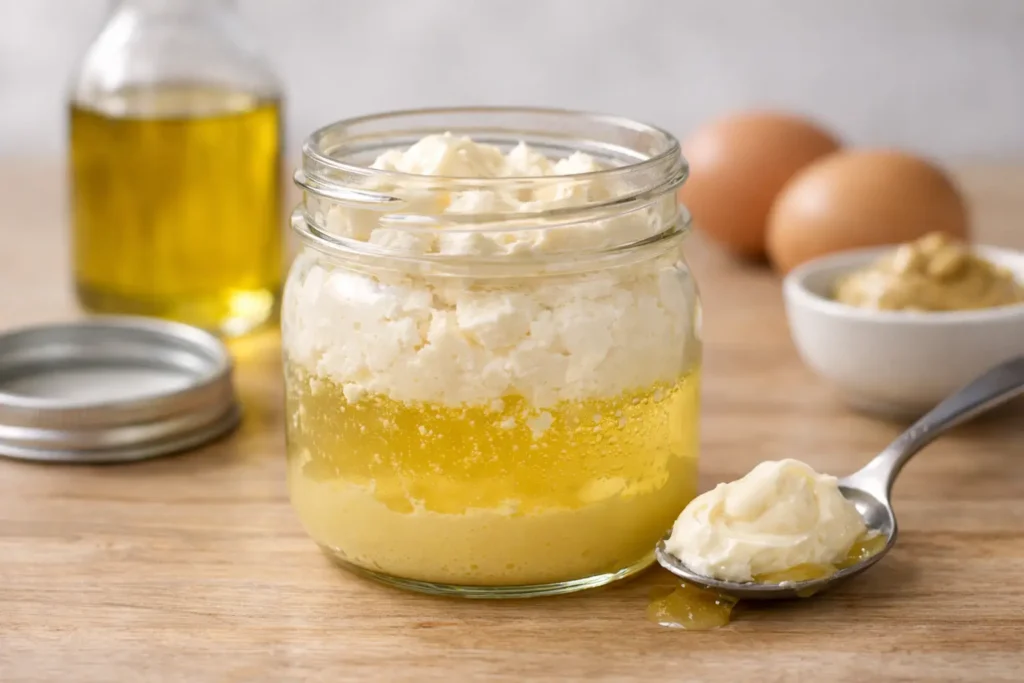
In industrial production, mayonnaise separation is usually the visible result of a hidden imbalance. Oil rises, water releases, texture weakens, and the product loses the glossy, dense structure buyers expect. Whether you are running full-fat mayonnaise, low-fat systems, or egg-free formulations, separation signals that the emulsion was either never fully built or could not remain stable under downstream conditions.
Mayonnaise is an oil-in-water emulsion. That means tiny oil droplets are dispersed throughout a continuous water phase and held in place by emulsifiers, viscosity, and mechanical energy. When that structure is not properly formed or maintained, the droplets begin to merge. Once coalescence starts, the emulsion weakens quickly and visible separation follows.
At plant scale, this rarely comes down to one mistake. More often, several smaller process deviations combine. A slight temperature drift, incomplete hydration of stabilizers, inconsistent powder incorporation, or poor vacuum control can each reduce stability. The batch may still pass an initial visual check, which is why some failures only show up after transfer, cooling, pumping, or storage.
The practical point is straightforward: mayonnaise does not separate by accident. It separates because the emulsion system was pushed outside its stability window.
Oil addition is one of the most common causes of emulsion failure. If oil enters the batch too quickly, the emulsifier system cannot cover the newly created droplet surface area fast enough. Instead of forming a fine, stable dispersion, droplets collide and merge into larger droplets. Once enough large droplets form, the emulsion begins to break.
This problem gets worse in high-throughput operations where operators try to shorten batch time by accelerating oil feed. Faster is not always better. The right oil addition profile depends on formulation viscosity, emulsifier strength, mixer geometry, and available shear.
Stable mayonnaise depends on small, uniform oil droplets. If mixing energy is too low, droplet size remains too large and the emulsion becomes vulnerable to creaming and coalescence. If the shear profile is inconsistent from batch to batch, texture and shelf stability will also vary.
At commercial scale, poor droplet size control can come from undersized equipment, worn mixing elements, incorrect rotor-stator configuration, or scale-up methods that do not preserve the same energy input per unit volume. A bench formula that works in the lab can fail in production if the equipment cannot replicate the dispersion quality.
Traditional mayonnaise relies heavily on egg yolk lecithin and proteins for emulsification. But the formulation landscape is more complex now. Low-fat, fat-free, and vegan systems often depend on combinations of hydrocolloids, starches, proteins, and alternative emulsifiers. If those ingredients are not selected or processed correctly, the batch may have enough initial body to look acceptable while lacking true emulsion stability.
This is especially relevant in reduced-fat products. Lower oil content changes mouthfeel and structure, so manufacturers often compensate with gums or modified starches. That can improve viscosity, but viscosity alone does not guarantee a stable emulsion. A thick product can still separate if the interfacial system is weak.
Dry ingredients are a common source of trouble in mayonnaise manufacturing. Starches, gums, proteins, and other powders must be fully dispersed and hydrated to perform correctly. If they enter the batch with agglomerates or fisheyes, they create uneven functionality across the system.
In practical terms, one part of the batch may have proper viscosity and water binding while another part does not. That inconsistency can weaken emulsion stability and create localized failure. Poor powder induction also slows production and increases rework, which turns a technical issue into a cost issue.
Temperature affects viscosity, ingredient functionality, and emulsification efficiency. If the batch is too cold, certain ingredients may hydrate poorly and oil dispersion can become less efficient. If it is too warm, viscosity may drop and droplets can move more freely, increasing the chance of coalescence.
Temperature also matters during post-mix handling. A batch that survives initial processing may still separate if cooled too slowly, exposed to temperature cycling, or held under unsuitable conditions before filling.
Entrained air is often overlooked when diagnosing mayonnaise separation. Air changes apparent viscosity, interferes with uniform mixing, and can destabilize the system during transfer or storage. It also contributes to oxidation and quality loss over time.
Vacuum processing matters here because it reduces air incorporation while improving ingredient wet-out and emulsion consistency. In many mayonnaise applications, vacuum is not just a quality enhancement. It is part of process stability.
Scale-up exposes weaknesses that a small pilot batch can hide. In the lab, operators can control addition rates closely, visually monitor powder dispersion, and make adjustments in real time. In a larger system, flow paths are different, vessel geometry changes, and mixing energy does not scale in a linear way.
A formula that performed well at 20 liters may separate at 2,000 liters because the process no longer builds the same droplet structure. Powder induction may be slower. Oil may enter the wrong zone. Recirculation may be insufficient. Dead zones may leave part of the batch underprocessed.
This is why emulsion stability should be treated as both a formulation issue and an equipment issue. If the process system cannot consistently deliver the required shear, vacuum, and ingredient incorporation pattern, the formulation has less room for error.
Full-fat mayonnaise is generally more forgiving than low-fat or vegan versions, but it can still break under poor process control. Reduced-fat systems usually have tighter process windows because they depend more heavily on stabilizers and water-phase design. Vegan mayonnaise often adds another layer of sensitivity because plant proteins and alternative emulsifiers do not always behave like egg yolk under shear, acid conditions, or thermal exposure.
That means the answer to why does mayonnaise separate changes slightly by product type. In one line, the root cause may be excessive oil feed. In another, it may be incomplete starch hydration or protein instability at the target pH. The correct diagnosis depends on the formula, the batch sequence, and the production system.
Prevention starts with process discipline. The water phase should be fully prepared before critical emulsification begins. Powders should be incorporated with equipment that minimizes clumping and accelerates hydration. Oil addition should be controlled, not rushed. Shear must be strong enough to generate fine droplets without creating unnecessary heat or damaging sensitive ingredients.
Vacuum processing can improve consistency by reducing entrained air and supporting better ingredient integration. Equipment design also matters. Rotor-stator performance, vessel shape, recirculation pattern, and powder induction capability all influence whether the emulsion forms evenly across the entire batch.
For manufacturers managing multiple SKUs, validation across formulations is essential. A process that works for standard mayonnaise may not hold for fat-free or vegan products without adjustment. Commercially, that is where specialized emulsification systems deliver value. Process reliability is not just about making a good batch once. It is about making the same stable batch every day, at production speed, with minimal waste.
Many teams first respond to separation by changing the formula. Sometimes that is necessary, but not always. If operators are compensating for poor dispersion with extra stabilizer or adding more emulsifier to cover inconsistent mixing, the plant may be treating a mechanical limitation as a formulation issue.
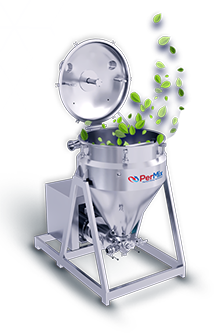
A properly engineered vacuum emulsifying system should help control droplet size, improve powder wet-out, reduce air, and support repeatable batch conditions. That becomes even more important when scaling specialty products or managing difficult ingredients. For processors focused on throughput and stability, equipment selection has a direct impact on shelf life, rework rate, and finished product quality.
PerMix works in that exact space, where emulsion science meets production reality. The goal is not just to mix ingredients. The goal is to build a stable mayonnaise process that holds under real manufacturing conditions.
When mayonnaise separates, the product is telling you something precise: the emulsion structure was not strong enough for the process it experienced. The fastest path forward is to trace that weakness back to its source and correct it at the system level, where stable production starts.

Get in touch with us today and learn how to we can help your business.