PerMix Mayonnaise Production
PerMix News

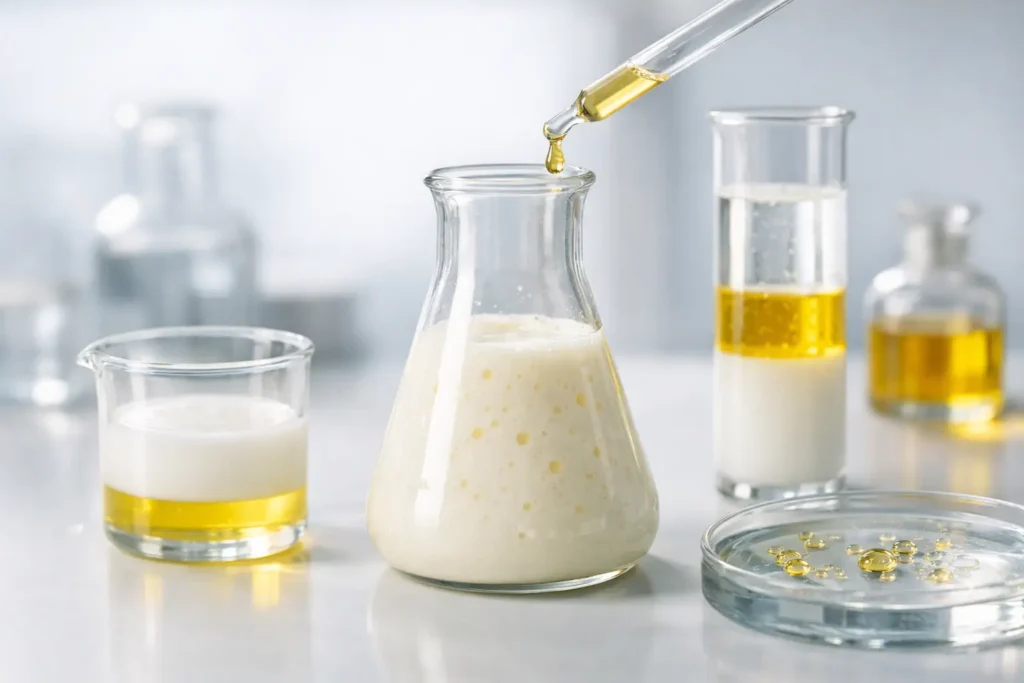
A stable mayonnaise or dressing rarely fails for one dramatic reason. More often, it drifts out of spec because several small variables move at once – oil addition rate, droplet size, powder hydration, temperature, vacuum level, or hold time between steps. If you are looking at how to improve emulsion stability, the right answer is not just a better recipe. It is tighter control of formulation, process, and equipment behavior across the full batch.
For food manufacturers, emulsion stability is not an abstract quality metric. It affects shelf life, visual appeal, texture, filling performance, yield, and complaint rates. In commercial production, even a slight tendency toward oiling off, serum separation, viscosity loss, or texture inconsistency can turn into downtime, rework, and product waste.
The first step is to define what kind of instability you are actually seeing. A broken emulsion, delayed separation during storage, air-related whitening, poor body, or viscosity collapse under shear can look similar on the line, but they do not come from the same root cause. Teams often respond by increasing emulsifier or thickener levels when the actual issue is poor dispersion, incomplete hydration, or the wrong mixing sequence.
In mayonnaise, dressings, and sauce systems, stability comes from building the right droplet structure and then protecting it. That means creating small, uniform oil droplets, distributing the emulsifier effectively at the interface, managing the water phase correctly, and avoiding process conditions that damage the finished structure after it forms.
A stable emulsion begins before mixing starts. Oil percentage, water phase composition, pH, salt, sugar, starch, gums, proteins, and egg-based or plant-based emulsifiers all interact. Changing one component to meet cost, labeling, or nutritional targets often changes the stability window.
This is especially true in low-fat, fat-free, and vegan systems. When oil is reduced, the formula loses some of the natural body and droplet-packing effect that helps conventional mayonnaise feel stable. The result is a narrower operating window. You may need stronger water-phase structure, more precise hydration of hydrocolloids, or a different emulsifier system to maintain texture and suspend the oil phase consistently.
The practical point is simple: do not evaluate ingredients in isolation. Evaluate the full system, including target viscosity, droplet size, acid addition, and the order in which ingredients enter the vessel.
Two formulas with identical ingredients can perform very differently if the sequence changes. Premature oil addition can overload the emulsifier before the water phase is ready. Delayed hydration of starches or gums can create weak spots in the structure. Poor incorporation of egg, protein, or plant-based emulsifiers can leave the system under-protected even when the dosage looks correct on paper.
In commercial mayonnaise processing, a controlled sequence usually delivers more repeatable results than trying to correct instability later with extra shear or extra stabilizer. Powders need proper wetting and dispersion before they can contribute to viscosity or water binding. Acids often need careful timing as well, since pH shifts can change hydration behavior and emulsifier performance.
If the goal is how to improve emulsion stability, droplet size control is one of the most important levers. Smaller and more uniform oil droplets generally improve stability because they reduce the tendency of droplets to rise, collide, and coalesce. But more shear is not automatically better.
Overprocessing can create heat, damage sensitive ingredients, and in some systems reduce final viscosity or change texture in undesirable ways. A sauce that looks smooth in the vessel may become thin after filling because the structure was pushed too hard. This is why stable emulsification depends on applying the right shear in the right stage, not the maximum shear available at all times.
For plant managers and process engineers, this is where equipment design becomes a production variable rather than a capital expense detail. Rotor-stator geometry, recirculation pattern, batch turnover, and vacuum capability all affect how consistently droplets are formed and maintained across the full volume.
Air is often an overlooked contributor to instability. Entrained air can distort density, change visual appearance, promote oxidation, interfere with accurate filling, and make it harder to judge whether the product is truly homogeneous. In emulsified food systems, vacuum mixing helps by reducing foaming and improving ingredient incorporation, especially when powders are involved.
This matters in mayonnaise and dressing production because powders such as starches, gums, proteins, and seasoning blends can form fisheyes or partially hydrated agglomerates if they are not drawn in and dispersed correctly. Those weak points often show up later as texture defects or uneven stability during storage.
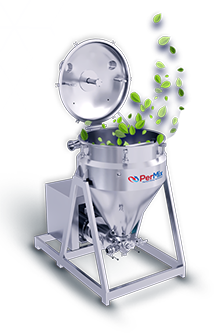
A properly designed vacuum emulsifying mixer gives manufacturers tighter control over deaeration, powder induction, and droplet formation in one integrated process. That combination supports both product quality and batch-to-batch consistency at scale.
Temperature affects viscosity, emulsifier behavior, hydration rate, and the ease of oil dispersion. If the batch is too cold, some ingredients may not hydrate or dissolve efficiently. If it runs too warm, viscosity can drop during formation and make the system more vulnerable to droplet growth or coalescence.
The right temperature profile depends on the product. A vegan dressing built around starch and hydrocolloids behaves differently from a full-fat mayonnaise with egg yolk. There is no universal setpoint that works across every SKU. What matters is holding the process inside a proven range and avoiding uncontrolled temperature rise from excessive mixing time or unnecessary recirculation.
In scale-up, this becomes even more important. A pilot batch may stay within range naturally, while a full production batch accumulates heat because of longer cycle times and larger energy input. Stability problems that appear only at commercial scale are often process-transfer problems, not formulation failures.
One of the fastest ways to destabilize an emulsion is to add oil faster than the system can absorb and disperse it. When this happens, local overloading occurs, droplets collide before they are protected, and the emulsion can weaken or break. Operators may describe this as a product that never quite “comes together” or one that looks acceptable initially but separates later.
A controlled oil feed, matched to mixer performance and batch viscosity, usually improves stability more effectively than increasing emulsifier usage. In other words, process discipline can outperform formulation cost increases.
Manufacturers working with modified starches, milk powders, proteins, gums, fibers, or seasoning blends know that dry ingredient incorporation is often where instability starts. Poor powder wet-out does not always create an immediate visible defect. Sometimes the batch passes through mixing and only later shows viscosity inconsistency, graininess, water release, or weak suspension.
The solution is not just stronger agitation. It is fast, uniform powder induction with enough shear to disperse particles and enough residence time for full hydration. Systems that pull powder efficiently into the liquid phase under vacuum can reduce lumping, shorten cycle times, and improve repeatability across operators and shifts.
For processors producing multiple mayonnaise and dressing styles, this matters even more. A line that performs well on standard full-fat mayonnaise may struggle on low-fat or vegan formulations if powder incorporation is inconsistent. Those products usually have less forgiveness built into the formula.
R&D can often make a stable emulsion in a controlled lab setting. The larger challenge is producing that same result every day across changing raw materials, operator teams, and batch sizes. This is where standard operating windows matter.
Instead of asking only whether a formula is stable, ask whether the process is repeatable. Can the system handle small variation in oil temperature, powder bulk density, or ingredient lot behavior? Can it produce the same droplet distribution from the first batch of the day to the last? Can operators follow a sequence that is realistic under production pressure?
The strongest improvement usually comes from tightening the full process window: ingredient preparation, addition order, vacuum level, shear stage, oil feed rate, temperature profile, and endpoint definition. When those variables are controlled, emulsion stability improves because the process becomes less dependent on operator correction.
That is why many manufacturers eventually treat emulsification as an engineered operation, not just a mixing step. With the right vacuum emulsifying and powder induction setup, companies such as PerMix help processors reduce variability while improving texture, stability, and throughput in demanding mayonnaise and sauce applications.
If your product separates only occasionally, that is still process data worth taking seriously. Small instability today usually becomes a larger efficiency problem as volumes grow, product lines expand, or formulations get leaner. The better move is to build a process that holds the emulsion steady before the market tests it for you.

Get in touch with us today and learn how to we can help your business.