PerMix Mayonnaise Production
PerMix News
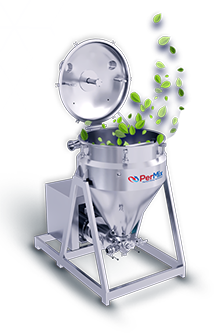

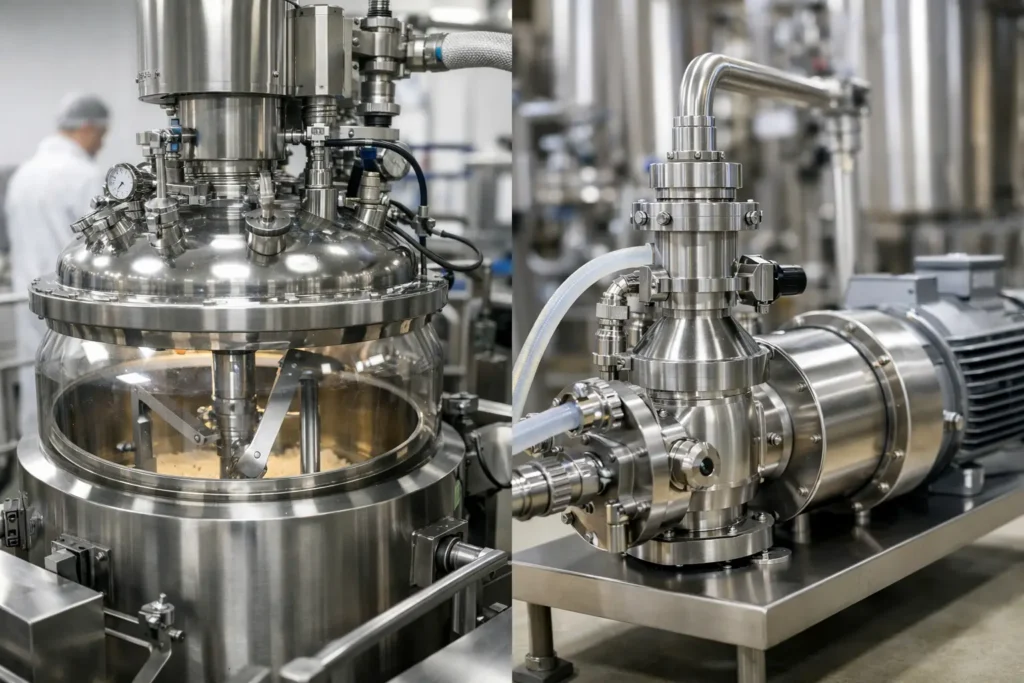
A mayonnaise line that looks efficient on paper can still miss the target in the tank. The usual problem is not only formula. It is process choice. In vacuum mixing versus inline homogenization, the better option depends on how you build emulsion, hydrate powders, control air, and protect texture at production scale.
For manufacturers of mayonnaise, dressings, ketchup, and similar viscous products, this is not an academic comparison. It affects batch time, droplet size, gloss, viscosity build, deaeration, cleaning strategy, and how reliably you can repeat results across shifts. If the line struggles with fish eyes, unstable emulsions, or inconsistent mouthfeel, the mixing principle is often the real constraint.
Vacuum mixing is a batch process built around a vessel, an agitator system, and high shear under vacuum. The vacuum helps remove entrapped air while the mixer disperses powders, draws in oil, and develops emulsion inside one controlled environment. In food applications such as mayonnaise and dressings, this matters because air is not a minor cosmetic issue. Excess air can distort viscosity readings, reduce visual quality, increase oxidation risk, and interfere with stable emulsion formation.
Inline homogenization works differently. Product moves through a rotor-stator head or similar high-shear device installed in a recirculation loop or transfer line. Shear is generated as material passes through a narrow work zone. This can be highly effective for droplet size reduction and fast dispersion, especially when the upstream process is already well organized. But it does not automatically solve aeration, powder wet-out, or vessel-side dead zones.
That distinction is where many purchasing decisions go wrong. Buyers sometimes compare shear intensity alone. In real food processing, the full process sequence matters more than peak shear.
In mayonnaise and structured emulsions, vacuum mixing offers a practical production advantage because multiple problems are handled at the same time. Oil incorporation, powder induction, deaeration, and emulsion development happen in one controlled batch. That is especially valuable when the formulation includes starches, gums, proteins, egg systems, or plant-based emulsifiers that need proper hydration before the product reaches final texture.
Under vacuum, powders are less likely to float, clump, or trap air during addition. That improves wetting and reduces the risk of undispersed material. For processors making low-fat or fat-free mayonnaise, where hydrocolloid performance is critical, this is a major benefit. These formulas are less forgiving than full-fat systems. If starch or gum hydration is incomplete, the defect shows up quickly as graininess, weak body, or instability.
Vacuum also supports cleaner visual appearance and more accurate density control. A product that leaves the mixer with less entrained air generally fills more consistently and presents better in the package. For high-value emulsified foods, that is not just a quality issue. It is a yield issue.
There is also a process control advantage. In a properly engineered vacuum emulsifying mixer, operators can manage phase addition, shear exposure, temperature response, and batch timing from a single platform. That reduces variability between operators and between product families. When a plant runs standard, low-fat, and vegan SKUs on the same line, that flexibility matters.
The harder the formulation, the stronger the case for vacuum mixing. Vegan mayonnaise, for example, often relies on more sensitive emulsifier systems and tighter process windows than conventional egg-based products. Low-oil products can be even more process-dependent because the aqueous phase must carry more of the texture burden.
In these cases, simply pushing product through an inline head at high shear may not be enough. If powders are not fully wetted before high shear, or if air is already incorporated upstream, the homogenizer can only fix part of the problem. It may reduce droplet size, but it will not reliably undo poor batching discipline.
Inline homogenization is not the wrong technology. In the right process, it is efficient and effective. It performs well when the product is pumpable, the ingredient addition sequence is already controlled, and the goal is targeted particle or droplet size reduction during recirculation or transfer.
For lower-viscosity sauces, pre-mixed liquid systems, or processes where a separate vessel handles hydration and deaeration, inline homogenization can be a strong fit. It can also be useful when manufacturers want to intensify an existing line without replacing the entire batch system.
There are commercial reasons plants choose it. Inline units can be compact, integrate into continuous or semi-continuous operations, and support throughput gains when the rest of the process is stable. For some facilities, especially those with established upstream preparation methods, that can be the most cost-effective move.
The limitation is that inline homogenization is usually only one step in the process chain. If the product requires strong powder induction, aggressive deaeration, and controlled emulsion build in a single vessel, extra equipment may be needed around it. Once those additions are counted, the apparent simplicity of inline processing can become less simple.
For mayonnaise specifically, the question is not which technology is more powerful in theory. It is which one gives better control over the full emulsion process.
Mayonnaise is sensitive to phase addition rate, shear profile, and air management. A stable emulsion depends on how the aqueous phase is prepared, how powders are incorporated, when oil is added, and how the system responds as viscosity rises. That last point is critical. A process that works when the batch is thin may behave very differently near the end of the cycle when the product becomes thick.
Vacuum mixing is often the better fit because the vessel is designed for that viscosity transition. It allows the product to be built progressively while controlling air and maintaining circulation through the batch. This is one reason many industrial mayonnaise systems rely on vacuum emulsifying mixers rather than treating homogenization as a standalone fix.
Inline homogenization can still play a role in mayonnaise lines, particularly in recirculation loops or hybrid systems. But when manufacturers face repeated issues such as broken batches, unstable texture, visible air, or poor starch dispersion, the core issue usually sits earlier in the process. A vacuum mixing platform addresses those root causes more directly.
Batch vacuum systems typically require a higher initial equipment commitment than a basic inline homogenizer. That part is real. But capital cost should be measured against total process performance, not just the price of a shear device.
If one system reduces rejects, shortens batch correction time, improves ingredient utilization, and supports more formulations on the same platform, the economics shift quickly. This is especially true for plants running premium emulsified products where consistency is tied directly to brand quality.
On the other hand, if the product range is narrow, powder handling is simple, and upstream mixing is already well controlled, inline homogenization may deliver acceptable results with lower complexity. The right answer depends on what the line must do every day, not what looks attractive in a spec sheet comparison.
Start with the formulation, not the machine category. If your products include high-viscosity emulsions, sensitive stabilizer systems, or difficult powders, process integration should be the priority. In that environment, vacuum mixing usually provides better control and more repeatable outcomes.
Next, look at your failure points. If the plant sees aeration, clumping, poor gloss, or batch-to-batch texture variation, ask whether those problems begin before homogenization even starts. If they do, adding more inline shear may not solve them.
Finally, consider scale-up. Many processes work in pilot runs and then lose stability at production volume because ingredient addition, circulation, and air control behave differently in larger batches. A system engineered around vacuum emulsification is often easier to scale with confidence because it manages several variables at once. That is why specialized equipment suppliers such as PerMix focus on application-specific mixer design rather than generic agitation alone.
The best process is the one that produces your target texture, stability, and throughput without constant operator rescue. If your product portfolio is broad and your formulations are demanding, vacuum mixing is often the stronger long-term choice. If your line is already disciplined and the product is less sensitive, inline homogenization can be a useful tool. The decision should be driven by emulsion performance on the plant floor, where results matter more than theory.

Get in touch with us today and learn how to we can help your business.