PerMix Mayonnaise Production
PerMix News

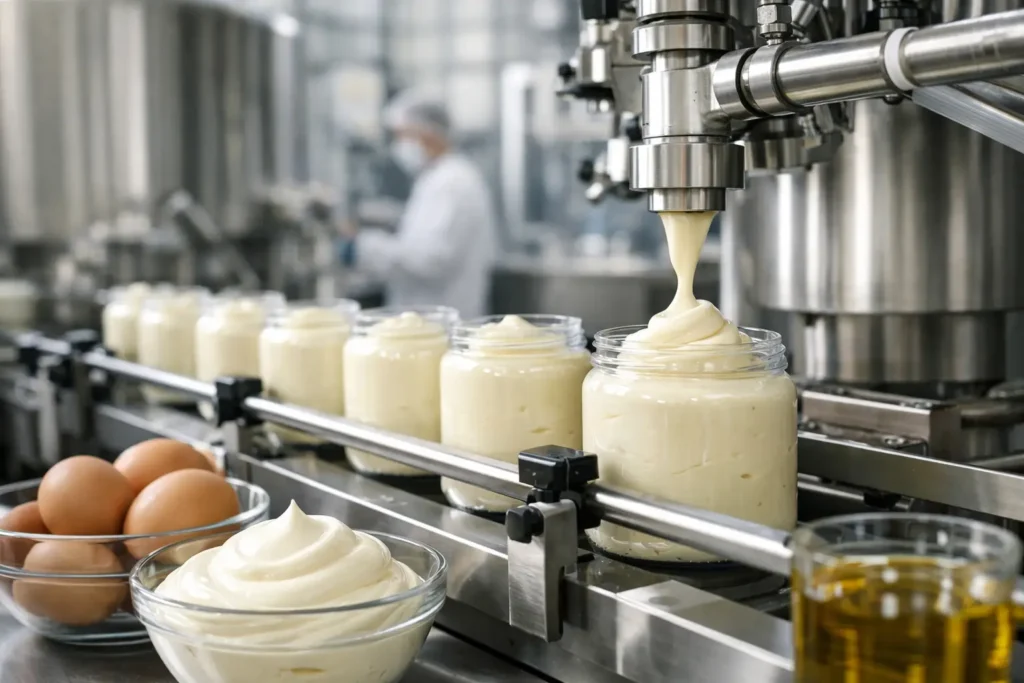
A jar of mayonnaise looks simple on the shelf. In production, it is anything but simple. If you are asking how is mayonnaise made in factories, the real answer is that commercial mayonnaise depends on precise emulsification, disciplined ingredient handling, and equipment designed to control shear, vacuum, temperature, and batch repeatability.
At factory scale, mayonnaise is not just mixed. It is engineered. The target is a stable oil-in-water emulsion with the right viscosity, gloss, taste, and shelf performance, delivered batch after batch without separation, fisheyes, lumps, or texture drift.
Industrial mayonnaise production usually follows a controlled sequence: preparing the water phase, dispersing powders, introducing eggs or egg alternatives, adding acid and seasonings, then gradually emulsifying the oil under high shear. In many plants, this happens inside a vacuum emulsifying mixer so air is minimized while dispersion and droplet size are tightly controlled.
The exact process varies by formulation. Full-fat mayonnaise behaves differently from low-fat mayonnaise. Vegan mayonnaise has its own stabilizer and protein challenges. A starch-thickened system responds differently than one built around gums or modified food starches. That is why process design matters as much as the recipe itself.
Mayonnaise starts with a familiar ingredient deck, but each component has a clear processing role. Oil provides body, richness, and the continuous texture consumers expect. Water is part of the continuous phase and helps carry acids, salts, sugars, and hydrocolloids. Egg yolk, whole egg, or plant-based emulsifier systems stabilize the emulsion by helping oil droplets remain dispersed.
Vinegar or another food acid does more than add flavor. It affects pH, microbial stability, and protein functionality. Salt and sugar shape taste, but they also influence water activity and overall formulation balance. Mustard, gums, starches, preservatives, and flavors are often added depending on label targets and regional product style.
In factory conditions, the challenge is not simply adding ingredients. It is incorporating them in the right order, at the right shear level, and often under vacuum. Dry powders are especially sensitive. If they are dumped into liquid without proper induction, they can form agglomerates that are difficult to break and can compromise final texture.
The process normally begins with the water phase. Water is loaded into the vessel first, followed by water-soluble ingredients such as salt, sugar, preservatives, and in many formulas, gums or starches. This stage is where many downstream quality issues start.
If powders are not fully dispersed, they can hydrate unevenly and create lumps or localized over-thickening. If hydration is incomplete, the product may look acceptable in the vessel but lose viscosity over time. Industrial systems are designed to pull powders quickly into the liquid stream and disperse them before they have a chance to clump.
For some recipes, heating may be used to help hydrate starches or dissolve ingredients more efficiently. For others, especially acid-sensitive systems, temperature must be tightly managed to avoid damaging emulsifier performance or changing the intended texture.
Once the water phase is prepared, eggs, egg yolks, or alternative emulsifier systems are introduced. This is the stage where the product begins to develop its structure, but it is still not mayonnaise yet. The continuous phase must be uniform before oil addition begins.
This step often includes mustard, flavors, and part of the acid system. Some processors split acid addition across stages to balance flavor development, protein behavior, and final pH control. There is no single rule that fits every plant. What works in a pilot kitchen may fail at 2,000 liters if the sequence is not adjusted for industrial flow and shear conditions.
This is the decisive stage. Oil is added gradually while the mixer generates the shear required to break the oil into fine droplets and disperse them through the water phase. If oil enters too fast, the emulsion can overload and break. If shear is too low, droplet size may remain too large, leading to weak texture and reduced stability.
In a well-designed factory process, oil feed rate, rotor-stator speed, vessel circulation, and vacuum level work together. The goal is a narrow droplet size distribution and a smooth, dense appearance. Vacuum is particularly valuable because it reduces air incorporation. Less entrained air means better appearance, more accurate filling, and improved product stability.
As the oil phase builds, viscosity rises sharply. That creates another processing challenge. Equipment must continue to move and shear an increasingly thick product without dead zones or uneven mixing. This is one reason mayonnaise is a specialist application rather than a generic liquid blending job.
Air is a persistent problem in mayonnaise manufacturing. Excess air can cause foaming, lighter color, lower fill-weight accuracy, and shorter shelf appeal. It can also interfere with texture evaluation because an aerated batch may look thicker or whiter than it really is.
Vacuum emulsifying systems address this directly. By processing under vacuum, manufacturers can reduce foam, improve ingredient wet-out, and produce a tighter, more uniform emulsion. Vacuum also supports cleaner powder incorporation and helps maintain a more polished final texture.
For plants running multiple SKUs, this becomes a productivity issue as much as a quality issue. Better deaeration and more reliable emulsification mean fewer rejected batches, less rework, and more predictable scale-up from R&D to full production.
A successful batch is measured by more than taste. Manufacturers monitor viscosity, pH, particle or droplet structure, temperature, and batch time. They also evaluate whether the product can hold its texture through pumping, filling, storage, and distribution.
Repeatability is where industrial equipment proves its value. A mayonnaise line has to deliver the same product whether the batch runs on Monday morning or Friday night. That requires controlled shear, consistent ingredient dosing, reliable vacuum performance, and vessel geometry that supports complete circulation.
There is always a trade-off. More shear can improve droplet reduction, but too much mechanical energy can damage the system or alter texture. Faster throughput improves output, but if powder induction or oil addition is rushed, quality can drop fast. Good process design is about finding the right operating window and holding it.
When mayonnaise fails in production, the root cause is usually process-related, equipment-related, or both. Broken emulsions often trace back to poor oil addition control, inadequate emulsifier activation, or insufficient shear at the critical point of droplet formation. Lumps and fisheyes usually come from poor powder induction and incomplete hydration.
Inconsistent viscosity can come from ingredient variability, but it is often tied to temperature swings, uneven mixing, or sequence errors. Air incorporation is another common issue, especially in open-top systems or mixers not designed for high-viscosity emulsions.
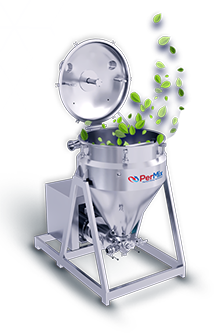
This is where specialized equipment changes the result. Systems such as vacuum emulsifying mixers and universal vacuum mixer processors are built for difficult products that need powder dispersion, controlled emulsification, and dependable batch-to-batch performance. PerMix focuses on these application demands because mayonnaise production rewards precision and punishes compromise.
Not all mayonnaise behaves the same in the mixer. Full-fat products rely heavily on oil structure and classic emulsification behavior. Low-fat and fat-free versions often depend more on starches, gums, and stabilizer systems to replace body and mouthfeel. Vegan mayonnaise can be even more sensitive because the emulsifier package may respond differently to acid, shear, and temperature.
That means equipment selection should match the formulation roadmap, not just the current recipe. A plant producing one standard mayonnaise today may need to launch vegan, reduced-fat, or clean-label versions tomorrow. The more formulation complexity you expect, the more important flexible mixing and powder handling become.
After the batch reaches target viscosity, pH, and texture, it is typically transferred to a holding or feed system for filling. Transfer must be gentle enough to protect the emulsion while still supporting production speed. Sanitary design is critical throughout the line, especially because mayonnaise ingredients can create difficult cleaning conditions if equipment is not designed for complete drainability and effective CIP.
The filling stage also benefits from a dense, low-air product. Better emulsion quality upstream usually leads to more accurate downstream filling and cleaner package appearance.
Factory mayonnaise is a process of control, not guesswork. The brands that scale successfully are the ones that treat emulsification as a production science, invest in the right equipment, and build a process around the realities of their formula rather than forcing the formula to fit the mixer. When that alignment is right, mayonnaise becomes much easier to make well at commercial scale.

Get in touch with us today and learn how to we can help your business.