PerMix Mayonnaise Production
PerMix News

When a mayonnaise line runs well, the product looks simple. Oil, water, eggs or egg alternatives, vinegar, starches, gums, and seasonings go in, and a smooth, stable emulsion comes out. In practice, how is commercial mayonnaise made comes down to process control. Ingredient order, shear, vacuum, powder incorporation, temperature, and batch timing all determine whether the result is glossy and consistent or broken and unstable.
For food manufacturers, mayonnaise production is not just about blending ingredients. It is about building a repeatable emulsification process that can hold texture, flavor, and shelf-life targets across batch after batch. That is why commercial mayonnaise systems are designed around more than mixing speed alone. They are built to manage dispersion, deaeration, hydration, and droplet size control under production conditions.
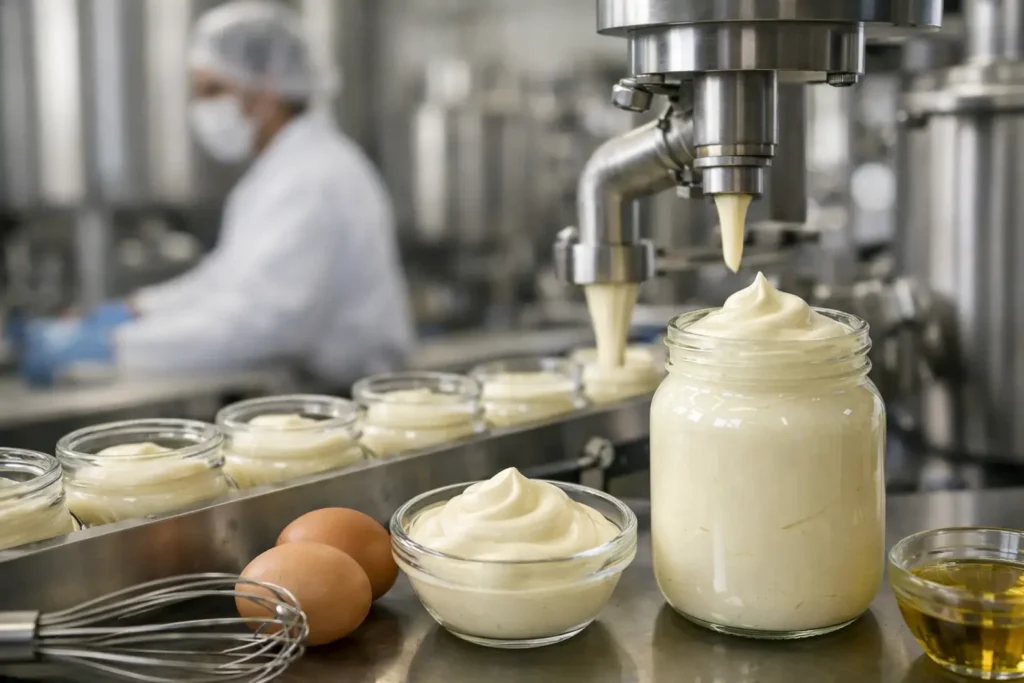
At commercial scale, mayonnaise is typically produced in a closed, sanitary mixing system that combines liquid handling, powder induction, high-shear emulsification, and vacuum processing. The exact formulation varies by market and label target, but the production logic is consistent. The water phase is prepared first, dry ingredients are dispersed and hydrated, acid and functional ingredients are incorporated, and oil is added in a controlled way while high shear creates and tightens the emulsion.
A standard full-fat mayonnaise relies on a high oil load, often with egg yolk as the primary emulsifier. Low-fat and fat-free systems are more demanding because they depend more heavily on starches, gums, proteins, and process precision to create body and stability. Vegan mayonnaise introduces another layer of complexity because the emulsifier system changes, and the process has to compensate for the missing functionality of egg.
This is why industrial producers do not treat mayonnaise as a simple tank-mixing application. The emulsion has to be built in the correct sequence and under the right mechanical conditions. If powders are not fully dispersed, if oil is added too fast, or if excessive air is pulled into the batch, quality issues show up quickly.
The batch usually starts with water in the main vessel. Depending on the recipe, processors then add vinegar or other acidulants, salt, sugar, preservatives, stabilizers, and water-soluble seasonings. In many plants, this stage also includes starches, gums, proteins, or other texturizers.
This step matters more than it appears. Powders that hit the vessel poorly can form fish eyes, clumps, or incomplete hydration zones. Those defects can carry through the entire batch, leading to poor texture and inconsistent viscosity. Commercial systems often use vacuum and powder induction to pull dry ingredients directly into the liquid phase quickly and cleanly, which improves dispersion and reduces dust.
Hydration time depends on the formula. Some starches and hydrocolloids need enough residence time and shear to fully activate before oil addition. If they are under-hydrated, the batch may seem acceptable in the mixer but drift during filling or storage.
This is one reason scale-up often exposes hidden formulation issues. A recipe that works in a lab beaker may not hydrate the same way in a large production vessel unless the mixer geometry, powder feed method, and batch cycle are designed correctly.
Traditional mayonnaise typically uses egg yolk or liquid egg as the main emulsifier. The egg phase helps reduce interfacial tension so oil can be dispersed into fine droplets and remain stable in the continuous phase. In vegan mayonnaise, manufacturers use alternative emulsifier systems such as modified starches, proteins, fibers, or plant-based emulsifiers.
The process window changes here depending on the recipe. Egg-based formulas may tolerate certain shear profiles well, while egg-free systems may require tighter control over ingredient order and oil addition rate. The target is always the same – build a stable emulsion with the required mouthfeel and shelf stability.
Oil addition is the critical stage in mayonnaise production. Commercial mayonnaise is an oil-in-water emulsion, which means the oil has to be broken into very small droplets and distributed uniformly throughout the continuous water phase. This does not happen by dumping in oil and hoping the mixer catches up.
In industrial production, oil is added gradually while a high-shear mixing head or emulsifying system creates the droplet structure. If oil is added too quickly, the emulsion can overload and break. If shear is too low, the droplet size stays too large and the texture becomes loose or unstable. If shear is too aggressive for too long, the product can heat up or suffer textural damage depending on the formulation.
Good commercial systems balance feed rate and shear energy so the batch thickens in a controlled way as the emulsion develops. Operators often see a clear rise in viscosity as the oil phase is fully incorporated.
Air is a common but costly problem in mayonnaise manufacturing. Entrained air can affect density, appearance, oxidation stability, filling accuracy, and shelf-life. It can also make the product look whiter than intended and interfere with a clean, glossy finish.
That is why many manufacturers produce mayonnaise under vacuum. Vacuum emulsification reduces air incorporation during mixing and helps strip out trapped bubbles. The result is a smoother, denser product with more consistent texture and better visual quality. In demanding formulations, especially high-viscosity or low-fat systems, vacuum processing is often the difference between a workable batch and an unstable one.
Once the emulsion is formed, processors may make final adjustments to flavor, acidity, color, and viscosity. The batch is then discharged to holding or directly to the filling line, depending on the plant layout.
At this stage, the product has to move without damaging the emulsion. Pump selection, line design, and transfer conditions all matter. A well-made mayonnaise can still be compromised downstream if the transfer system adds too much shear or air.
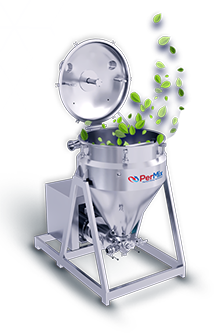
The question is not just how is commercial mayonnaise made, but what kind of equipment makes it repeatable. Industrial mayonnaise production usually centers on a vacuum emulsifying mixer or vacuum mixer processor equipped to handle both liquids and powders in one integrated system.
The most effective setups combine several functions. They create strong circulation in the vessel, apply localized high shear where the emulsion is formed, induce powders efficiently into the batch, and maintain vacuum throughout the process. This integrated approach is especially valuable when producing multiple SKUs such as standard, low-fat, fat-free, and vegan mayonnaise on the same line.
For manufacturers evaluating capital equipment, this is where engineering matters. A system designed specifically for emulsified condiments will generally outperform a general-purpose mixer because mayonnaise has narrow process tolerances. Droplet size distribution, powder wet-out, vessel design, rotor-stator performance, and cleanability all affect the commercial outcome.
PerMix focuses on this type of application-specific processing, particularly with vacuum emulsifying systems built for mayonnaise, dressings, and other viscous emulsions. For plants trying to reduce batch failures and improve consistency, that specialization matters.
Most mayonnaise problems trace back to a handful of process weaknesses. Poor powder incorporation can leave undispersed starch or gum. Inadequate shear can create a weak emulsion. Excessive air can hurt texture and appearance. Incorrect oil addition rate can break the batch. Temperature drift can also change viscosity development and ingredient functionality.
There is also no single answer for every formula. A high-oil mayonnaise behaves differently from a low-fat system. A vegan recipe may need more careful hydration and emulsifier management than an egg-based one. Plants that run multiple formulas need equipment and process settings that can adapt without sacrificing throughput.
That is why experienced manufacturers look at mayonnaise as a complete process, not a single mixing step. The line has to support formulation goals, operator consistency, sanitation demands, and production scale all at once.
If you are specifying a mayonnaise production system, focus on the points that affect product quality and operational reliability: vacuum capability, high-shear emulsification performance, powder induction efficiency, cleanability, batch repeatability, and the ability to scale from pilot to full production.
It also helps to evaluate how the system handles your hardest formula, not your easiest one. If the line can manage a low-fat or vegan mayonnaise with difficult powders and tight texture targets, it will usually handle standard formulations with less risk. That is a more useful test than judging equipment on nominal vessel size alone.
Mayonnaise manufacturing rewards precision. The plants that get the best results are not relying on luck or operator instinct. They are using equipment designed to control the emulsion from first ingredient addition to final discharge. If your process still struggles with broken batches, poor dispersion, or inconsistent viscosity, the real opportunity is not just in the recipe. It is in building a better system around it.

Get in touch with us today and learn how to we can help your business.