PerMix Mayonnaise Production
PerMix News

A mayonnaise line usually shows its weak points fast. You see it in broken emulsion, fisheyes from dry powders, long cycle times, and batches that look fine in R&D but fail once production volume increases. That is why the question of the best mixer for mayonnaise production is not really about buying a tank with an agitator. It is about choosing a system that can build a stable emulsion, control viscosity, and repeat that result under commercial operating conditions.
For industrial mayonnaise, the mixer has to do more than blend oil, water, egg, starch, gums, and acidulants. It has to manage several process demands at the same time. It must disperse powders quickly, reduce droplet size consistently, limit air incorporation, and move increasingly viscous product without dead zones.
That is why high-shear vacuum emulsification systems are usually the right answer for serious mayonnaise manufacturing. A basic propeller or paddle mixer can circulate ingredients, but circulation alone does not create a fine, stable emulsion. Mayonnaise depends on controlled shear and efficient phase incorporation. If the mixer cannot deliver both, batch quality becomes operator-dependent, and production risk increases.
The best mixer is the one that matches your formulation and throughput. A full-fat mayonnaise, a low-fat spread, and a vegan emulsion do not always behave the same way. The equipment has to accommodate those differences without forcing long process times or constant manual correction.
On paper, many mixers appear capable. In practice, mayonnaise exposes design limitations quickly.
The first problem is insufficient shear. Oil needs to be introduced and dispersed into the aqueous phase in a controlled way. If droplet size is too large or too inconsistent, the final product may lack body, separate during storage, or show unstable texture after temperature fluctuations.
The second problem is poor powder handling. Dry starches, gums, stabilizers, milk proteins, and seasoning blends can form lumps if they are added into a tank without strong induction and wetting. Once fisheyes form, they are difficult to break down completely. That means longer mixing times, wasted batches, or product that fails texture targets.
The third problem is air. Open-top mixing can pull in unwanted air, creating foam, oxidation issues, inaccurate fill weights, and a less dense finished product. In mayonnaise, trapped air also interferes with visual quality and process consistency.
The fourth problem is scale-up. A mixer that performs adequately in a small pilot batch may not maintain the same tip speed, circulation pattern, or residence time at production scale. That gap is where many manufacturers lose efficiency.
For mayonnaise production, there are several mixer categories on the market, but they are not equal.
A simple agitator tank is the lowest-performance option. It may work for pre-mixing liquids or low-viscosity products, but it is rarely the best choice for a finished mayonnaise process. It lacks the shear intensity required for stable emulsification and usually struggles with difficult powders.
An in-line rotor-stator mixer can generate strong shear and may fit certain continuous or semi-continuous setups. However, it depends on the overall system design. If ingredient charging, powder wet-out, deaeration, and vessel circulation are not integrated well, the line can still suffer from inconsistency.
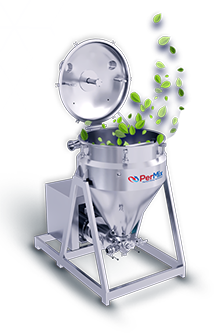
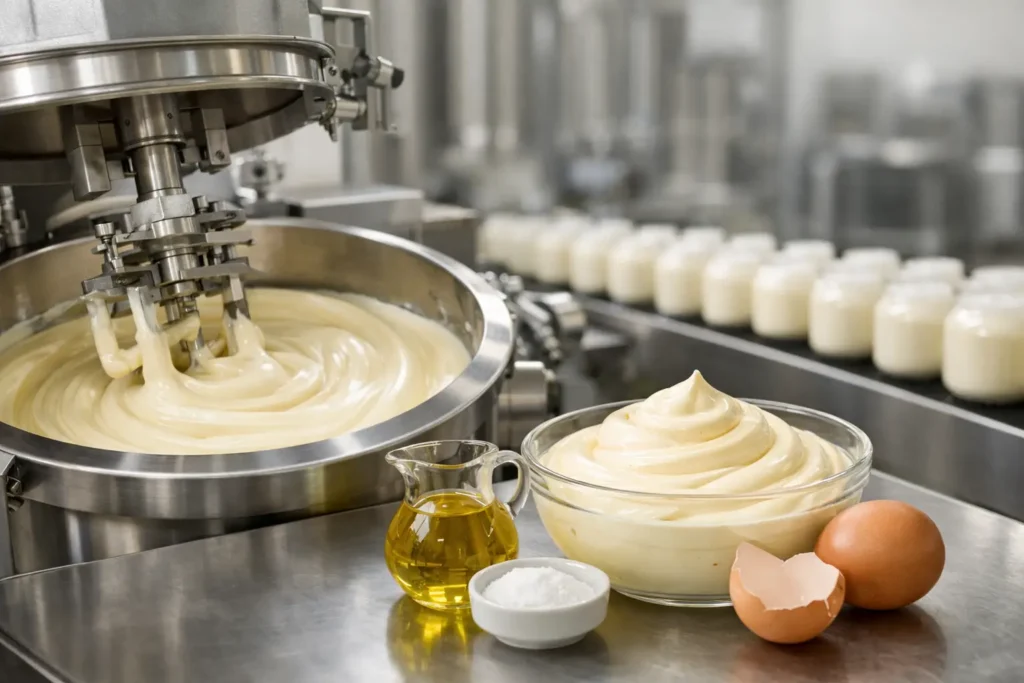
A vacuum emulsifying mixer is often the strongest fit for commercial mayonnaise manufacturing. This type of system combines vessel agitation with a high-shear emulsifying head under vacuum conditions. That matters because it addresses the real process demands together rather than one at a time.
For manufacturers handling broader product ranges, a universal vacuum mixer processor can offer more flexibility. It supports mayonnaise, dressings, ketchup, sauces, and other viscous emulsions in one platform. That can be a strong commercial advantage when product development is active or SKU complexity is growing.
If the goal is to identify the best mixer for mayonnaise production, vacuum emulsifying technology stands out for a reason. It is built around emulsion quality and process control.
Vacuum improves the process by reducing air entrapment during mixing. That gives a smoother, denser product and supports more repeatable batch outcomes. It also helps ingredient incorporation, especially when powders are involved, because the system can pull materials into the product phase more effectively than open mixing alone.
The high-shear emulsifying head is equally important. It reduces droplet size and improves droplet distribution, which directly affects texture, gloss, mouthfeel, and shelf stability. In mayonnaise, those are not cosmetic details. They are core product quality metrics.
A well-engineered vacuum emulsifying mixer also shortens process time. Faster powder wet-out, quicker oil dispersion, and reduced rework all improve throughput. For a plant manager, that translates into better line utilization. For procurement, it means lower cost per batch over time, not just a lower purchase price upfront.
When evaluating equipment, the shortlist should be practical and process-driven.
High-shear capability is non-negotiable. The mixer needs enough shear energy to build and maintain a stable emulsion, especially when processing high-oil or high-viscosity formulas.
Vacuum operation is a major advantage. It reduces entrained air and supports product quality, especially in formulations where smooth appearance and dense texture are required.
Powder induction deserves close attention. If your formulas include starches, gums, proteins, or seasoning systems, powder incorporation can become the main bottleneck. A mixer that handles powders poorly will cost time on every batch.
Agitation design matters as viscosity increases. Anchor or scraper agitation can help move thick product efficiently and improve heat transfer when temperature control is part of the process.
Cleaning and sanitary construction also affect real plant performance. Food manufacturers need hygienic design, consistent cleanability, and reliable material finishes. A mixer that performs well but creates sanitation headaches is not the right investment.
Finally, consider scale and control. Recipe repeatability depends on more than mechanical design. It also depends on how accurately the system manages time, speed, vacuum, temperature, and ingredient addition.
Not every mayonnaise behaves like a classic full-fat recipe. That is where equipment selection becomes more technical.
Full-fat mayonnaise often requires controlled oil addition and strong emulsification to achieve the target body without overprocessing. The mixer must create small, consistent droplets while preserving batch efficiency.
Low-fat and fat-free systems can be even more demanding. They often rely on starches, hydrocolloids, or protein systems to build viscosity and mouthfeel. That raises the importance of powder dispersion and hydration. A mixer that cannot wet and distribute these ingredients properly will struggle to produce a smooth product.
Vegan mayonnaise introduces another variable because the emulsification system changes. Without egg yolk, the process may depend on alternative emulsifiers and stabilizers that respond differently to shear and ingredient order. In these cases, flexibility matters as much as power.
This is why the best mixer is rarely the cheapest standard unit. It is the system that supports your actual formulations, not an idealized version of them.
A serious equipment review should focus on process outcomes. Ask whether the mixer can handle your target viscosity range, your most difficult powders, and your expected batch size. Ask how it performs when moving from pilot to production. Ask what happens if you add more SKUs next year.
You should also look at cycle time, not just finished quality. A mixer that produces good mayonnaise in 90 minutes may lose to one that produces the same or better quality in 45. Throughput, labor use, and batch repeatability are commercial metrics, not side issues.
Supplier knowledge matters too. Mayonnaise is not a generic liquid mixing application. It is a specialized emulsification process. A manufacturer that understands broken emulsions, powder agglomeration, and scale-up behavior will usually provide better equipment guidance than one selling a broad catalog without process depth.
PerMix is known in this space for application-focused systems such as PVC Vacuum Emulsifying Mixers and Universal Vacuum Mixer Processors designed around these exact production challenges.
For most commercial mayonnaise manufacturers, the best mixer for mayonnaise production is a vacuum emulsifying mixer with strong high-shear performance, effective powder induction, and vessel agitation designed for viscous products. That combination addresses the actual causes of inconsistency, not just the visible symptoms.
There are cases where another setup makes sense. A highly specialized continuous line, a low-volume pilot operation, or a facility producing simpler dressings may justify a different approach. But when mayonnaise quality, efficiency, and scale matter, vacuum emulsification is usually the benchmark.
The better question is not which mixer looks impressive on a specification sheet. It is which system will keep your emulsion stable, your batches repeatable, and your production schedule on track when real manufacturing pressure starts. That is where the right mixer earns its value every day.

Get in touch with us today and learn how to we can help your business.