PerMix Mayonnaise Production
PerMix News

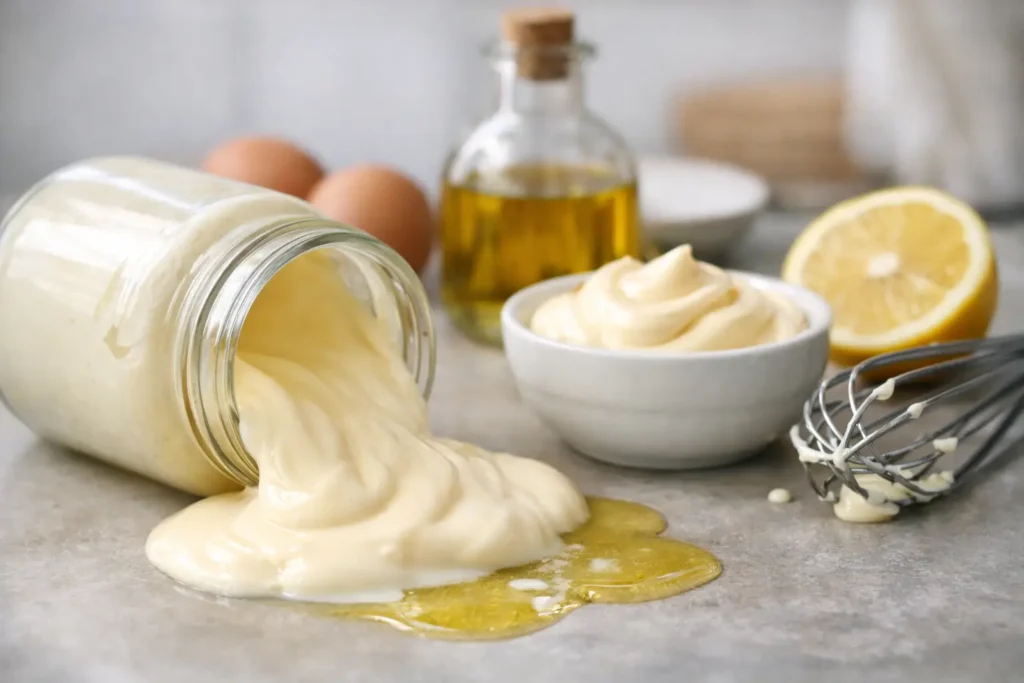
A mayonnaise batch can look perfect at discharge and still fail hours later in the tote, during filling, or after a short period in storage. That is why asking what causes mayonnaise instability is not just a formulation question. In commercial production, it is a process control question, an equipment question, and often a scale-up question.
Mayonnaise is a high-oil emulsion with very little room for error. Small shifts in shear, ingredient hydration, temperature, vacuum level, or phase addition can push the system from stable to fragile. When that happens, the visible symptoms vary. One plant sees oiling off. Another sees viscosity loss, air pockets, graininess, or a weak body that collapses under pump shear. The root cause is rarely random.
At the most basic level, mayonnaise becomes unstable when the continuous phase cannot keep oil droplets properly dispersed and separated over time. Stability depends on creating the right droplet size distribution, building the right viscosity in the water phase, and avoiding process conditions that damage the emulsion after it forms.
That sounds straightforward, but industrial mayonnaise is not a simple lab emulsion. Commercial lines must handle large batch volumes, dry ingredient incorporation, varying oil ratios, and different targets for full-fat, low-fat, fat-free, and vegan products. Each of those variables changes the margin for error.
In practice, instability usually comes from several factors acting together rather than one dramatic mistake. A plant may have acceptable formulation design but poor powder wet-out. Or strong emulsification but poor cooling discipline. Or good small-batch results that break at production scale because flow patterns and residence time change.
A stable mayonnaise depends heavily on oil droplet size and distribution. If droplets are too large, or if the batch contains a wide spread of droplet sizes, the larger droplets tend to rise, collide, and merge. That is the beginning of coalescence, and once it starts, visible separation is not far behind.
Droplet control is shaped by emulsifier availability, oil addition rate, and mixing intensity. Too little shear and the droplets never reduce enough. Too much poorly managed shear can also create problems, especially later in the process when structure has already formed and the emulsion is more vulnerable to mechanical damage.
This is where equipment design matters. Rotor-stator geometry, recirculation pattern, batch turnover, and vacuum operation all influence whether shear is applied efficiently or wasted. More power alone does not guarantee stability. The goal is controlled emulsification, not aggressive mixing for its own sake.
The order of addition is one of the most underestimated drivers of instability. If the water phase is not properly built before oil enters, the system may never develop the viscosity and emulsifier coverage needed to support a stable emulsion.
Egg yolk or other emulsifying systems need to be dispersed correctly and present at the interface when oil droplets form. Hydrocolloids, starches, and stabilizers also need enough hydration time to develop functionality. If powders are added late, dispersed poorly, or added into an already viscous system without proper induction, fisheyes and incomplete hydration can reduce stability even when the recipe looks correct on paper.
In many plants, instability blamed on formulation is actually poor ingredient incorporation. Dry starches and gums are especially sensitive. If they are not fully wetted and hydrated, the continuous phase remains weaker than intended.
Temperature affects viscosity, emulsifier performance, hydration behavior, and oil phase behavior all at once. That is why it is often central to what causes mayonnaise instability at scale.
If the batch runs too warm during emulsification, viscosity drops and droplet movement increases, which raises the risk of coalescence. Elevated temperature can also change the way egg proteins, starches, and gums behave. On the other hand, if ingredients are too cold, hydration may be incomplete and certain components may not disperse properly.
The correct temperature window depends on the formula. Full-fat mayonnaise, reduced-oil systems, and vegan emulsions do not respond the same way. Plants that process multiple SKUs on one line need tighter control because an operating window that works for one formula may weaken another.
Heat introduced by high shear is another common issue. A mixer may be producing acceptable droplet size while also generating enough frictional heat to reduce long-term stability. That trade-off needs to be managed, not ignored.
Air is not harmless in mayonnaise. Entrained air can distort viscosity readings, create foaming, reduce visual quality, and contribute to oxidative stress over shelf life. It can also interfere with droplet packing and make the emulsion less uniform.
In open mixing systems, air pickup is often built into the process. The batch may leave the mixer looking acceptable, but the body is lighter, less dense, and more variable during transfer and filling. Vacuum emulsification helps address this by reducing air inclusion while improving powder wet-out and emulsion uniformity.
For manufacturers focused on repeatable texture and shelf stability, deaeration is not a cosmetic step. It is part of building a stronger product.
Mayonnaise stability is not only about dispersing oil. It is also about giving the continuous phase enough strength to hold that dispersed oil in place. If the aqueous phase lacks viscosity or structure, the emulsion may form initially but remain vulnerable during storage, pumping, or thermal variation.
This is a common challenge in low-fat and fat-free mayonnaise. As oil is reduced, the system loses part of the natural structure that full-fat mayonnaise gets from densely packed droplets. The missing body has to be rebuilt through starches, gums, proteins, or other texturizing systems. If that structure is underdeveloped, instability shows up quickly.
Vegan mayonnaise presents a related but distinct challenge. Without egg yolk, the emulsifying system changes, and so does the process window. Protein selection, hydration behavior, pH sensitivity, and shear response all become more critical. A process designed for traditional mayonnaise does not always transfer cleanly.
Acid and salt are essential to mayonnaise flavor and preservation, but they also affect emulsion behavior. pH can change protein functionality and alter the performance of some hydrocolloids. Salt affects ionic strength and can influence viscosity and droplet interaction.
This does not mean low pH or normal seasoning levels automatically cause instability. It means the formulation has to be built with those conditions in mind. A system that is stable before acid addition may respond very differently after the final pH is reached.
That is another reason process sequence matters. Timing of acid addition, dilution effects, and local concentration during dosing can all change the final structure.
A bench sample can tolerate process inconsistency that a 500-gallon batch cannot. At larger scale, oil addition time changes, mixing zones become less uniform, powder induction gets harder, and heat removal becomes less efficient. What looked stable in development can become unstable in production because the physical process is no longer the same.
This is where many manufacturers misread the problem. They assume the formula failed, when the actual issue is that the process did not scale with enough control. Equipment sizing, recirculation rate, vacuum capability, and powder handling are not secondary considerations. They directly affect emulsion quality.
For processors running multiple viscosities and formula types, the safest approach is application-specific process design. A system built for reliable high-oil mayonnaise may need different handling logic for fat-free or vegan products.
The first step is to stop treating mayonnaise instability as a single-variable problem. If a batch breaks, check the full chain: water phase preparation, powder hydration, oil addition profile, shear level, temperature rise, air incorporation, transfer conditions, and final filling stress. Looking at only the recipe usually misses the real cause.
The second step is to validate whether the equipment is creating the process the formula actually needs. Stable mayonnaise requires repeatable dispersion, controlled emulsification, and strong deaeration. When powders are difficult to wet or structure is inconsistent batch to batch, the process is already signaling risk.
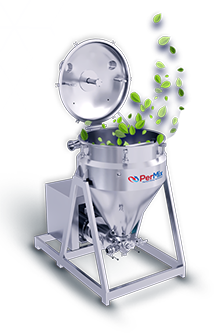
For commercial producers, this is where engineered mixing systems make a measurable difference. PerMix focuses on exactly these process points – vacuum emulsification, reliable powder incorporation, and scalable control for demanding mayonnaise applications. That matters because better stability is not just a quality target. It protects yield, shelf life, filling performance, and brand consistency.
A stable mayonnaise is built long before the product reaches the jar. The best results come from treating formulation and processing as one system, then controlling that system with the same discipline you apply to any other critical manufacturing operation.

Get in touch with us today and learn how to we can help your business.