PerMix Mayonnaise Production
PerMix News
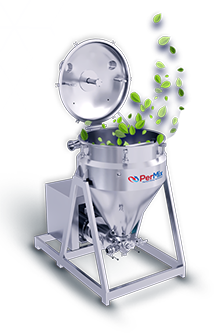

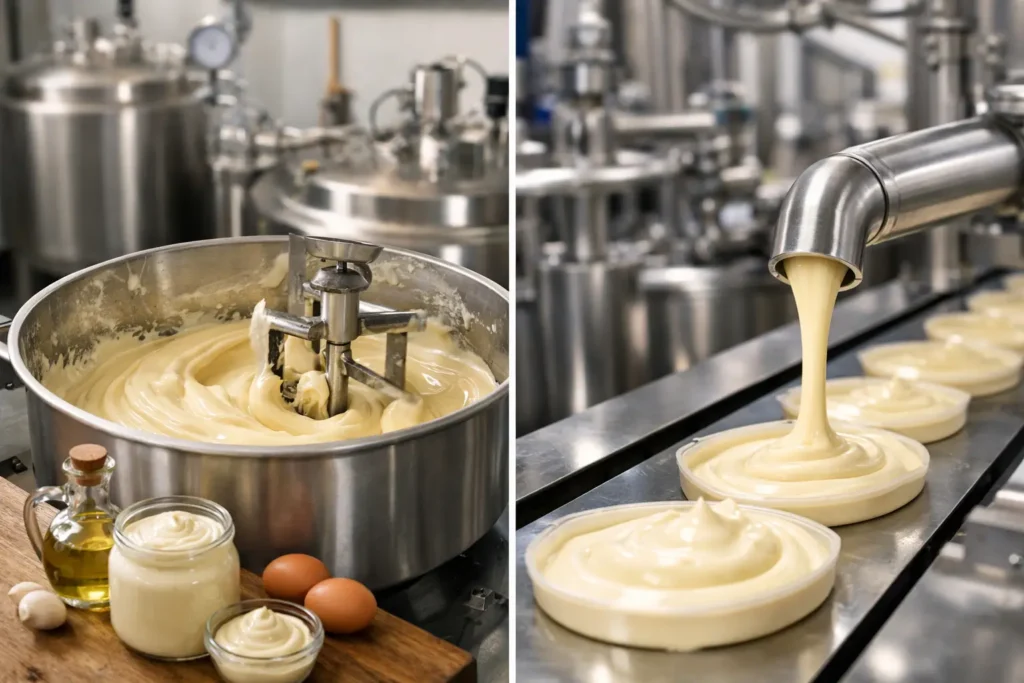
A mayonnaise line can look efficient on paper and still create daily production losses if the process format is wrong. In batch vs continuous mayonnaise processing, the real question is not which system sounds more advanced. It is which one gives your plant the best control over emulsion quality, throughput, labor, sanitation, and future product expansion.
For manufacturers producing mayonnaise, dressings, and related emulsified sauces, that choice affects far more than mixer selection. It shapes how ingredients are introduced, how quickly powders hydrate, how consistently oil is dispersed, how recipes are changed over, and how confidently production can scale.
Batch processing produces a defined quantity of mayonnaise in a vessel, one cycle at a time. Ingredients are charged according to recipe, mixed under controlled conditions, emulsified, deaerated if required, and then discharged before the next run begins. The process is discrete, with clear start and finish points.
Continuous processing feeds ingredients into the system at controlled rates and produces mayonnaise as an ongoing flow. Oil, water phase, acids, stabilizers, starches, gums, egg components, and other inputs are metered into the process continuously. The emulsion is formed and maintained in-line, with output tied directly to feed accuracy and process stability.
Both formats can produce high-quality mayonnaise. The better option depends on your production profile. If your plant runs multiple SKUs, frequent flavor changes, and shorter campaigns, batch often makes operational sense. If demand is high, formulations are stable, and uptime matters more than flexibility, continuous processing can deliver major gains.
Batch systems are often the right fit for plants that need formulation flexibility. That includes producers running full-fat, low-fat, fat-free, and vegan mayonnaise across the same manufacturing area. It also includes companies still refining formulas, validating shelf life, or moving products from pilot scale into commercial production.
The main advantage is control at the recipe level. Operators can verify each ingredient addition, adjust process timing, and respond to viscosity changes during the run. If a starch hydrates slower than expected or a gum package behaves differently lot to lot, the team has room to correct before discharge.
This matters with mayonnaise because small process variations can create large quality problems. Poor powder incorporation can lead to fisheyes. Incorrect oil addition rates can destabilize the emulsion. Inadequate vacuum can leave entrapped air that affects appearance, filling accuracy, and shelf stability. In a well-designed batch vacuum emulsifying mixer, those variables are easier to isolate and manage.
Batch processing also simplifies product changeover. When a plant makes a standard mayonnaise in the morning and a vegan sandwich spread in the afternoon, a vessel-based approach can reduce formulation crossover risk. Cleaning, verification, and restart are more straightforward when each run is contained.
The trade-off is throughput efficiency. Every batch includes fill time, processing time, discharge time, and cleaning time. As volumes increase, those non-productive intervals start to limit total output. Labor demand can also be higher if ingredient charging is more manual.
Continuous mayonnaise production is built for sustained output. When demand is predictable and the formulation is established, it can reduce cycle losses and increase line efficiency. Instead of stopping and starting, the process runs at a steady state, which can support higher hourly production with lower labor input per unit produced.
The strongest case for continuous processing is usually found in plants producing large volumes of the same SKU or a small family of closely related products. In those cases, metering accuracy and process repeatability can outperform traditional batch scheduling. The system does not wait for a vessel to empty and refill. It keeps producing.
That efficiency carries commercial benefits. Higher utilization can reduce cost per pound. Ingredient feeds can be automated with tight control. Integration with downstream holding, filling, and packaging can be more direct. For high-volume operations, these gains are substantial.
But continuous processing is less forgiving when the upstream process is unstable. If powder feeding is inconsistent, if flow meters drift, or if ingredient properties vary more than expected, product quality can move off target quickly. In a continuous line, a problem is not confined to a single kettle. It can affect every pound produced until corrected.
That is why continuous systems demand strong process engineering. Ingredient delivery, shear profile, residence time, vacuum handling, and CIP design all need to be aligned. The equipment can perform at a very high level, but only when the process is built around accuracy and consistency.
Many buyers frame the decision as a simple capacity question. In practice, mayonnaise quality depends on how the process handles dispersion, emulsification, deaeration, and viscosity build.
Batch systems often provide a wider operating window for difficult formulations. If you are producing low-fat mayonnaise with heavy stabilizer use, or vegan mayonnaise where emulsifier performance differs from traditional egg-based systems, process flexibility matters. Vacuum mixing and effective powder induction become critical because these products are more sensitive to lumping, texture defects, and phase instability.
Continuous systems can produce excellent texture and droplet distribution, but they benefit most from formulas that are already well characterized. If the emulsion breaks easily under narrow process conditions, a continuous setup may require tighter controls than the plant is prepared to maintain.
So the quality discussion should focus less on batch versus continuous as labels and more on whether the system gives the product what it needs. Stable oil incorporation, complete powder wet-out, controlled shear, and repeatable deaeration are the real performance indicators.
From a plant management perspective, batch and continuous systems use time differently. Batch processing concentrates effort into cycles. Operators prepare ingredients, charge the vessel, monitor the run, discharge, and repeat. Downtime between runs is part of the model.
Continuous processing shifts the emphasis toward setup precision and line stability. Once the process is running correctly, output is steady and labor can be lower relative to volume. For facilities under pressure to increase throughput without expanding headcount, that can be decisive.
Still, utilization is not just about nameplate capacity. A continuous line running frequent recipe changes can lose much of its advantage. A batch system sized correctly for actual demand may deliver better real-world performance than an oversized continuous installation that spends too much time in transition or cleaning.
This is where equipment sizing matters. The right system is the one matched to your campaign length, SKU count, sanitation schedule, and production targets, not the one with the biggest theoretical output.
The best decision usually starts with four operational questions. How many SKUs do you run each week? How stable are your formulations? What hourly output do you truly need? How much process automation can your team support reliably?
If the answer is high SKU variability, frequent adjustments, and ongoing product development, batch is often the stronger choice. It supports recipe control, troubleshooting, and cleaner separation between products.
If the answer is high volume, stable demand, and long production campaigns, continuous processing deserves serious consideration. It can reduce unit cost and improve plant efficiency when the supporting systems are engineered correctly.
For many manufacturers, the smartest path is not ideological. It is staged. They begin with a high-performance batch platform to establish formulations, improve stability, and grow market demand. As volume increases and the product mix becomes more predictable, they evaluate continuous capacity where it makes financial and operational sense.
That approach is common because mayonnaise manufacturing is rarely static. Product lines expand. Nutritional claims change. New emulsifier systems are introduced. Retail and foodservice volumes shift. A process that works today should not limit the business tomorrow.
The wrong lesson to take from batch vs continuous mayonnaise processing is that one is modern and the other is outdated. Both are proven industrial methods. The difference is fit.
A well-engineered batch vacuum emulsifying system can outperform a poorly specified continuous line in consistency, yield, and downtime. A well-designed continuous system can outperform multiple batch vessels when volumes are high and recipes are stable. Performance comes from aligning equipment design with formulation behavior and plant realities.
That is why serious manufacturers look beyond brochure language. They evaluate powder induction performance, vacuum capability, shear control, cleanability, instrumentation, and scale-up logic. They ask how the system handles starches, gums, egg alternatives, and viscous phases. They focus on measurable production outcomes.
For processors planning their next mayonnaise investment, the right question is simple: which process gives your operation the best combination of product quality, output, flexibility, and control? Answer that honestly, and the equipment decision becomes much clearer. At PerMix, that is where better mayonnaise production starts.

Get in touch with us today and learn how to we can help your business.