PerMix Mayonnaise Production
PerMix News
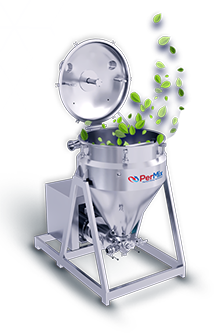

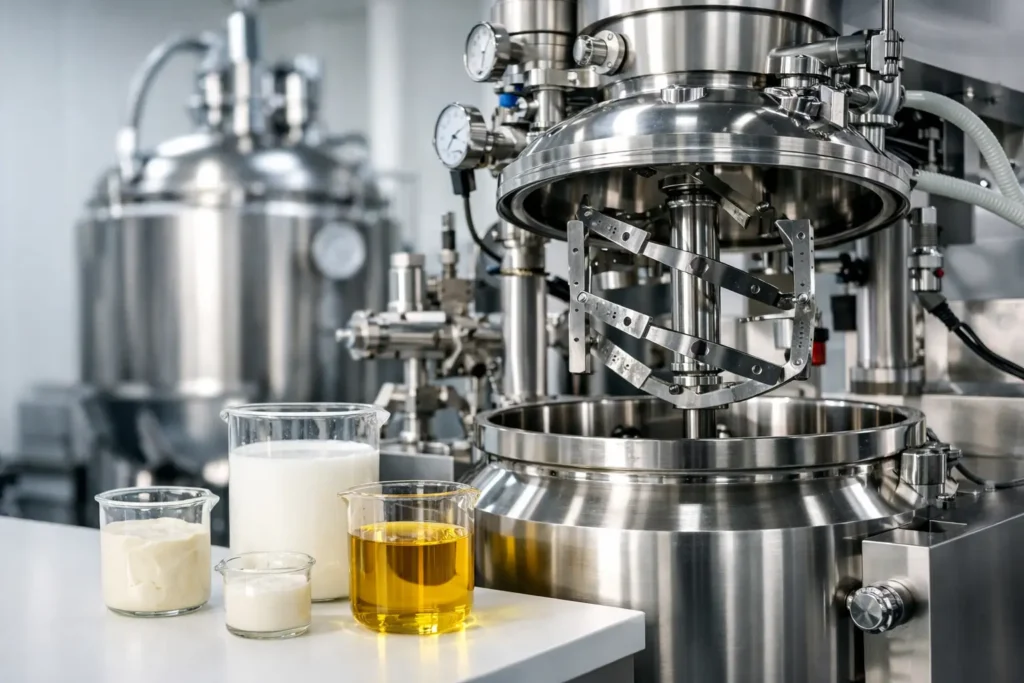
A stable mayonnaise batch rarely fails because of one big mistake. More often, it breaks because several small process variables drift at once – ingredient addition rate, powder wet-out, shear profile, vacuum level, or temperature. This vacuum emulsification process guide is written for manufacturers who need repeatable texture, stable shelf life, and faster batch execution across mayonnaise, dressings, sauces, and other viscous emulsified foods.
For commercial production, vacuum emulsification is not just a mixing method. It is a controlled process that combines dispersion, deaeration, particle size reduction, and hydration in one integrated system. When the process is set correctly, it improves batch consistency, reduces foam, supports efficient powder incorporation, and helps protect the finished product from common defects such as phase separation, weak body, and inconsistent mouthfeel.
At its core, emulsification creates a stable distribution of one immiscible phase into another, usually oil in water for mayonnaise and many dressings. The vacuum changes how that process behaves in production. By reducing entrapped air during mixing, it limits foam formation and improves the working environment for high-shear dispersion.
That matters because air is not a minor side issue in viscous food manufacturing. Air can distort volume readings, affect texture perception, interfere with powder wetting, and contribute to instability over time. In products that depend on a tight, glossy structure, controlling air is part of controlling quality.
A properly designed vacuum emulsifying system also supports faster ingredient integration. Powders such as starches, gums, proteins, and stabilizers can be drawn into the liquid phase more efficiently, reducing fish eyes and surface clumping. For processors running low-fat, fat-free, or vegan formulations, this becomes even more important because those formulas often depend on more demanding hydration and stabilization steps than full-fat mayonnaise.
The process starts long before the mixer turns on. Formula design, ingredient sequence, target viscosity, and thermal profile all shape the final result. Equipment cannot fully compensate for a poor process design, but the right system can widen the operating window and make the process more forgiving.
Most emulsified food systems begin with a water phase and an oil phase, along with functional ingredients that must hydrate, dissolve, or disperse at the right point in the batch. Acid, sugar, salt, starches, gums, proteins, egg ingredients, preservatives, and flavor systems each influence viscosity and emulsion behavior.
This is where many scale-up issues begin. An R&D formula that performs in a small vessel may behave differently in production when powder loading, batch depth, and shear exposure change. If powders are introduced too late, they may never hydrate properly. If oil is added too quickly before the aqueous phase is structured, the emulsion may form with poor stability.
For mayonnaise and similar oil-in-water systems, the continuous phase must be built first. That usually means dissolving and hydrating water-soluble ingredients under controlled agitation before significant oil loading begins. The exact sequence depends on the formula, especially when working with modified starch, hydrocolloids, or plant proteins.
Under vacuum, the mixer can pull powders below the surface more efficiently than open-top mixing methods. This reduces dusting, improves operator control, and shortens dispersion time. It also supports more uniform hydration, which directly affects final viscosity and suspension quality.
Oil addition is where emulsion quality is won or lost. If the oil feed rate exceeds the system’s ability to disperse droplets and stabilize the interface, the batch may invert or break. If the addition is too slow, cycle time suffers and production efficiency drops.
The right rate depends on emulsifier strength, phase ratio, product viscosity, rotor-stator performance, and vessel geometry. There is no universal number that fits every product. High-oil mayonnaise, low-fat dressing, and vegan emulsions each respond differently. The practical goal is a controlled droplet size distribution that matches the product target without overstressing the batch.
More shear is not always better. High shear is necessary to reduce droplet size and disperse difficult ingredients, but excessive shear can damage the product structure, raise temperature, and create unnecessary wear. Process engineers should think in terms of effective shear exposure rather than maximum machine speed.
In commercial systems, the most reliable results come from matching rotor-stator design, recirculation pattern, and batch viscosity to the product requirement. Thick mayonnaise may need a different shear profile than a pourable dressing or ketchup-style emulsion. The equipment should support that range without forcing operators into narrow process limits.
As the emulsion forms and viscosity rises, vacuum helps remove entrained air that would otherwise remain trapped in the structure. This improves visual appearance and can support more accurate filling by reducing density variation from one batch to the next. It also helps prevent the spongy or aerated texture that can appear when mixing is aggressive but deaeration is weak.
Finishing under vacuum is especially useful when the formula includes powders that tend to trap air or when the batch has gone through several recirculation passes. In those cases, deaeration is not an optional cleanup step. It is part of the process design.
In production, consistency comes from controlling a short list of variables with discipline. Vacuum level affects deaeration and powder induction behavior. Shear intensity affects droplet size and texture. Ingredient order affects hydration and stability. Temperature affects viscosity, solubility, and emulsifier performance.
These variables also interact. For example, increasing temperature may improve ingredient dissolution but reduce viscosity enough to change shear behavior. Pulling deeper vacuum may improve deaeration but alter evaporation or ingredient handling. That is why good process control is never just a recipe issue. It is an equipment-and-method issue.
For food manufacturers, the strongest systems are the ones that give operators clear control over these variables without excessive manual intervention. A vacuum emulsifying mixer should not only produce a batch. It should make the batch repeatable across shifts, operators, and production volumes.
The most common failures are familiar: lumps from poor powder wetting, broken emulsion after oil addition, texture variation from inconsistent shear, and air incorporation that leaves the product light or unstable. In many plants, these problems are treated as formulation issues first. Sometimes they are. But just as often, the root cause is process execution.
Low-fat and fat-free systems are particularly sensitive because they rely more heavily on stabilizers and water-phase structure. Vegan formulations can also create challenges due to different emulsifier behavior and protein functionality compared with egg-based systems. In these applications, the margin for error is smaller, so equipment design matters more.
That is why powder induction capability, vacuum efficiency, and mixer geometry should be evaluated as part of process performance, not as secondary machine features. If the system struggles with dry ingredient incorporation or cannot maintain stable mixing as viscosity climbs, the formula may never show its true potential at scale.
A vacuum emulsification system should be selected around the product family, batch size, viscosity range, and ingredient behavior. A plant making standard mayonnaise at one viscosity target has a different requirement from a manufacturer producing multiple SKUs across low-fat, vegan, and dressing applications.
The right platform should handle both emulsion formation and difficult ingredient incorporation with strong repeatability. It should support sanitary design, efficient cleaning, and production throughput that fits the business case. It should also give the team room to adjust process parameters during development and scale-up.
This is where specialized equipment providers bring value. PerMix focuses on commercial emulsified food processing with systems engineered for mayonnaise, dressings, sauces, and related products where vacuum mixing, high-shear performance, and powder handling directly affect product quality and output.
For procurement teams, price always matters. But the cheaper machine is not the lower-cost option if it extends batch times, increases rejects, or limits future formulations. The better question is whether the system delivers stable emulsions, efficient cycles, and reliable scale-up across the products you plan to run.
A good vacuum emulsification process is measured in results you can see on the plant floor – shorter mixing time, fewer defects, cleaner powder incorporation, stable viscosity, and batches that hold up after packaging. When those outcomes are built into the process from the start, production gets easier, quality gets tighter, and growth becomes much more practical.

Get in touch with us today and learn how to we can help your business.