PerMix Mayonnaise Production
PerMix News

A mayonnaise batch can look smooth in the tank and still fail on the line. Oil separation, weak body, visible powder specks, aeration, and unstable viscosity often trace back to one question: vacuum mixer versus rotor stator – which processing approach is actually required? For condiment manufacturers, the answer is rarely a simple choice between two competing machines. A well-engineered vacuum emulsifying mixer frequently uses a rotor-stator homogenizer as one part of a complete batch system.
The real decision is whether your process needs only high shear, or high shear combined with controlled vacuum, bulk agitation, powder induction, temperature management, and repeatable batch handling. That distinction has a direct effect on product stability, cycle time, sanitation, and operating cost.
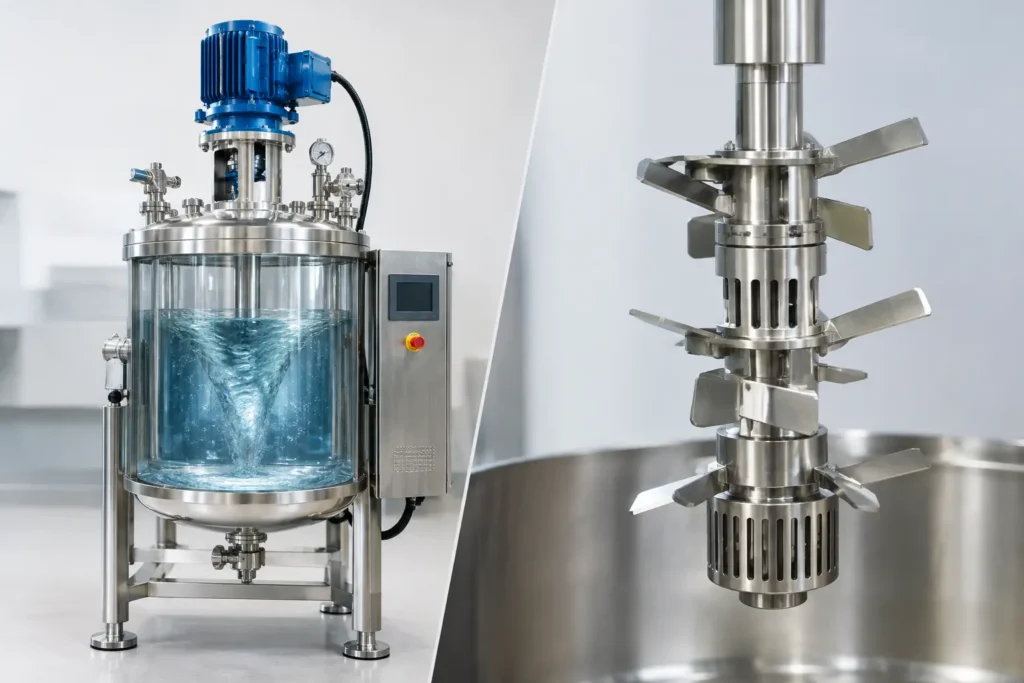
A vacuum mixer is a processing system. It commonly combines a closed vessel, anchor or sweep agitator, scraper blades, vacuum capability, heating and cooling jacket, and a high-shear emulsifying head. The system is designed to manage the entire batch, from liquid addition and powder wet-out through emulsification, deaeration, cooling, and discharge.
A rotor-stator is a high-shear mixing device. Its rotating rotor passes close to a stationary stator, generating localized mechanical shear. Product is drawn into the head, accelerated, and forced through the stator openings. This action breaks down agglomerates, reduces droplet size, and disperses ingredients rapidly in the zone of shear.
That makes the comparison slightly misleading. A rotor-stator head can be installed at the bottom of a vacuum mixer, mounted in-line in a recirculation loop, or used as a stand-alone disperser. It is an important emulsification tool, but it does not by itself provide the complete process control needed for many commercial mayonnaise and dressing formulas.
Rotor-stator technology is highly effective when a process problem is concentrated in dispersion or droplet-size reduction. It can rapidly hydrate gums, disperse starches, break oil into fine droplets, and eliminate soft agglomerates that conventional agitation leaves behind.
For a simple liquid-liquid emulsion, an in-line rotor-stator can be a practical solution. Manufacturers may use it to pre-emulsify oil and water phases, blend a stabilizer solution, or improve the uniformity of a product that is already well controlled by upstream and downstream equipment.
The limitation is volume coverage. High shear occurs at the head itself, not automatically throughout the vessel. If material is not circulated through the shear zone effectively, portions of the batch can receive less treatment. Dense powders may float, bridge, or form fisheyes before they reach the rotor-stator. High-viscosity product can also resist circulation, reducing the efficiency of an in-line approach.
A rotor-stator alone also does not remove entrained air. It will often introduce or retain air when powders are added at the surface, particularly in open tanks. For premium mayonnaise, whipped dressings, and high-solids sauces, trapped air can affect color, apparent volume, filling accuracy, oxidation risk, and finished texture.
A vacuum emulsifying mixer controls the conditions around emulsification, not just the mechanical force used to create it. Under vacuum, the system helps remove air from the batch while reducing foam during processing. This is especially valuable when handling dry ingredients, viscous bases, or formulas where a clean, dense appearance is part of the product specification.
The anchor agitator moves product across the vessel walls and through the bulk mass. Scrapers improve heat transfer and prevent product from remaining on heated or cooled surfaces for too long. The rotor-stator homogenizer then supplies the localized high shear needed to create and stabilize the emulsion.
This combined action is important for mayonnaise. The process must distribute egg, starch, gums, acid, water, oil, salt, and flavor components in a controlled sequence. Oil droplet size matters, but so do powder hydration, thermal control, shear exposure, and air removal. A vacuum system gives the operator more control over the full batch instead of relying on a single high-shear point to correct issues later.
For low-fat, fat-free, and vegan mayonnaise, this wider control window becomes even more valuable. These products often depend on starches, proteins, hydrocolloids, or other functional ingredients to replace the body and lubricity normally supplied by oil and egg. Inadequate wet-out can produce graininess or uneven viscosity. Excessive shear, however, can damage certain hydrocolloids or create a texture that no longer matches the target product. The right system must deliver sufficient energy without treating every formulation as if it has the same processing requirements.
A stand-alone or in-line rotor-stator may be the right choice when the product is relatively low in viscosity, powder loading is modest, and the plant already has effective vacuum, heating, cooling, and vessel agitation in place. It can also fit continuous production where ingredients flow through a controlled recirculation or single-pass system.
A vacuum emulsifying mixer is generally the stronger choice when the batch requires multiple process functions in one sanitary vessel. This includes mayonnaise, creamy salad dressings, ketchup bases, sandwich spreads, high-viscosity sauces, and products with difficult powders or functional ingredients.
Consider the following operating questions before selecting equipment:
If several answers are yes, a complete vacuum processing system will typically deliver better control than a rotor-stator used by itself.
Equipment selection should not be based on motor horsepower alone. A high-shear head must be sized according to batch volume, viscosity, recirculation pattern, ingredient addition rate, and the desired emulsion characteristics. An undersized homogenizer may leave agglomerates and wide droplet distribution. An oversized unit operated without process discipline can create unnecessary heat, overwork sensitive ingredients, or extend cleaning requirements.
The same applies to vacuum level. Vacuum is not a marketing feature added after the fact. It should support the formulation and batch sequence. Drawing vacuum at the right stage can improve powder induction and deaeration. Applying it without considering product foaming behavior, temperature, and addition method can complicate the batch instead of improving it.
This is why equipment design and process development must work together. The most productive system is not simply the one with the highest shear rate. It is the one that moves every ingredient through the correct process conditions, consistently and at the throughput your plant requires.
For commercial food production, the equipment decision extends beyond the finished emulsion. Vessel geometry, sanitary construction, seal design, discharge configuration, and clean-in-place capability affect uptime every day. A system that produces an excellent pilot batch but requires difficult manual cleaning between allergen-sensitive or flavor-sensitive products can become a production bottleneck.
Batch size also deserves careful attention. Selecting a vessel based only on maximum theoretical capacity can reduce performance when smaller batches are run. The working volume must allow effective agitation, rotor-stator engagement, and vacuum control across the product range. Manufacturers planning regional growth should also consider how transfer pumps, holding tanks, fillers, and downstream cooling will support the selected mixer.
PerMix designs vacuum emulsification systems around these operating realities, with equipment configurations matched to formulation behavior, production targets, and sanitary requirements rather than a one-size-fits-all machine specification.
The practical answer to vacuum mixer versus rotor stator is that most demanding emulsified food applications benefit from both: a rotor-stator for controlled high shear and a vacuum mixer platform that manages the entire batch. Start with the product failure you need to prevent, then select the processing system that gives your operators the control to prevent it every run.

Get in touch with us today and learn how to we can help your business.